
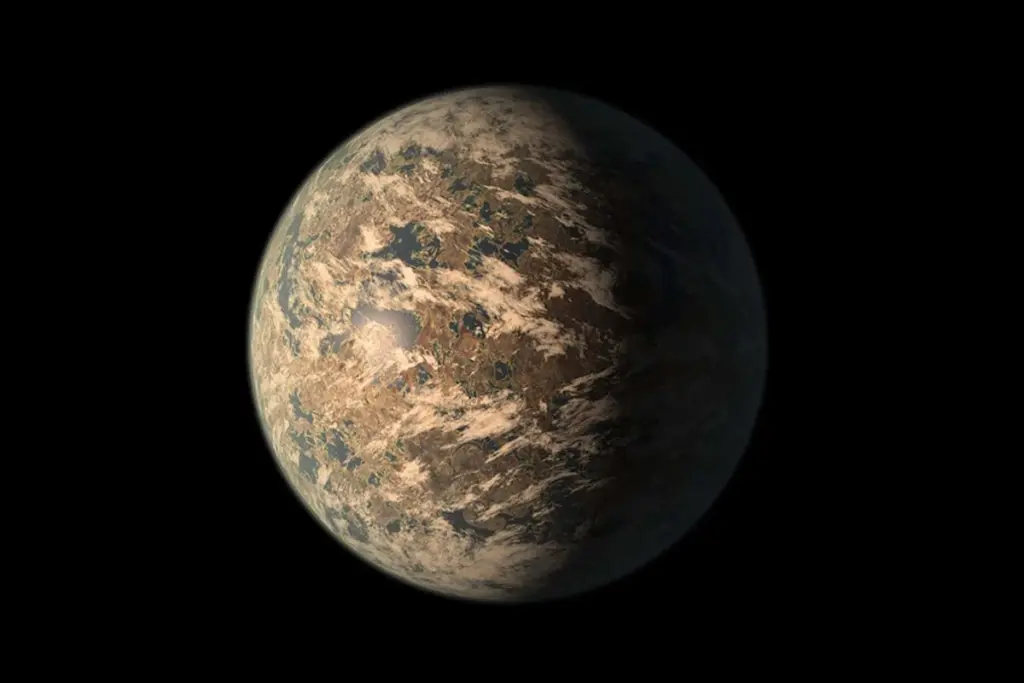
There are encouraging signs suggesting an exoplanet within the TRAPPIST-1 star system, positioned approximately 40 light-years from Earth, may possess an atmosphere capable of sustaining life. However, confirming this hypothesis will require astronomers to conduct additional observations, potentially fifteen times more than what has been gathered so far.
The TRAPPIST-1 system comprises a small red dwarf star orbited by at least seven planets. Its discovery in 2016 quickly made it a prime candidate in the search for extraterrestrial life. This interest stemmed from the fact that three of its planets reside within the so-called habitable zone, also known as the Goldilocks zone, where conditions are theoretically suitable for liquid water to exist on a planet’s surface.
Ryan MacDonald of the University of St Andrews highlighted the significant initial excitement the TRAPPIST-1 system generated among the astronomical community. Subsequent imaging of three of its exoplanets, including two within this crucial habitable zone, led to disappointment when no atmospheric signatures were detected. Nevertheless, MacDonald and his research team have maintained a focus on TRAPPIST-1e, a planet situated precisely in the center of the habitable zone, and now report grounds for renewed optimism.
Investigating TRAPPIST-1e with the James Webb Space Telescope
MacDonald and his colleagues utilized the James Webb Space Telescope in 2023 to examine TRAPPIST-1e. Since then, extensive efforts have been dedicated to processing the collected data to produce a clearer understanding of the planet. The standard method for determining if a distant exoplanet has an atmosphere involves capturing images as the planet transits in front of its host star. By analyzing subtle shifts in the starlight, scientists can identify specific chemicals present in any atmosphere, including those that might indicate habitability.
A complicating factor is TRAPPIST-1’s nature as a red dwarf star. Being considerably cooler than our Sun, its emissions present a more complex analytical challenge. For instance, chemicals like water, which could signal a hospitable atmosphere, might also be present within the star itself. This necessitates a careful disentanglement of signals originating from TRAPPIST-1e’s atmosphere from those of the TRAPPIST-1 starlight filtering through it. This demanding task required the development of new modeling techniques and years of meticulous work.
The preliminary findings suggest that TRAPPIST-1e may indeed possess an atmosphere conducive to life, potentially marking a notable development in the ongoing quest for habitable conditions beyond Earth.
Promising Atmospheric Signatures and Future Research
“It does look like there are some bumps and wiggles in the data that, based on our atmospheric modelling, are well fit by a nitrogen-rich atmosphere, and potentially with molecules like methane,” stated MacDonald. He elaborated that among all the spectral data obtained for the TRAPPIST-1 planets thus far, this particular set is the most promising, indicating the potential presence of something significant. MacDonald expressed a personal hope that the planet situated at the heart of the system’s habitable zone would indeed have an atmosphere, given the profound implications for astrobiology and the search for life.
MacDonald further explained that if the presence of a nitrogen-rich atmosphere is confirmed through subsequent data analysis, the next critical step will involve searching for gases such as methane or carbon dioxide. Using climate models, researchers will then aim to determine the probable surface temperature and assess whether these conditions would support liquid water, a key requirement for hosting life.
However, the research team emphasizes that the current data and models cannot definitively exclude the possibility that TRAPPIST-1e is a barren rocky world. More observational data is essential. To date, the team has analyzed data from four JWST observations. Over the coming period, they aim to conduct an additional fifteen such observations. “We need to shrink the error bars,” MacDonald commented, underscoring the need for greater precision.
The Broader Context of Exoplanet Habitability
Matthew Genge of Imperial College London noted that while numerous exoplanets are being discovered, astronomers are particularly focused on identifying those with conditions suitable for life. He articulated the complexity of habitability: “The real complexity is you could be the right distance from the sun, but if you’ve got the wrong atmosphere, you can be a hot hellhole like Venus or you can be a freezing cold Mars.” Genge believes that as astronomers survey a vast number of exoplanets, the discovery of one with a nitrogen/oxygen-rich atmosphere seems inevitable. He also suggested that an oxygen-rich atmosphere might be an indicator of biological processes, such as photosynthesis, potentially involving plant life.
Reflecting on the age of TRAPPIST-1e, Genge mused, “If [TRAPPIST-1e] is habitable, just imagine what’s gone on on that planet for the last 7.6 billion years.” He posited that the older a planet is, the greater the likelihood for intelligence to evolve.
MacDonald projected that by the year 2060, humanity might have identified several planets where the gathered data is difficult to explain without invoking the presence of life. However, he cautioned that this would still be a considerable distance from definitively proving the existence of extraterrestrial life, describing astronomers as a “sceptical bunch.”
Journal Reference: The Astrophysical Journal Letters DOI: 10.3847/2041-8213/adf42e