
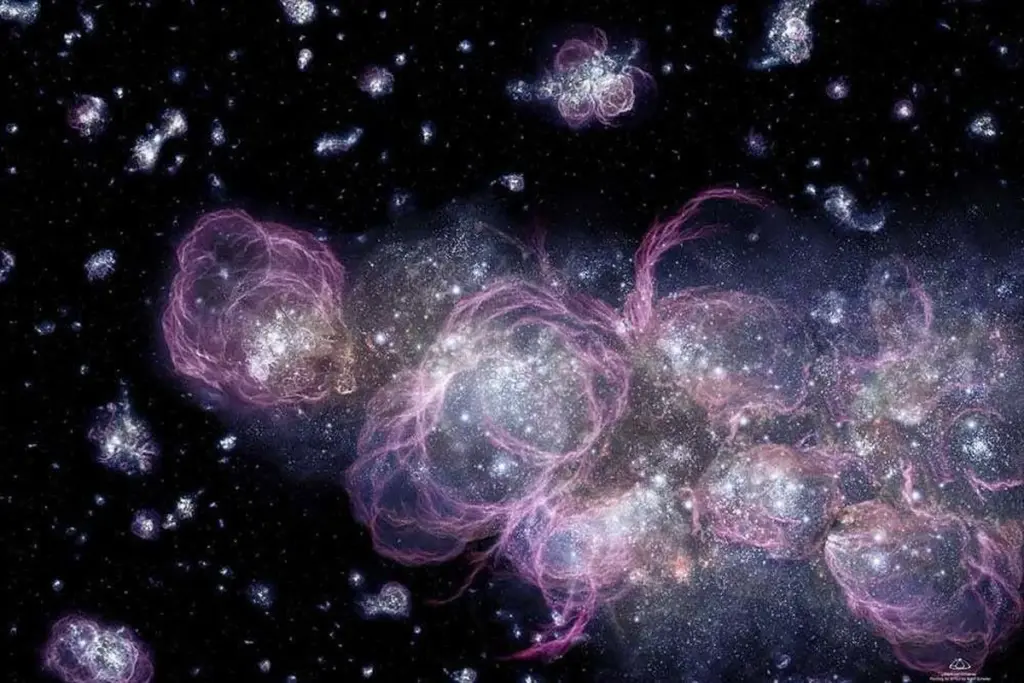
Astronomers have achieved a significant breakthrough, providing the most compelling view yet of some of the universe’s earliest stars. These celestial bodies are markedly different from any previously observed, potentially offering profound insights into fundamental properties of the early cosmos, including the mass of the initial stars and their influence on subsequent stellar generations.
Current scientific understanding suggests that the very first stars to emerge in our universe were composed almost exclusively of hydrogen and helium, with a notable absence of heavier elements. These early stars were also immense and intensely hot, possessing hundreds of times the mass and tens of thousands of degrees more heat than our present-day Sun.
However, the ephemeral nature of most of these stars, known as Population III, meant they had a relatively short lifespan before undergoing supernova explosions. This brevity, coupled with their existence in the nascent stages of the universe, has historically made conclusively identifying a galaxy dominated by them a formidable challenge for astronomers.
Hebe: A Candidate for Population III Stars
A team led by Roberto Maiolino at the University of Cambridge has identified the galaxy Hebe, a collection of stars dating back to approximately 400 million years after the Big Bang. This galaxy exhibits characteristics strongly indicative of being populated by Population III stars.
Crucially, Hebe shows no detectable elements heavier than hydrogen or helium. Furthermore, the light emanating from the galaxy is concentrated within a specific frequency strongly associated with helium that has been ionized. This condition is exclusively produced by extremely high-temperature stars, a hallmark of Population III stars.
“It appears that Population III stars are, as far as we can ascertain, the most plausible explanation,” Maiolino stated. “All other proposed explanations are highly unsatisfactory.”
Observational Evidence and Confirmation
Hebe was initially detected by Maiolino’s team in 2024 utilizing the James Webb Space Telescope (JWST). Early observations revealed a helium line that hinted at the presence of Population III stars. However, uncertainties remained regarding the authenticity of this line, its potential origin from a different galaxy, and the possible presence of heavier metals within the stars.
Subsequent and more detailed observations with the JWST have now provided crucial corroborating evidence. The researchers have identified a second spectral line, linked to ionized hydrogen, originating from the same celestial source. This finding confirms the reality of the ionized helium line and strengthens the hypothesis of Population III stars being present.
Hannah Übler, a team member from Ludwig Maximilian University of Munich, Germany, detailed the rigorous verification process. “I spent a considerable amount of time meticulously scrutinizing the data, ensuring that this was a secure line detection,” she explained. “Once it was clear that we observed this [ionized hydrogen] peak and no other line detections, it was truly remarkable. It was a great moment to know, and possess proof, that what we had asserted a few years prior was indeed accurate: here we had helium and hydrogen, pointing towards the Population III scenario.”
Challenges and Future Implications
Daniel Whalen at the University of Portsmouth acknowledged the compelling nature of these findings. He noted that the presence of the ionized helium line strongly suggests the observation of extremely hot objects, consistent with expectations for Population III stars. However, he cautioned that the evidence is not yet conclusive, as the current level of observational precision is insufficient to definitively rule out the presence of heavier elements, which would instead classify them as more evolved Population II stars.
The observation of a galaxy containing the abundance of Population III stars proposed by Maiolino’s team presents a significant challenge for existing cosmological simulations. Current models of the early universe generally predict that the first stars formed in relatively isolated and sparse clusters, making the aggregation of such a large number of Population III stars in a single location difficult to explain without pre-existing heavier elements.
Whalen posed a critical question: “How do you manage to accumulate 100,000 solar masses of Pop III stars in one location without any prior contamination of the gas? Because we never observe masses of Pop III stars forming all at once. It simply doesn’t happen.”
Despite these challenges, if confirmed as Population III stars, this discovery could yield invaluable data about the early universe. Maiolino emphasized the broader scientific gain beyond mere discovery. “It’s not just about the race to plant a flag on Population III, proclaiming ‘we found it,’ and that’s the end of it. In reality, we are already learning a great deal.”
The initial observations of Hebe have already enabled Maiolino’s team to develop simulations estimating the mass of the first stars. Their findings indicate that a majority of these early stars were approximately ten to a hundred times more massive than the Sun, with significantly fewer stars being smaller than this range.