
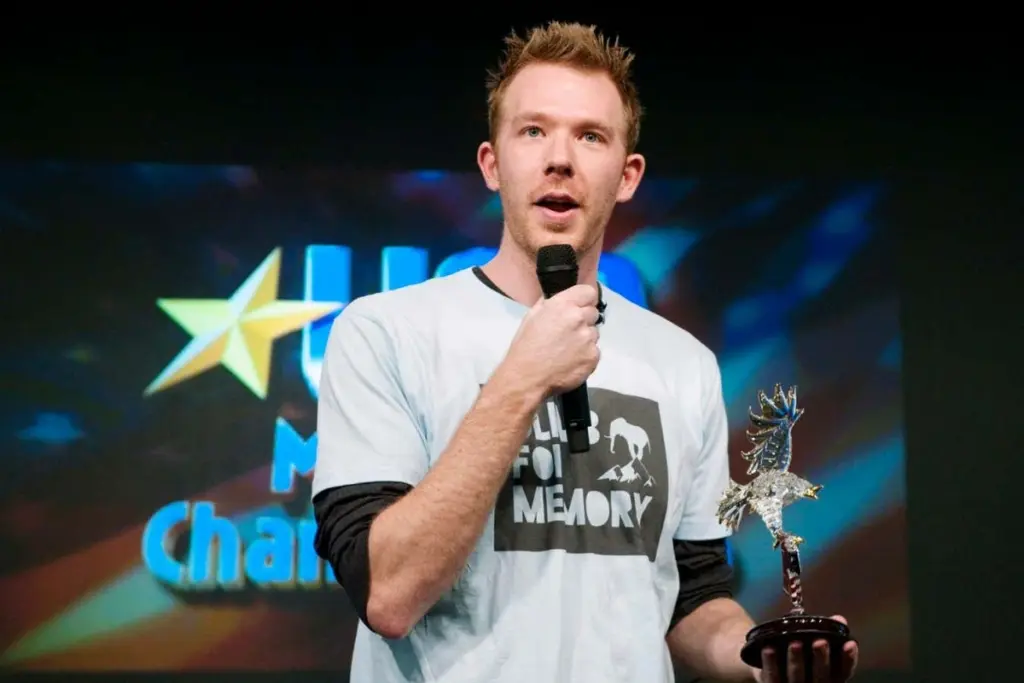
Nelson Dellis, a six-time US memory champion, has demonstrated remarkable mnemonic abilities, including memorizing a shuffled deck of cards in under 41 seconds and recalling the first 10,000 digits of pi. Scientists have recently conducted an in-depth study of his brain, aiming to understand the mechanisms behind these exceptional feats and to identify transferable skills for the general public.
Dellis himself reports having an average memory until his late twenties. The impetus for his memory training came when his grandmother’s decline due to Alzheimer’s disease. This personal experience motivated him to dedicate hours daily to memory exercises, focusing on numbers, names, and words. He emphasizes the continuous nature of this practice, stating, “I still train my memory regularly. It’s like a muscle; if you don’t use it, it fades.”
While memory impairment, particularly related to dementia, has been a significant focus of research, less attention has been paid to individuals possessing extraordinary memory capabilities. To address this knowledge gap, a team of researchers, including those from Washington University in St. Louis, Missouri, has turned to Nelson Dellis as a subject for study.
Investigating Dellis’s Brain
Dellis underwent extensive brain scanning over two separate periods, totaling approximately 13 hours in 2015 and 2021. These scans were conducted both while he was at rest and during specific memory-testing tasks. In one such test, he was presented with sets of four to seven words, each appearing on screen for slightly over a second. The instruction was to employ rote memorization, a technique reliant on repetition for retention.
Describing the experience, Dellis noted, “You’re lying still in a scanner trying to memorise things, which is not exactly how I normally train, but it was really cool to be part of something that’s trying to bridge the gap between what memory athletes do and what science can measure.” His neural activity during these tasks was subsequently compared against that of two scientists who served as control subjects, identified as having very good, though not exceptional, memory capacity.
Neural Activity and Memory Techniques
Analysis of the data by researchers at Washington University in St. Louis revealed that Dellis and the controls exhibited similar brain activity patterns during the rote memorization task. Across all three individuals, neuronal signaling intensified in specific brain regions: the retrosplenial cortex (associated with navigation), the extrastriate visual cortex (involved in visual information processing), and the dorsal frontal cortex (linked to working memory).
However, Dellis explained that rote memorization is not his primary method. “Rote memorisation is a terrible approach to memorising, but it’s what most people know how to do,” he commented. This suggests that while the brain regions involved were activated similarly in the controlled setting, Dellis’s typical strategies differ significantly.
The Power of the Memory Palace
A more advanced task, performed solely by Dellis while in the scanner, involved memorizing the order of a shuffled deck of cards. For this challenge, he utilized the method of loci, commonly known as a memory palace. This technique involves associating pieces of information with specific, familiar locations, such as within one’s home, and then mentally traversing these locations in sequence to retrieve the data.
“That simple shift, from abstract to visual, is the foundation of almost every memory technique I use,” Dellis stated. This method engaged the same three cortical areas as the previous task. Crucially, it also altered activity within his hippocampus, a vital brain structure for memory formation. In the first task, hippocampal activity was higher during encoding (the process of acquiring new information and integrating it with existing knowledge) than during recall.
This pattern was reversed in the card-memorization task. Additionally, this second task activated Dellis’s caudate nuclei, C-shaped structures involved in both memory and learning. The researchers, who opted not to be interviewed, proposed that the engagement of the caudate nuclei suggests that memory, when trained with such methods, becomes a “consolidated skill.”
Broader Brain Connectivity
Further comparisons were made by analyzing Dellis’s brain activity against that of 887 participants from the Human Connectome Project. The research team observed that the memory champion displayed significantly greater functional connectivity. This term refers to the degree to which different brain regions coordinate their activity, indicating a higher level of efficient collaboration among these areas in Dellis’s brain.
Implications and Potential Applications
Dellis and other experts advocate for the wider adoption of the method of loci. Martin Dresler from Radboud University Medical Center in the Netherlands commented, “Given the very clear behavioural benefit, it is somewhat surprising that techniques such as the method of loci are not more widely used in educational and clinical settings.”
Dresler suggested that this technique might be particularly effective because it leverages our innate evolutionary strengths. He explained, “The reason why the method of loci works so well is probably because it translates abstract information into visuo-spatial information. Our brains did not evolve to memorise numbers or playing cards or dates or even something as abstract as language, but we evolved to find our way through nature to the next food source and know where to avoid predators. So we’re very good at visuo-spatial settings and finding our way through nature, and that is exactly what the method of loci does.”
However, Craig Stark of the University of California, Irvine, pointed out the uncertainty regarding the extent to which others can replicate Dellis’s extraordinary memory. “We don’t have a good handle on which aspects are training-derived and which are just him. They’re not looking at [the effects of] training or at strengthening. They’re looking at him.” This highlights the need for further research to isolate the specific contributions of training versus inherent abilities.
For those finding intensive memory training daunting, Dellis also attributes his success to a healthy lifestyle, including regular exercise. Morris Moscovitch from the University of Toronto in Canada offered practical advice for improving everyday memory: “For better everyday memory, do what your mother told you — pay attention, eat well, sleep well and exercise.”