
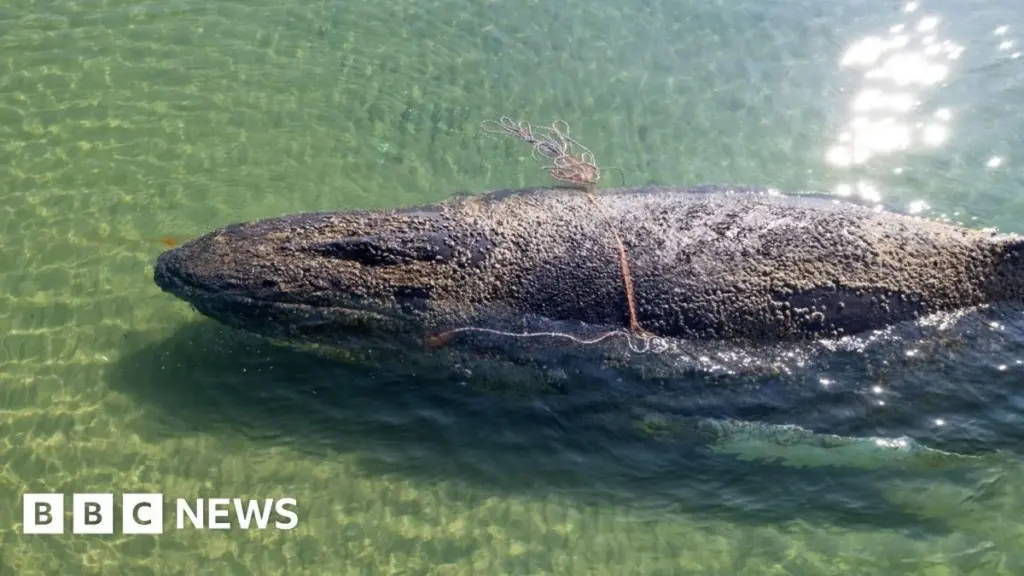
After an extended effort spanning over a week, authorities have acknowledged that their chances of saving a humpback whale stranded on Germany’s northern shore have diminished.
The whale initially became trapped on a sandbank on March 23rd. While it was successfully freed days later, the animal subsequently navigated into shallow waters near Poel Island, a location further along the Baltic Sea coastline.
“We hold a firm belief that the animal will perish there,” stated Burkard Baschek, director of the German Oceanographic Museum, on Wednesday.
During a poignant press conference, local environmental minister Till Backhaus described the situation as “an exceptional tragedy.” He conveyed that rescue teams had “tried everything to give him a chance.”
Thilo Maack, a marine biologist with Greenpeace, explained that efforts were made to prevent the whale from entering a shallow bay on Poel Island. However, the animal proceeded into the bay regardless.
The humpback was first observed in German coastal waters in early March. It is theorized that the whale became entangled in fishing nets before ultimately becoming stranded on a sandbank at Timmendorfer Strand, close to the town of Travemünde.
Compounding its difficulties, the humpback is also believed to have been suffering from a skin ailment. This condition is thought to have been exacerbated by the reduced salinity characteristic of the Baltic Sea.
Earlier in the week, there was optimism the whale might relocate to deeper waters. This hope was fueled by the excavation of a channel that allowed it to depart from its initial site.
However, attempts to guide the humpback towards the more saline waters of the North Sea proved unsuccessful. Instead, the whale traveled eastward along the coast, eventually becoming trapped once more in a bay near the city of Wismar.
Rescuers managed to guide the animal away from Wismar, but only as far as the neighboring Poel Island. There, it now rests on the seabed. With predictions of falling water levels, officials assess the whale is too weak to attempt further movement.
Baschek reported a decline in the whale’s breathing and its responses to rescue efforts. He indicated that the likelihood of successfully guiding it out of the bay was so minimal that further attempts would be inhumane.
The window for the whale’s survival is understood to have closed early on Wednesday.
Backhaus, a prominent rescue official for the northern state of Mecklenburg-Western Pomerania, informed reporters that a 500-meter (approximately 1,640 feet) exclusion zone had been established around the whale. This measure was implemented to allow the animal to pass away with dignity.