
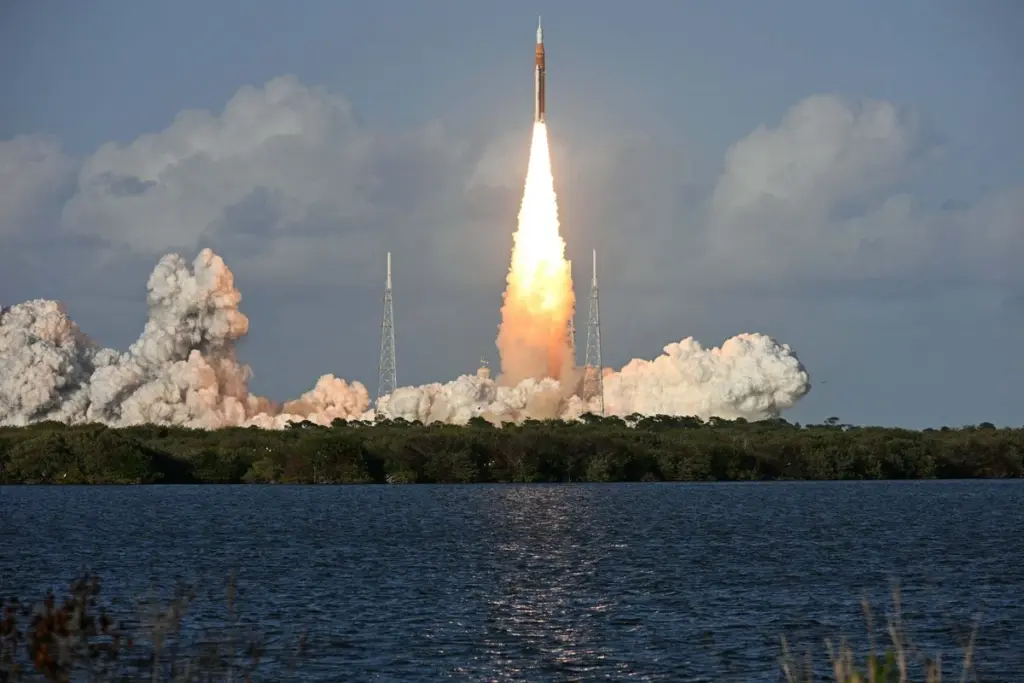
The journey to the moon has begun anew with the first crewed mission since the Apollo program concluded in 1972. The Artemis II mission, which lifted off from Cape Canaveral, Florida, on April 1st, carries four astronauts aiming to venture further from Earth than any humans have previously. This voyage represents a significant step in space exploration.
This launch marks only the second flight for NASA’s powerful Space Launch System rocket, paired with its Orion crew capsule. Critically, it is the maiden voyage for this spacecraft with astronauts on board. The preceding launch, in 2022, was for the uncrewed Artemis I mission. That mission successfully completed a looped trajectory around the moon, a path intended to be mirrored by Artemis II.
Mission Objectives and Astronaut Involvement
Following the successful launch, the NASA crew—Reid Wiseman, Victor Glover, and Christina Koch—along with Canadian astronaut Jeremy Hansen, will dedicate the initial two days of their expedition to orbiting Earth. During this phase, they will conduct essential tests on the Orion spacecraft. A key component of these checks involves the astronauts manually piloting Orion for a docking procedure with another orbiting craft. While the capsule is designed for autonomous steering for the majority of its flight, including future missions, this specific docking maneuver requires direct astronaut control.
“You’re not always going to manually dock, but you may need to manually stop a docking that’s not going well,” Glover explained during a press conference on March 29th. He further elaborated, “Even if we don’t do the operation by hand [in the future], we need to be able to stop it.” This highlights the critical need for human oversight in complex space operations.
Journey to the Moon and Scientific Observation
Subsequently, Orion will embark on a trajectory looping around the moon. At its furthest point, the spacecraft will be approximately 402,000 kilometers from Earth. This distance surpasses the record established by the Apollo 13 astronauts in 1970. The mission will bring the crew as close as 6,513 kilometers to the lunar surface. This proximity will afford the astronauts an unparalleled opportunity to observe portions of the moon that remained unseen by human eyes during the Apollo era, largely due to differing light conditions.
Future Missions and Lunar Presence Ambitions
The entire Artemis II mission is projected to last about 10 days, concluding with the Orion capsule’s return to Earth. Should the mission proceed without issues, attention will then turn to Artemis III, slated for 2027. Originally planned as a lunar landing mission, Artemis III will now focus on testing the docking system in orbit around Earth with the lunar lander(s) intended to transport astronauts to the moon’s surface. The actual lunar landing is now anticipated for the Artemis IV mission in 2028.
“Our motto from day one has been ‘Help Artemis III succeed’,” stated Wiseman during the press conference, underscoring the interconnected nature of these missions. The collective efforts of these Artemis missions are foundational to NASA’s broader objective of establishing a permanent moon base. Officials there envision this base facilitating a sustained human presence on the moon for many decades.
“It is our strong hope that this mission is the start of an era where everyone, every person on Earth, can look at the moon and see it also as a destination [rather than some distant rock in the sky],” added Koch, articulating a vision of increased accessibility and connection to the celestial body.