
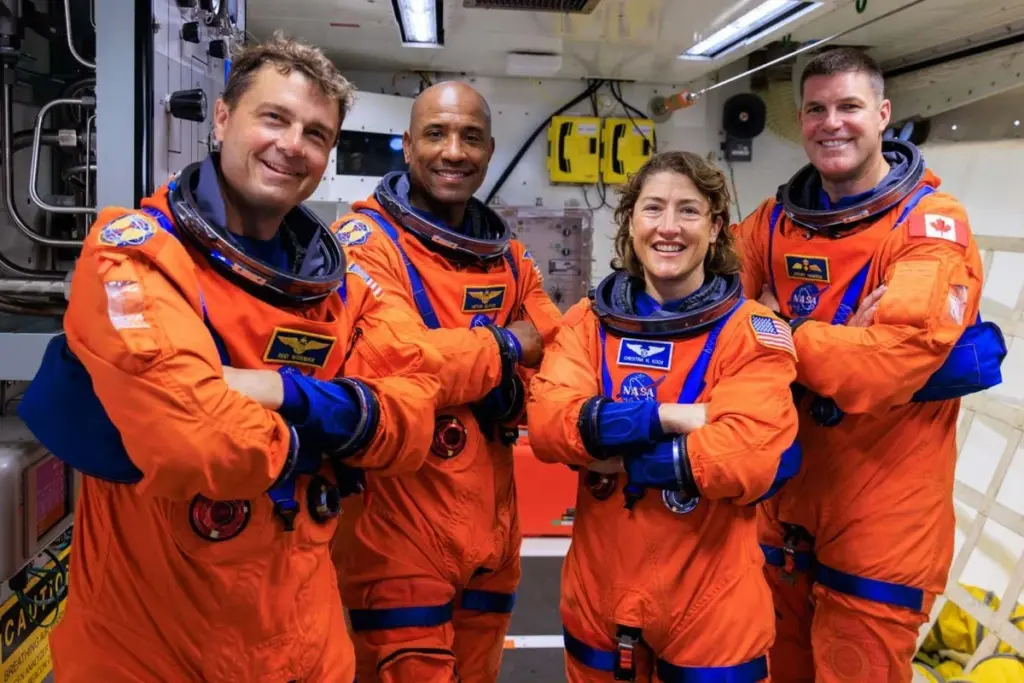
This year marks a significant milestone in space exploration as astronauts are slated to return to the moon for the first time in over fifty years.
NASA’s Artemis II mission, tentatively scheduled for launch no later than April 2026, will carry four astronauts on a trajectory around the moon. This orbital loop is designed to pave the way for future crewed landings on the lunar surface, once again placing human boots on the moon.
The mission has experienced several postponements from its initial projected launch window between 2019 and 2021, largely due to complex logistical challenges. However, recent developments suggest the wait may soon be over.
In September, NASA indicated that the Space Launch System (SLS) rocket was prepared for crewed flight. By November, the Orion crew capsule had been integrated with the rocket for a final series of tests. NASA has even expressed a hope to advance the launch to February instead of April, although the feasibility of this earlier date remains uncertain.
Artemis II Crew and Mission Objectives
The four astronauts selected for this historic voyage are Reid Wiseman, Victor Glover, Christina Koch, and Jeremy Hansen. Wiseman, Glover, and Koch are all NASA astronauts, each having previously completed at least one space mission. Hansen, representing the Canadian Space Agency, will embark on his inaugural spaceflight.
“As astronauts, we volunteer to execute and operate missions because we believe in human spaceflight; we believe in exploration,” stated Christina Koch. “To fulfill that personal mission in a new way, undertaking something we haven’t done in over 50 years, is simply phenomenal.”
The Artemis II mission is expected to span approximately 10 days. The initial two days will involve orbiting Earth, allowing the crew to rigorously test the life support systems. During this phase, they will also practice a protocol for rendezvous with other spacecraft in orbit, using a de-orbited rocket stage as a target.
Following these Earth-bound preparations, the Orion capsule’s main thruster will engage, propelling the spacecraft into a figure-eight trajectory around the moon. This maneuver will not involve entering lunar orbit; instead, the capsule will complete a single loop before commencing its journey home. The closest the spacecraft will come to the moon’s surface is approximately 7,400 kilometers.
Upon its return, the Orion spacecraft is programmed to splash down in the Pacific Ocean.
Technological Advancements and Future Aspirations
This mission profile bears a strong resemblance to the uncrewed Artemis I mission, which successfully orbited the moon in November 2022 as a critical flight test for both the SLS rocket and the Orion capsule. Significant modifications have been implemented since that initial test flight.
Among other improvements, the spacecraft’s navigation and communication systems have been enhanced. Additional external plates have been affixed to the SLS rocket to mitigate vibrations. Crucially, the Orion capsule has been equipped with comprehensive systems designed to ensure the safety of the astronauts onboard.
Artemis II is nevertheless considered a test flight. Success in this mission is intended to lay the groundwork for Artemis III, slated for 2027. This subsequent mission aims to achieve the first human lunar landing since the Apollo 17 mission in 1972.
However, concerns surrounding SpaceX’s Starship lander, designated to transport the crew to the lunar surface, could potentially introduce further delays to the Artemis III timeline.
The Artemis program carries substantial expectations. A series of increasingly complex missions are planned throughout the 2030s, with the ultimate objective of establishing a permanent human presence on the moon.
“Our mission will establish the foundation for future endeavors to the lunar surface and Mars,” stated acting NASA administrator Sean Duffy in a formal announcement. The concept of Artemis serving as a precursor to journeys to the Red Planet has been a long-standing aspiration, though NASA’s concrete plans for human Mars exploration are still under development.
Should Artemis II prove successful, it will signify a pivotal shift in space travel: the recommencement of human expeditions beyond low Earth orbit, potentially heralding further ambitious undertakings in the future.