
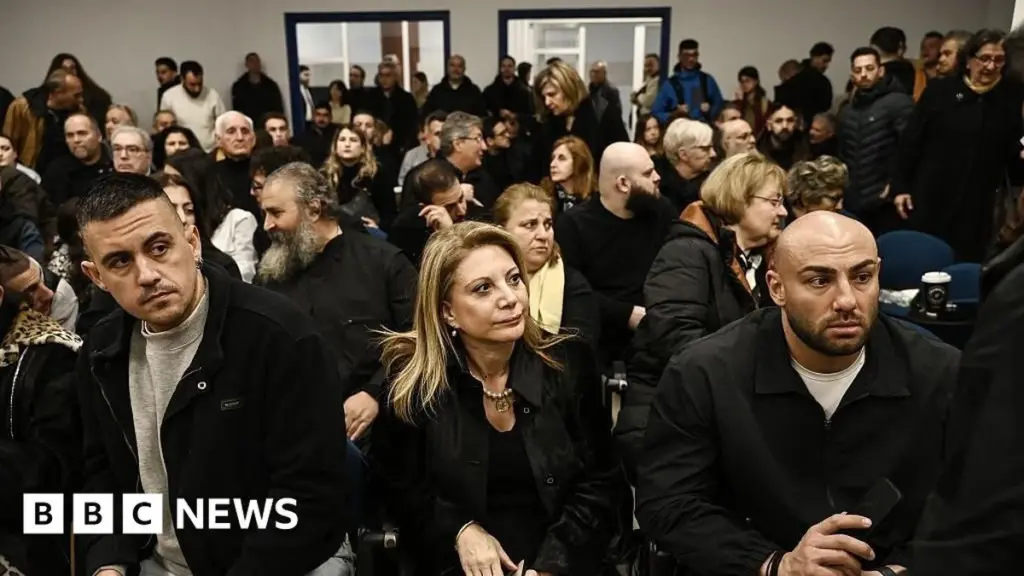
Relatives of the 57 individuals who perished in Greece’s most devastating train disaster converged on a courtroom Wednesday, voicing their unwavering demand for justice for the victims. The highly anticipated trial faced an initial postponement due to the disarray that characterized its commencement the previous week.
The majority of those who lost their lives in the collision, which occurred three years prior, were students. Their intercity train, traveling from Athens to Thessaloniki, collided head-on with a freight train on the same track near Tempi in the country’s central region. Shockingly, some victims are believed to have succumbed to burns after surviving the initial impact, compounding the tragedy.
Last week, many grieving family members found themselves unable to enter the courtroom in the central town of Larisa. The situation on Wednesday offered little improvement. Law enforcement officials permitted entry only to individuals legally scheduled to participate in the proceedings. A chorus of complaints arose from some relatives, citing concerns over police occupying two rows of seating. Others expressed frustration over insufficient visibility of the courtroom proceedings.
Zoe Konstantopoulou, a defense lawyer, advocated for the trial to be filmed, citing the access limitations faced by the families. The disaster, which occurred in February 2023, is widely referred to in Greece as the “Tempi crime.” Many observers interpret it as a stark reflection of systemic negligence and corruption at the highest levels of the state.
A total of thirty-six individuals are currently on trial. This complex case is projected to involve testimony from 350 witnesses and is expected to span several years. Anastasia, one of the victims, was en route to her lectures in the northern city, returning after observing a public holiday with her family. Her father, Dimitris, speaking to the BBC in the aftermath of the crash, conveyed his enduring pride in his daughter, describing her as someone who “only had love to give.” He articulated the profound anguish of the families, stating, “We relatives call it a state assassination of our children, and all the people who were aboard that train… in which European country could this be possible?” Anastasia had been traveling with her 20-year-old twin cousins, Thomi and Chrysa, who also perished in the accident.
If convicted, thirty-three of the defendants face potential life imprisonment. Among those standing trial is a station master. He, alongside all other responsible parties, failed to detect that the two trains had been operating on a collision course for a full ten minutes. Other railway officials also face charges, alongside two former Italian employees of the trains’ parent company, Ferrovie dello Stato.
The nation’s railway network had reportedly not utilized European Union funding designated for safety enhancements. Laura Kovesi, the head of the European Public Prosecutor’s Office, later commented that the collision could have been averted had the allocated funds been invested in modernizing the signaling system promptly. Prior to the disaster, trade unions in Greece had issued warnings, indicating an impending catastrophe on the railway network was a distinct possibility.
To the astonishment of many, the crash site was bulldozed within days of the incident. Experts believe this action destroyed potentially critical evidence. This rapid disposal of the site fueled allegations of a cover-up, claims that authorities have consistently denied. Despite widespread public outrage, Prime Minister Kyriakos Mitsotakis secured re-election shortly after the disaster. He has since weathered two no-confidence votes related to the incident in parliament. Mitsotakis offered his apologies to the victims’ families in the days following the crash and has repeatedly appealed for public patience to allow the legal process to unfold.
To the considerable frustration of many campaigners, no politicians are among the individuals currently facing trial. The legal proceedings are being held in a reconfigured conference hall, a facility reported to have cost hundreds of thousands of euros. Prime Minister Mitsotakis has described it as “among the most functional and modern in Europe.” Over 60,000 pages of evidence are slated for presentation, with 200 lawyers involved. However, the proceedings devolved into chaos on March 23rd when the courtroom became excessively crowded.
Survivors of the tragedy and family members of the deceased were compelled to occupy seats designated for the accused, most of whom were absent. Lawyers argued forcefully that health and safety regulations were being contravened. Maria Karystianou, who lost her 19-year-old daughter Marthi, described the situation as relatives being “packed like sardines,” terming the spectacle “an absolute disgrace.”