
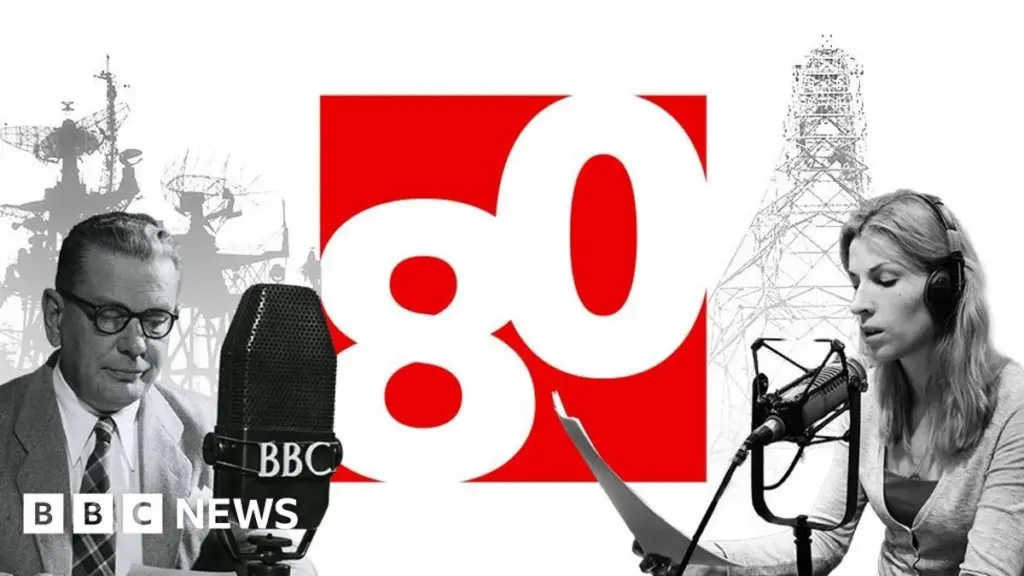
The Kremlin’s ongoing efforts to control online content in Russia present significant challenges for media outlets like the BBC Russian Service, making it increasingly difficult to reach their intended audience.
For eight decades, BBC Russian has navigated these restrictions. Initially, this involved circumventing the jamming of its short-wave radio transmissions. More recently, the focus has shifted to overcoming the blocking of its website.
Recent measures in Russia have included widespread disruptions to mobile internet services and reported plans to block the Telegram news and messaging application.
The Dawn of a New Broadcast Era
BBC Russian commenced its regular radio broadcasts in the Russian language on March 24, 1946. The primary objective was to provide listeners living in the Soviet Union, behind the Iron Curtain, with an alternative to state-controlled propaganda and a heavily curated cultural landscape.
By 1949, jamming of these broadcasts had become a standard practice.
A Persistent Pursuit of Information
“For nearly half of the 20th century, Soviet citizens had to go to considerable lengths to listen to foreign broadcasts,” recalls Natalia Rubinstein, a former BBC presenter and a resident of present-day St. Petersburg. “For some, it truly became a sport. We were genuinely eager to know what was being concealed from us.”
Rubinstein recounts how individuals engaged in cross-country skiing, a popular winter activity in Russia, would often take their radios with them outside the city limits, areas where jamming was less pronounced. “I can still visualize it: a person leaning against a tree, ski poles beside them, listening to the radio as it was somehow nestled on their chest,” she reminisces.
The technique of jamming foreign broadcasts was first employed by Nazi Germany during World War Two. This involved transmitting disruptive noise or signals from more powerful transmitters situated closer to the listeners’ locations.
Throughout the Cold War, the BBC diligently repeated its 90-minute Russian-language news bulletin three times each week. This scheduling aimed to ensure that listeners had at least one opportunity to tune in.
Beyond the News: Culture and Connection
The broadcasts offered more than just news. Soviet listeners could also access Western rock music, hear segments from banned literary works, and even participate in quizzes for a limited time.
“My father used to listen to the ‘enemy voices’ at night,” notes one post on a forum dedicated to foreign broadcast listeners. “He would sit on a three-legged stool, press his forehead against the radio, and patiently, amidst the crackling and the wail of the jammers, find the correct frequency. It felt as though those were the sounds of outer space reaching us.”
Not all programming was subject to jamming. According to a CIA memo from 1960, reports concerning daily life in Britain or the United States were broadcast without interruption. However, discussions of global conflicts or analyses of the economic and political conditions within the Socialist bloc were consistently jammed.
Outwitting the Blockade
On occasion, BBC Russian managed to outmaneuver the jamming efforts. Peter Udell, who led the BBC’s East European Service, shared an account from 1982, the year Soviet leader Leonid Brezhnev died. “We concluded our Russian broadcast as usual at midnight Moscow time. Then, a few minutes later, unexpectedly by the jamming teams in the Soviet Union, we reappeared with a special program about Brezhnev’s death. I believe for a good number of minutes, it went through clearly because the jammers presumed they had completed their shift and perhaps retired for the night.”
The secretive nature and delayed reporting by Russian state media often provided foreign broadcasters with a strategic advantage. In 1964, for instance, the BBC reported the removal of Soviet leader Nikita Khrushchev from power well before official news reached Soviet citizens domestically.
The End of Jamming and a New Era of Engagement
By 1987, amidst the liberalizing reforms under Mikhail Gorbachev, Natalia Rubinstein found herself in London, reading BBC news bulletins rather than solely listening to them. A studio manager had relayed an urgent message: “We’ve just received a call from BBC Monitoring. Ten minutes ago, the Russians stopped the jamming. It’s official. We’re broadcasting without interference. You should inform our listeners.”
For decades, the BBC Russian team had only a vague understanding of their audience. Now, they began to receive direct feedback. “Initially, we started receiving sacks of wonderful letters from the Russian provinces,” Rubinstein recalled. “Secondly, Russian radio stations, both regional and Moscow-based, began to retransmit our programs.”
In 1988, BBC Russian listeners had the opportunity to engage live with UK Prime Minister Margaret Thatcher as she answered their questions. Over 800 calls were received from across the USSR, with 15 being selected for broadcast.
Around this period, BBC Russian established its first office in Moscow. By 2022, the service had expanded significantly, with its Moscow and London teams comprising over 100 journalists, competiting with the country’s leading independent media outlets. The primary platform had transitioned from radio to the website and social media.
New Challenges in a Changed Landscape
In the final week of February 2022, coinciding with Russia’s full-scale invasion of Ukraine, BBC Russian’s audience more than tripled, reaching 10 million individuals.
On March 4, 2022, the BBC’s website, along with those of other prominent independent and foreign news organizations, was blocked in Russia. The stated reason was the “spreading of false information of public interest.”
New legislation made it illegal to refer to the invasion as a “war,” enforcing the official designation of “special military operation.” This development necessitated that local BBC Russian staff depart the country if they wished to continue reporting objectively and safely. A new office was subsequently established in Riga, the Latvian capital.
Personal Costs and Enduring Commitment
These changes have exacted a substantial personal toll on every member of the BBC Russian team. Eight BBC Russian journalists have been designated “foreign agents” by the Russian state—a status that echoes Soviet-era campaigns against “enemies of the people” and almost invariably leads to criminal prosecution.
Jenny Norton, head of BBC News Russian, observes that with reductions in funding for US foreign broadcast networks and independent Russian media struggling financially, the BBC’s service is evolving into an increasingly solitary, yet crucial, voice. “A new generation of Russians are now having to fight to stay connected to the world,” she states. “And our team must contend with internet blocking and shutdowns to maintain our reach to them.”
The Evolving Digital Iron Curtain
In the four years since the conflict began, Russia’s digital Iron Curtain has become progressively more difficult to bypass. One survey indicates that 36% of Russians utilize virtual private networks to circumvent these blockades. However, Russia’s internet watchdog actively works to block VPNs as their popularity increases.
Internet outages have been reported across various Russian cities, including recent incidents in the capital, Moscow. This has fueled concerns that during shutdowns, access may be restricted to a government-approved “whitelist” of services and websites, similar to practices seen in Iran.
Popular messaging applications like Telegram and WhatsApp are facing restrictions, with a preference being shown for the government-backed messenger, Max. Despite these obstacles, Russians continue to circumvent the blockade, demonstrating a consistent ability to discover new ways to access journalism. The current audience has grown to 12 million people weekly, underscoring the enduring necessity for BBC Russian, a need as strong today as it was in 1946.