
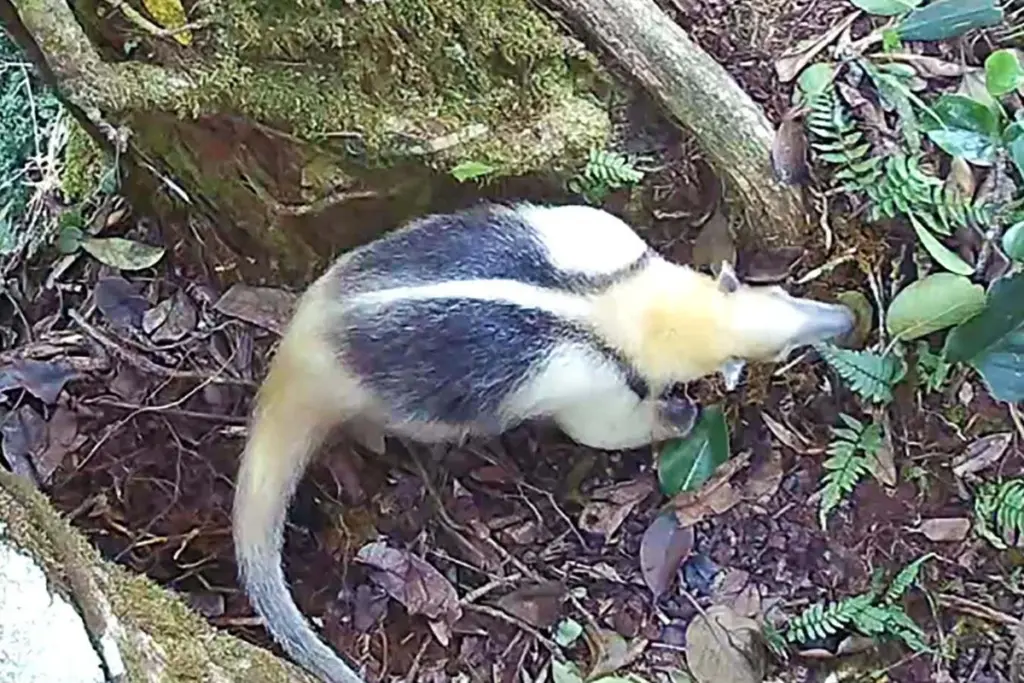
Seemingly exclusive to the forest canopy, a surprising gathering spot has been identified: a communal latrine used by a diverse array of tree-dwelling mammals. This elevated privy serves a variety of species, including opossums, two-toed sloths, and various wild cats.
The initial discovery was made by Jeremy Quirós-Navarro, an independent ecologist working in Costa Rica. While searching for a suitable location to install a camera high in the trees, he encountered a natural platform approximately 30 meters above the ground within a strangler fig tree. This platform was noticeably covered with feces of differing colors and textures.
Further observations revealed the presence of more such latrine sites. Notably, Quirós-Navarro observed that these sites consistently appeared on the same species of tree: Ficus tuerckheimii.
Scientific Investigation and Findings
To understand this peculiar behavior, Quirós-Navarro and his colleagues deployed video traps at one of these latrines situated in the Monteverde Cloud Forest Preserve. After a two-month period, the researchers were astonished to document the usage of this single site by an impressive seventeen different mammal species.
Quirós-Navarro described the find as “crazy,” remarking that the number of species using the latrine represented “almost the total number of canopy mammals that you can find in the cloud forest.” The site experienced an average of three visits per day.
Species and Their Behaviors
Evidence from the camera traps indicated various activities. Wildcats, specifically margays, were observed spraying urine, a behavior commonly associated with territorial marking. Porcupines also utilized the latrine, defecating and rubbing against branches, which likely served to deposit scent.
Other mammals frequently passing through included opossums, white-faced capuchins, and coatis. Howler monkeys and weasels were also recorded as users of the facility.
Perhaps one of the most surprising findings was the use of these elevated latrines by two-toed sloths. This contradicted previous assumptions, as these animals were believed to defecate exclusively on the ground.
Geographical Distribution and Ecological Significance
The research team expanded their survey to examine 170 additional trees. This broader investigation confirmed the existence of more latrine sites, exclusively found on the Ficus tuerckheimii species of strangler fig.
Quirós-Navarro noted that anecdotal reports suggest similar strangler fig latrines have been observed in Honduras and Borneo, indicating a potentially wider phenomenon.
“This toilet sharing is fascinating and highly unusual,” commented Neil Jordan of the University of New South Wales, Australia, who was not involved in the study. He highlighted the inherent difficulty in observing animals in the forest canopy, stating, “It’s super hard to study animals 30 metres up in the canopy. So it’s not surprising that it hasn’t been discovered before.”
Potential Functions of Communal Latrines
The observed behavior echoes that of some ground-dwelling animals, such as rhinos and hyenas, which are known to establish communal latrines. Scientists theorize that such shared sites serve multiple purposes for animals. These may include territorial marking, facilitating the exchange of information about individuals within a population, acting as navigational markers, and consolidating waste to minimize predator detection in other areas.
The Strangler Fig’s Role
The strangler fig itself is a distinctive plant, characterized by its gradual enveloping of a host tree, often leading to the host’s demise. The Ficus tuerckheimii species, specifically, exhibits a cluster of branches at canopy height that Quirós-Navarro likened to an “upturned hand.” This formation creates a “comfortable, protected well in the middle,” providing an ideal structure for a latrine.
The extraordinary length of its branches, estimated at 12 meters, creates extensive aerial pathways. These branches can even span rivers, suggesting that these particular trees might hold disproportionate importance within the forest ecosystem.
These trees are also popular among climbers, some of whom have been observed camping on the latrine platforms. Quirós-Navarro expressed concern that disrupting even a single strangler fig tree could have significant ecological repercussions, potentially affecting communication and connectivity between different forest areas.