
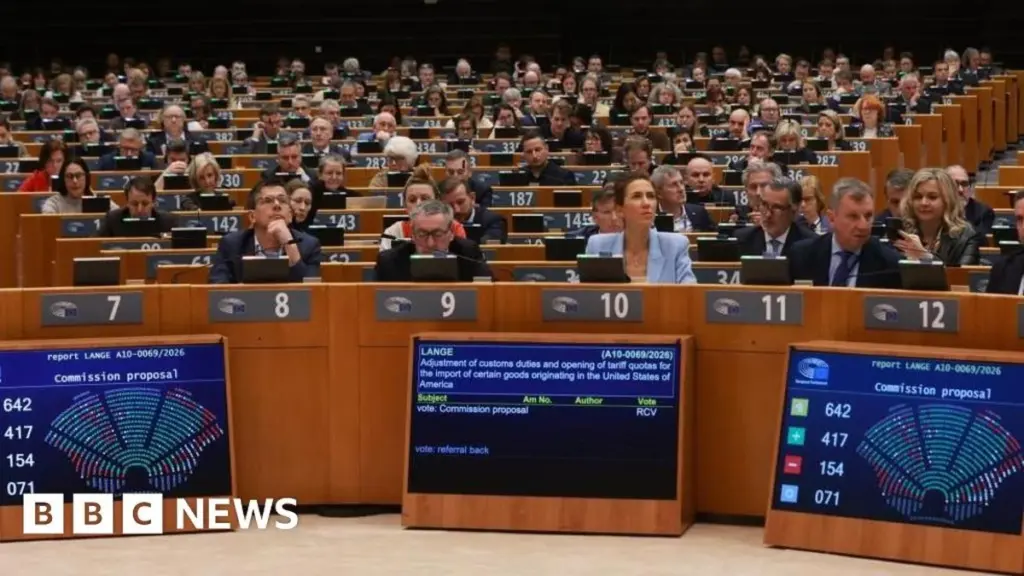
The European Parliament has approved legislation designed to enact a trade accord between the European Union and the United States. This decision follows several months of uncertainty, largely stemming from President Donald Trump’s previous threats regarding tariffs.
On Thursday, a majority of parliamentary lawmakers voted in favor of the implemented measures. However, they also stipulated a series of protective safeguards. These are intended to guarantee that the United States adheres to its commitments within the trade deal that was initially negotiated last July.
Under the proposed legislation, tariffs on most EU goods would be set at 15%. This represents a reduction from the 30% rate that had been threatened earlier. In return, the agreement includes stipulations for European investment in the US and the removal of existing EU import duties on American industrial products.
This parliamentary vote occurs after a period of delay. This postponement was influenced by President Trump’s earlier statements regarding the annexation of Greenland and a subsequent ruling by the US Supreme Court that deemed some of his tariffs unlawful.
The European assembly cast its vote on the legislation with 417 members in favor, 154 against, and 71 abstentions. The approved text now requires endorsement from all 27 EU member states before it can be implemented. A final vote on the matter is anticipated in either April or May.
During Thursday’s session, lawmakers moved to reinforce the agreement’s protective measures. One significant provision allows for the suspension of the accord if the US imposes additional tariffs exceeding 15% or introduces new duties on EU products. Another safeguard would halt the deal should the US threaten the territorial sovereignty of the EU.
Members of the European Parliament also incorporated a “sunrise clause.” This stipulation ensures that any reduction in EU tariffs will only come into effect if the United States upholds its end of the agreement. This includes lowering tariffs to 15% for EU products that contain less than 50% steel and aluminum.
When the initial framework agreement was announced last summer, President Trump indicated that the existing 50% US tariff on global steel and aluminum would still be applied to the EU. However, the parliament’s vote on Thursday supports accepting zero tariffs on US goods only if a substantial number of European products manufactured with steel and aluminum are exempted from that 50% tariff.
A “sunset clause” has been included, whereby the agreement is set to conclude by March 31, 2028.
Following the vote, Valdis Dombrovskis, European Commissioner for Economy, stated that reassurances had been received from the US regarding their intention to honor the deal. He added that while constructive relationships and the avoidance of volatility would continue to be pursued, vigilance against risks to EU interests would be maintained.
Maros Šefčovič, EU Commissioner for Trade, characterized the parliamentary vote as a crucial step forward for the trade relationship.
The initial framework agreement was reached during a meeting between European Commission President Ursula von der Leyen and President Trump. This encounter took place at the president’s Turnberry golf course in Scotland last July. Ms. von der Leyen described the deal as “huge,” while Mr. Trump characterized it as “good for everybody.”
At the time, President Trump stated that the EU would increase its investment in the US by $600 billion, a figure that included the purchase of American military equipment. He also projected an expenditure of $750 billion on energy.
Ms. von der Leyen suggested that increased purchases of American liquified natural gas, oil, and nuclear fuels would contribute to reducing Europe’s dependence on Russian energy supplies.
The United States and the European Union represent each other’s largest trading partners. According to European data, goods and services valued at over €1.6 trillion (or $1.9 trillion USD, £1.4 trillion GBP) were exchanged in 2024. This volume represents nearly one-third of all global trade.
Trade specifically in goods amounted to approximately $976 billion in 2024. In that year, the US imported roughly $606 billion in goods from the EU, while exporting around $370 billion.
President Trump has previously employed tariffs against numerous US trading partners, an approach he has described as an effort to reduce the US trade deficit and restructure the global trading system. Since the announcement of broad tariffs under the initiative referred to as “Liberation Day” last year, the EU has focused on diversifying its trade relationships.
Earlier this week, the bloc finalized a comprehensive trade agreement with Australia. In January, following nearly two decades of intermittent negotiations, a significant trade deal was announced with India.