
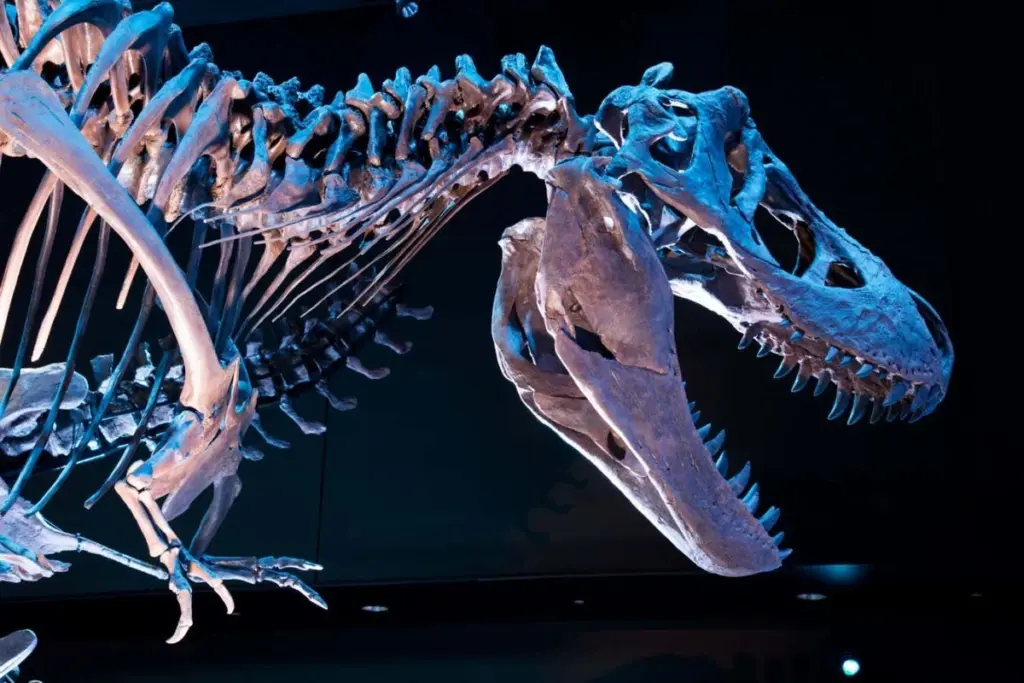
The name “Tyrannosaurus Rex” evokes immense power and a fearsome presence, often associated with an undisputed reign over its prehistoric domain. As Greg Paul, an independent dinosaur researcher, notes, “That name is so cool, and it’s just developed tremendous loyalty.” This sentiment is so strong that even a rock band adopted the moniker. For decades, scientific consensus painted T. rex as an apex predator so dominant it commanded its entire ecosystem. It was believed to have out-muscled all other life forms, holding a veritable stranglehold on its environment as the ultimate hunter of its era.
However, recent fossil discoveries have challenged this long-held view. A segment of paleontologists has proposed that T. rex might not have been the sole ruler. Their findings suggest that this renowned dinosaur shared its territory with at least two other tyrannosaur species. This revision posits T. rex as one hunter among several that roamed North America during the twilight of the Mesozoic Era. This bold assertion has gained significant traction, with many researchers, like Steve Brusatte of the University of Edinburgh, admitting, “Many of us have changed our minds.” The speed and magnitude of this shift in opinion are rare, carrying profound implications for how we understand dinosaur ecosystems and the eventual demise of the dinosaur-dominated world.
The Reign of the Tyrant Lizard King
Tyrannosaurus rex rightfully earned its formidable reputation. Upon its discovery and naming in 1905, it stood as the largest predatory dinosaur known. While subsequent findings have revealed a few other species reaching similar sizes, none possessed quite the same imposing stature and power. Scott Persons at the South Carolina State Museum highlights its unique physical attributes: “It’s got this really wide skull and enormous teeth. T. rex is still king when it comes to biting power.”
For paleontologists, the fascination extends beyond mere physical might. The prevailing belief has long been that T. rex exerted a considerable influence on its surroundings. Flourishing across a vast portion of North America from approximately 69 to 66 million years ago, many T. rex fossils have been recovered from the aptly named Hell Creek Formation in Montana. This geological stratum yields fossils of numerous herbivorous dinosaur species. For years, the prevailing narrative was that T. rex’s dominance limited the diversity of predatory dinosaurs. The hypothesis was that this exceptionally effective predator outcompeted nearly all other meat-eaters. Smaller predators were reportedly displaced by juvenile T. rex, medium-sized hunters by adolescent specimens, and no large predator could coexist with the adults. As Lindsay Zanno of North Carolina State University observed, “There was this assumption that in T. rex’s ecosystem things were different.”
This dominant perspective persisted even when evidence hinted at a more complex picture. In the 1940s, a skull discovered in the Hell Creek Formation belonged to a carnivorous dinosaur that rivaled a polar bear in size. Most researchers initially dismissed it as the skull of a young T. rex. However, by the late 1980s, Robert Bakker and his colleagues from the University of Colorado questioned this assumption. The skull, now known as the Cleveland skull, possessed 30 teeth in its upper jaw, contrasting with the typical 24 found in adult T. rex. Furthermore, the Cleveland skull’s teeth were slender and blade-like, unlike the stouter, more banana-shaped teeth of adult T. rex. Bakker’s team proposed that the Cleveland skull represented a smaller predator coexisting with T. rex, which they named Nanotyrannus lancensis.
The scientific community largely rejected this proposal. Instead, the consensus remained that the Cleveland skull belonged to a juvenile T. rex, attributing the changes in tooth number and shape to the animal’s growth. Even when proponents of Nanotyrannus pointed out that close relatives of T. rex did not experience such dental transformations during growth, the majority clung to the juvenile T. rex theory. Zanno mused, “Part of me wonders if the fame surrounding Tyrannosaurus rex infiltrated our minds a little bit. Even as scientists, we thought: this is such an amazing animal that it does something completely different.”
The Young T. Rex Hypothesis Under Scrutiny
The prevailing notion of T. rex as the sole predator received significant backing from a 2020 study. By that time, additional remains of small tyrannosaurs had been unearthed in the Hell Creek Formation. Holly Woodward of Oklahoma State University, alongside Zanno and other collaborators, examined two partial skeletons nicknamed Jane and Petey. These skeletons included limb bones, offering a new avenue for investigating the Nanotyrannus theory.
Limb bones grow by adding growth rings, much like tree trunks. By sectioning a bone and counting these rings under a microscope, researchers can estimate an animal’s age and maturity. Growth rates slow as animals mature, leading to more tightly spaced rings. Analysis of Jane and Petey’s bones revealed both specimens were between 13 and 15 years old and were still growing rapidly. This indicated neither could be a fully mature Nanotyrannus. Instead, both appeared to be juvenile T. rex, which were known to reach full size in their 30s. For many, this study seemed to settle the debate, marking another blow against the existence of Nanotyrannus.
The Dueling Dinosaurs and a Shift in Perspective
However, a significant revelation was on the horizon. In 2006, fossil hunters discovered exceptionally preserved remains of a small tyrannosaur and a Triceratops within the Hell Creek Formation, appearing to be locked in combat. These fossils, known as the Dueling Dinosaurs, went up for auction in 2013 and the landowner’s price was not met. Commercial interest waned. Years later, Zanno successfully advocated for the Dueling Dinosaurs to be placed in a public collection. The North Carolina Museum of Natural Sciences, where Zanno conducts research, spearheaded a campaign to raise approximately $6 million for their acquisition.
By 2022, the Dueling Dinosaurs had arrived at the museum. Zanno, along with her colleague James Napoli of Stony Brook University, began analyzing the smaller tyrannosaur, nicknamed Manteo. Zanno was confident they would confirm Manteo as a young T. rex, reflecting the prevailing consensus. However, the two researchers soon encountered significant doubts.
The mismatch wasn’t limited to the teeth; the entire skeleton presented discrepancies. Manteo was estimated to weigh around 700 kilograms, a fraction of an adult T. rex’s weight. Astonishingly, its arms were proportionally longer than those of an 8-tonne adult T. rex, and it possessed more vertebrae in its tail. Crucially, the growth rings in its leg bones indicated that Manteo was mature at its death. “It was basically fully grown, and so that made it impossible for this to be a juvenile T. rex,” Napoli explained.
A further surprise emerged when Zanno and Napoli compared Manteo with other small tyrannosaurs. Clear resemblances were found with the Cleveland skull. Manteo also shared characteristics with Jane, despite the 2020 study suggesting Jane would grow much larger than Manteo. The researchers proposed placing these fossils into distinct species: Manteo and the Cleveland skull into Nanotyrannus lancensis, and Jane into a newly named species, Nanotyrannus lethaeus. What was once believed to be a single tyrannosaur species in the Hell Creek Formation suddenly expanded to three.
The Palentological Community Responds
Zanno and Napoli published their findings in October of the previous year, and the paleontological community reacted swiftly. Previously, many researchers expressed skepticism about Nanotyrannus, primarily due to the absence of an adult specimen. Brusatte noted, “For years, many of us had been saying that we’re sceptical of Nanotyrannus, and we’re sceptical because nobody has found an adult.” Manteo appeared to fill that void.
Within weeks, another adult Nanotyrannus specimen came to light – the Cleveland skull itself. While skulls are difficult to age, making it impossible to determine if the Cleveland specimen belonged to a juvenile or adult, Caitlin Colleary of the Cleveland Museum of Natural History had an insight. She realized that the skull preserved a small throat bone, the hyoid, which might contain growth rings similar to those in leg bones. Her colleague, Christopher Griffin of Princeton University, investigated this possibility. Their research confirmed the presence of growth rings and suggested the Cleveland skull belonged to a mature, albeit small, tyrannosaur. This publication in December surprised many, as previous assessments had identified it as a juvenile.
Despite this growing evidence, some dissent remains. Woodward expresses caution regarding the hyoid bone as an indicator of maturity, stating, “It makes me very cautious to use that bone as an indicator of maturity.” Thomas Carr of Carthage College is even more skeptical, strongly advocating that all small tyrannosaurs from the Hell Creek Formation are juvenile T. rex. He believes Manteo is also best understood in this context. Carr points to distinctive changes in T. rex’s snout bones as it aged, describing them as becoming rough like “candle wax.” He argues that Manteo and other Nanotyrannus specimens lack these features, making their adult status improbable.
Napoli offers a counterexplanation. He and Zanno’s phylogenetic analysis of T. rex and its relatives suggests Nanotyrannus is not a close relative. Instead, it appears to be a more primitive tyrannosaur that coexisted with T. rex, potentially explaining its lack of T. rex-specific adult adaptations. Meanwhile, Woodward’s latest research, though cautious about some new findings, may inadvertently bolster the Nanotyrannus hypothesis. Her team’s recent study on T. rex growth rates analyzed 17 individuals, with 15 showing similar growth patterns. The remaining two, Jane and Petey, exhibited slower growth, which Woodward’s team suggests might indicate they were not T. rex.
Beyond T. Rex: The Specter of Multiple Large Tyrannosaurs
The potential reclassification of T. rex isn’t confined to the smaller tyrannosaurs. A debate has also emerged regarding the classification of large T. rex specimens. Since 2022, researchers like Greg Paul, Scott Persons, and Jay Van Raalte have argued for the existence of three large tyrannosaur species within the Hell Creek Formation. They proposed an ancestral form, Tyrannosaurus imperator, which evolved into two coexisting species: a more slender Tyrannosaurus regina and a more robust predator retaining the T. rex designation.
This proposal met with resistance. Within months, several researchers, including Carr, Zanno, Napoli, and Brusatte, published a rebuttal, asserting that the fossil evidence did not support the division into three large species. However, in their Manteo study, Zanno and Napoli reassessed their stance. If Nanotyrannus had been overlooked for so long, it raised the possibility that additional species of giant tyrannosaurs might also be present. Zanno expressed intent to gather data for further investigation, though conclusive results are expected to take years.
Implications for Prehistoric Ecosystems
The implications of these potential taxonomic revisions are as significant as T. rex itself. While modern animals are understood to be energetic and colorful, paleontologists have been hesitant to attribute similar diversity to dinosaur ecosystems. This reluctance stemmed from the assumption that most large dinosaur species followed the T. rex model: laying numerous eggs and producing vast numbers of hatchlings that would fiercely compete with smaller species. If T. rex, the paradigm for this model, coexisted with other tyrannosaurs, a reevaluation of dinosaurian ecosystem organization is warranted. Napoli suggests, “Maybe ecosystems weren’t that different from today. But there’s a beauty in that because it means we should expect a taxonomically diverse array of species, like modern ecosystems.”
Ancient Ecosystems and the Brink of Extinction
The Hell Creek Formation is particularly significant as it represents one of the last dinosaur-dominated ecosystems, thriving until an asteroid impact triggered a mass extinction. Some researchers propose that a decline in dinosaur species numbers commencing millions of years prior contributed to this extinction event. The confirmation of Nanotyrannus adds to the evidence suggesting dinosaurs were, in fact, flourishing on the day of impact. This, as Zanno and Napoli noted in their Manteo study, compels a critical re-evaluation of decades of research on the mass extinction. Zanno emphasizes, “Predators are really important signals of ecosystem health and stability. So even though Nanotyrannus is just one genus, its position in the food chain tells us a lot about the broader stability of the ecosystem before the asteroid struck.”
Furthermore, the reassessment of T. rex is only beginning. Dividing this iconic dinosaur into multiple species opens new avenues of inquiry. One pressing question is how these different tyrannosaurs divided the ancient landscape among themselves. Analysis of Manteo’s teeth, specifically their chemical composition, could offer insights into diet and, consequently, territorial division. “Did Nanotyrannus and T. rex diverge in their behaviours to survive together? It’s a fascinating question,” Zanno remarked. “But until a few months ago, nobody even realised it was one we had to tackle.”