
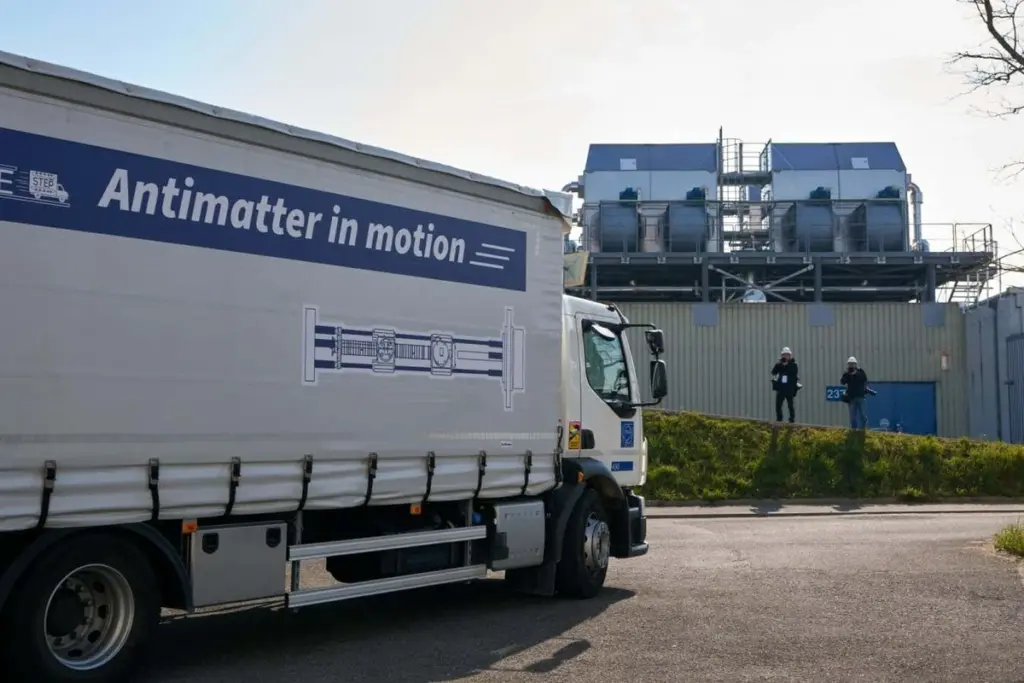
In a significant step for particle physics, approximately 100 antiprotons have completed a 20-minute journey aboard a lorry across the CERN particle physics laboratory’s campus near Geneva, Switzerland. This successful test marks the initial trial of a proposed antimatter delivery system. Scientists envision this service enabling on-demand transportation of antiprotons to laboratories throughout Europe, facilitating deeper study into their enigmatic properties.
Christian Smorra at CERN expressed his satisfaction with reaching this crucial stage. “I’m very happy that we are now at the stage where it’s possible to [transport antimatter],” he stated. “It has been a long journey, and it’s a lot of sweat and tears that went into this to make it work.”
Every form of matter possesses an antimatter counterpart, theoretically identical except for an opposite electric charge. For instance, a positron serves as the antimatter equivalent of an electron. The interaction between a matter particle and its antimatter counterpart results in annihilation, producing new particles or releasing a burst of energy. This inherent reactivity makes the storage and examination of antimatter properties a delicate undertaking.
It is only in recent decades that scientists at CERN’s Antiproton Decelerator, often referred to as the antimatter factory, have achieved the capability to produce and retain sufficient quantities of antimatter, such as antiprotons, for experimental analysis. The overarching scientific goal is to conduct further experiments that may shed light on why the observable universe predominantly consists of matter rather than its counterpart.
The Challenge of Antimatter Handling and the STEP Project
Antiprotons are generated at speeds approaching light. To manage these high velocities, scientists employ powerful magnetic fields. However, this method complicates the direct measurement of antiprotons’ own magnetic properties. In response to this challenge, Christian Smorra and his team launched the Symmetry Tests in Experiments with Portable antiprotons (STEP) project in 2018.
The STEP project developed a portable container. This system utilizes a liquid helium tank and robust magnetic fields, designed to eventually allow antiprotons to be transported to facilities offering a less magnetically disturbed environment. This approach aims to overcome the limitations imposed by the magnetic interference present in the antimatter production facility.
Successful Test Run and Future Implications
The STEP project recently concluded a successful trial run. The portable system, mounted on the back of a truck, completed a roughly 4-kilometer circuit on the CERN campus roads. This transported 92 antiprotons from the antimatter factory and safely returned them, with the cargo remaining intact throughout the journey.
Jeffrey Hangst from Aarhus University in Denmark, who oversees the nearby ALPHA experiment that investigates antihydrogen atoms, commented on the significance of this development. “This really opens up many more years of precision measurements, because this stops them from being hindered by the noise in the hall,” he remarked. This suggests that transporting antiprotons to environments with reduced magnetic interference will enable more sensitive and detailed experimental analysis.
Smorra and his team aspire to demonstrate the STEP project’s capability for much longer-range transportation, ultimately delivering antimatter to magnetically quiet laboratories across the European continent. The realization of this goal may, however, require several years to materialize. Much of CERN’s infrastructure is scheduled for closure for upgrades to the Large Hadron Collider, with these enhancements not anticipated to conclude until late 2028.