
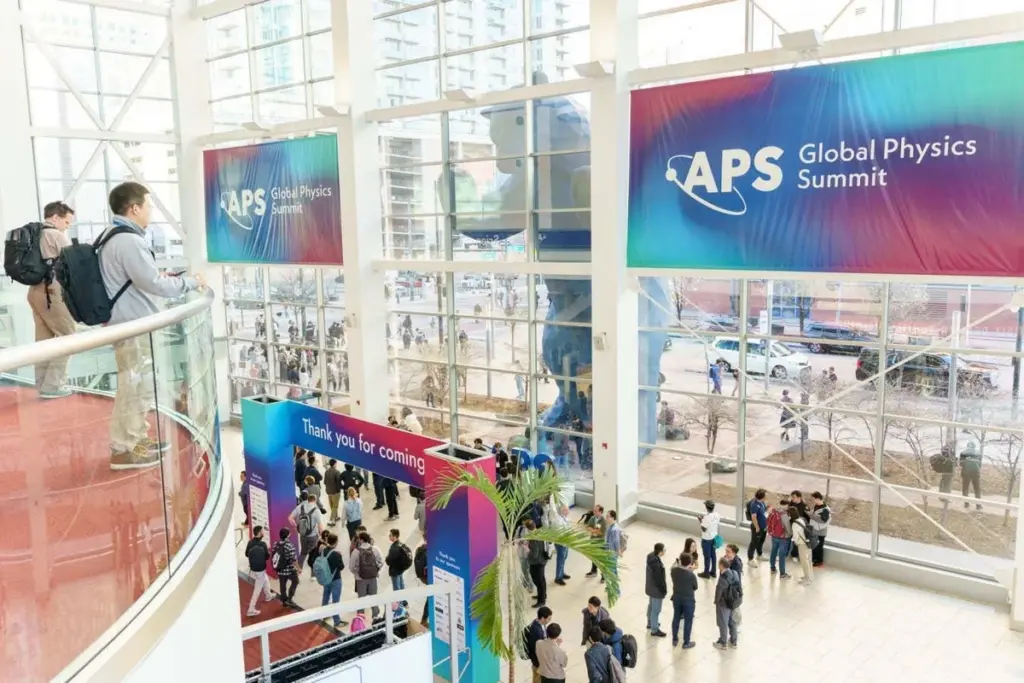
Attending the American Physical Society Global Physics Summit in Denver, Colorado, a gathering of 14,000 researchers, one observes a novel phenomenon: physicists increasingly turning to artificial intelligence for assistance in understanding complex scientific discussions. This scene, while still somewhat unfamiliar, is becoming commonplace.
Throughout the presentations, laptop screens frequently display AI chatbots, tasked with simplifying intricate concepts. Queries like “What are the benefits of transmon qubits?” or “Explain spintronics to me” are met with swift, emoji-illustrated responses. The utility of these AI tools in clarifying material during lectures is evident.
However, the question of whether AI can contribute meaningfully to actual physics research emerged as a central and hotly debated topic at the conference. Discussions spanned formal presentations to informal exchanges during breaks and social events.
AI as a Research Partner
In one notable presentation, Matthew Schwartz of Harvard University asserted that Anthropic’s Claude chatbot possesses the capability to solve advanced physics problems with a proficiency comparable to a doctoral student in the early stages of their program. Schwartz detailed his experience co-authoring a quantum field theory study in January, collaborating with Claude for approximately two weeks. He estimated that achieving the same research outcome with a human student would have required around two years.
Schwartz posits that AI could significantly impact theoretical physics, potentially accelerating the resolution of long-standing challenges. He stated that he now only mentors students who are open to AI collaboration, suggesting that fundamental physics problems, such as reconciling quantum theory with Einstein’s theory of general relativity, might be solved within five years due to AI advancements. His experience working with Claude left him feeling akin to Einstein, leading him to envision a future where many could attain similar levels of insight, a perspective he encapsulated in his talk titled “10,000 Einsteins.”
Caution and Uncertainty
Schwartz’s viewpoint represents one end of the spectrum concerning AI’s role. Savannah Thais from the City University of New York argued for a more measured approach, suggesting it is premature to definitively assess the technology’s transformative potential for physics. Thais highlighted AI’s adeptness at generating scientifically plausible narratives, yet noted the absence of a foolproof method for verifying their scientific accuracy. She pointed out that critical steps within AI processes are often obscured from researchers, and underlying assumptions, particularly in fields like particle physics, can lead to diminished accuracy in outcomes.
Rachel Burley of the American Physical Society discussed the initial optimism surrounding AI’s potential to assist physicists with academic writing and publication. However, she also acknowledged the current strain on the peer-review system, exacerbated by a recent surge in journal submissions, partly facilitated by AI tools.
The Human Element in Future Research
A prevailing question throughout these discussions, both formal and informal, concerns the future role of human researchers as AI capabilities expand. Matthew Ginsburg, a former physicist with extensive experience in AI development, including at Google DeepMind, contrasted AI’s provision of consensus expert opinions with the origin of scientific breakthroughs, which often stem from researchers challenging established paradigms or posing novel questions.
Schwartz speculated that human physicists might increasingly focus on “taste-making”—identifying and prioritizing the most compelling and significant research problems. He expressed a sentiment of cautious optimism, stating, “My fear is that some things may get worse before they get better. It’s amazing and also a little scary.”