
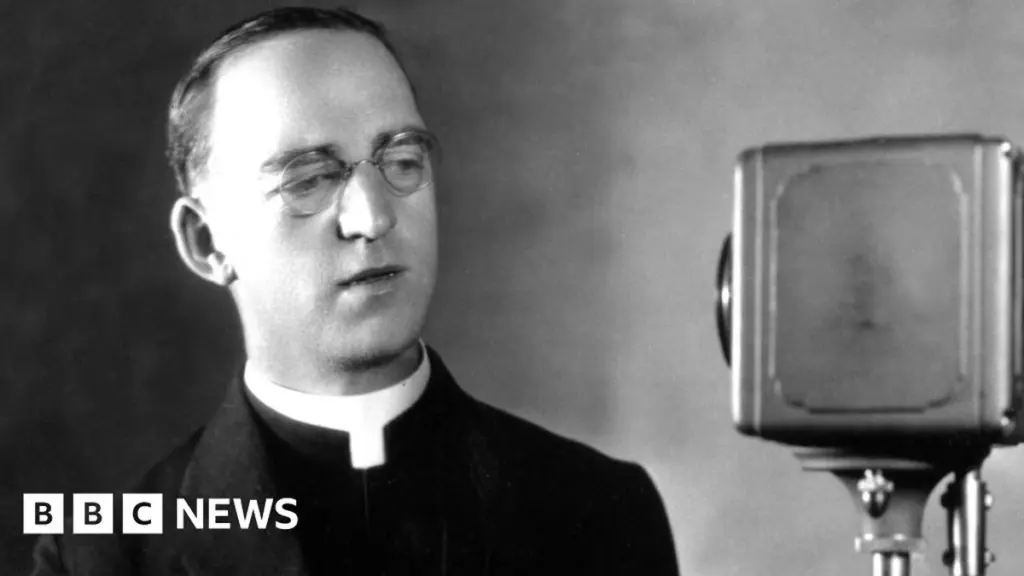
An Irish-born priest whose innovative methods for addressing child poverty significantly influenced child welfare efforts, and whose life story inspired an Academy Award-winning film, has reached a crucial stage in the Catholic Church’s process towards sainthood.
Father Edward Flanagan established a sanctuary in the United States to aid countless orphaned and impoverished boys during the era of World War I. He acquired a farm in Nebraska, transforming it into a comprehensive village dedicated to the care of abandoned and disadvantaged youths. This endeavor became known as Boys Town.
Recently, Pope Leo XIV officially recognized the late Irish-American priest as “venerable.” This designation signifies a pivotal step on the path to canonization, acknowledging his heroic virtues and exemplary Christian life.
Over a century after Father Flanagan initiated his refuge for “wayward boys,” the expansive Boys Town campus continues to operate, providing support to millions of young individuals and their families. The organization celebrated its founder as a visionary who held firm to the belief that “every child deserves to be valued and loved, and a chance to live a healthy, positive life.”
Father Flanagan’s compelling life narrative served as the basis for the 1938 film Boys Town, starring Spencer Tracy and a young Mickey Rooney. The film garnered critical acclaim, securing two Academy Awards, including the Oscar for Best Actor awarded to Tracy for his portrayal of Father Flanagan.
Origins and Early Life of Father Flanagan
Born in 1886 in the village of Ballymoe, located in western Ireland, Father Flanagan grew up in a large Catholic family. He received his initial education in counties Roscommon and Sligo, while also contributing to his family’s farm operations during his youth.
Emigrating to the United States with his sister in his late teens, he soon commenced his theological studies at a seminary in Maryland. He was ordained in 1912 and subsequently began his ministry as a parish priest within the Diocese of Omaha, Nebraska.
Observing the widespread unemployment and economic hardship prevailing in Omaha, Father Flanagan established a shelter for homeless men. Through extensive conversations with these individuals, he gained deep insight into the circumstances that led to their destitution.
He was particularly struck by the prevalence of childhood poverty and neglect among these men, many of whom had experienced chaotic upbringings with parents who were either deceased or had abandoned them. These observations, coupled with his own research into the juvenile justice system, solidified his conviction that early intervention was crucial for children at risk of delinquency.
Father Flanagan articulated his philosophy, stating, “I’ve always hated the cruel system that neglects boys until they’re forced into breaking the law.”
Founding and Growth of Boys Town
In 1917, Father Flanagan opened his inaugural residence for boys in Omaha. Within its first year, this home provided care and education for over 150 youths. The program’s success quickly outpaced the capacity of the Omaha property, leading him in 1921 to acquire Overlook Farm, which would soon become internationally recognized as Boys Town.
Despite facing some opposition to his ambitious project, Father Flanagan remained steadfast in ensuring the facility welcomed all boys, irrespective of their racial background, religious affiliation, or nationality. The developing village eventually encompassed multiple schools, churches, a post office, a hospital with health clinics, and its own police and fire departments.
Father Flanagan gained global recognition for his pioneering work and progressive perspective on juvenile justice. He famously asserted, “There are no bad boys. There is only bad environment, bad training, bad example, bad thinking.”
During a visit to his native Ireland in 1946, he voiced criticism of the Irish justice system, which at that time still involved the imprisonment of children. Father Flanagan passed away two years later while on a mission in Germany to assess child welfare conditions.
Recognition and Legacy
Father Flanagan was among six individuals whose lives and “heroic virtues” were recognized by the Pope on a recent Monday, positioning them as potential candidates for sainthood. This announcement was also met with positive reception from the Catholic Church in Ireland.
Bishop Kevin Doran, who leads the diocese into which Father Flanagan was born, described him as a “model of Christian living.” Bishop Doran noted that Boys Town was founded during a “time of crisis, when many young people were living rough on the streets and getting in trouble with the law.” He added that Father Flanagan created a haven where “young people could feel at home, and have all the advantages of a solid education and formation for life.”
Bishop Doran observed, “Father Flanagan’s life and virtue have much to say to us today, in a wealthy country where so many children are forced to live with homelessness, and in a world in which we still find it so easy to define people as ‘hostile aliens.'”
The village of Boys Town has held the designation of a US National Historic Landmark since 1985. In 2024, the organization provided services and resources to over 3.5 million families across the United States, including healthcare and crisis intervention.
In response to Pope Leo XIV’s announcement, the organization stated that Father Flanagan was “a true visionary whose belief in the potential of every child still shapes Boys Town today.”