
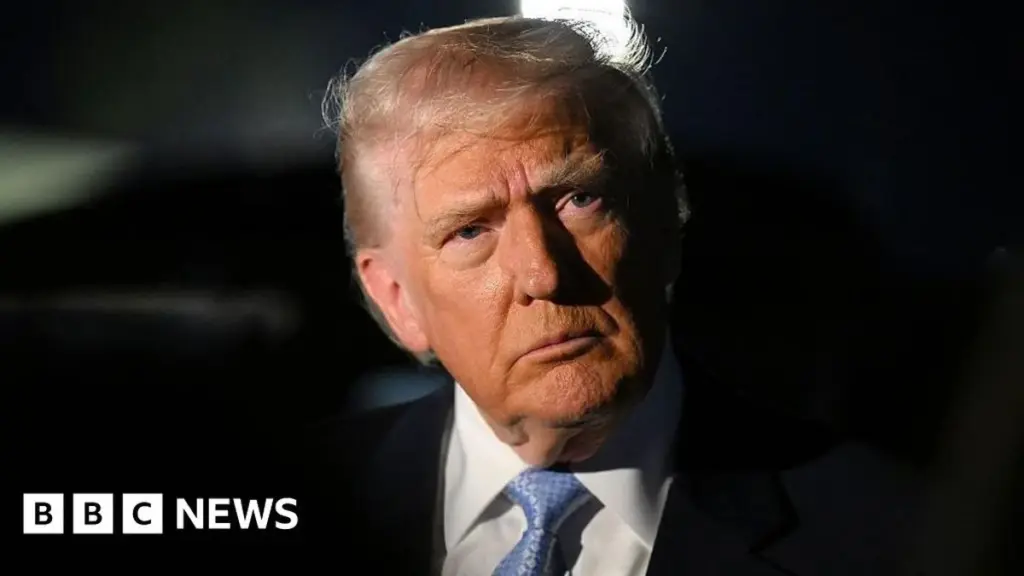
Donald Trump’s tenure as president frequently saw him openly criticize, even attack, Washington’s NATO allies. However, his recent assertion that failing to secure the Strait of Hormuz would severely impact NATO’s future suggests an alignment with the alliance’s foundational purpose that has already prompted surprise.
General Sir Nick Carter, the former Chief of the Defence Staff, noted to the BBC that NATO was established as a defensive organization. He clarified that the alliance was not conceived for one member to initiate a “war of choice” and subsequently compel others to participate. He expressed uncertainty about whether this alignment reflected the NATO vision shared by its members.
Given that the president had, just two months prior, made assertive claims regarding Greenland—the sovereign territory of a NATO fellow member—his current remarks carry a notable layer of irony. This observation may shed light on some of the direct responses received.
Allies Express Hesitation and Doubt
In Germany, a government spokesperson stated unequivocally that the conflict with Iran was unrelated to NATO. Concurrently, Defense Minister Boris Pistorius appeared to dismiss the notion that Europe’s limited naval capabilities could significantly alter the situation. He questioned what Trump expected from a few European frigates that the formidable US Navy could not accomplish, emphasizing, “This is not our war. We have not started it.”
Despite these expressed reservations, the pressing and growing need for a resolution to the crisis in the Persian Gulf remains undeniable. Iran’s effective obstruction of the Strait of Hormuz, permitting only a few vessels carrying its oil to allies such as India and China, has compelled Western governments to urgently seek a solution.
While the crisis may have been precipitated by Donald Trump’s decision to engage in military action, a swift resolution is imperative to mitigate further adverse impacts on the global economy. Yet, it is already evident that no simple solution is readily available.
Naval Challenges and Technological Gaps
At a news conference on Monday, Sir Keir Starmer indicated that ongoing discussions with American, European, and Gulf partners were focused on developing a “viable plan.” However, he stressed that tangible decisions had not yet been reached.
The prime minister referenced the presence of autonomous mine-hunting systems already deployed in the region. This deployment occurs at a time when HMS Middleton, a mine countermeasures vessel (MCMV), is undergoing extensive maintenance in Portsmouth, marking the first instance in decades without a British mine-clearing ship stationed in the area.
Consequently, the Royal Navy is expected to deploy newly developed maritime drones. These systems are designed to detect and neutralize mines without exposing crews to direct risk. However, a significant challenge Donald Trump faces is that mine sweeping, once a fundamental naval operation, has long ceased to be a high priority for many forces.
Tom Sharpe, a former Royal Navy commander, pointed out that the latest British technologies have yet to undergo combat testing. He remarked to the BBC that the effectiveness of these systems would likely become apparent within the forthcoming weeks. General Carter further noted that the last major de-mining operation conducted by Western nations at sea occurred in 1991, following Iraq’s mine-laying activities off Kuwait during the first Gulf War.
He recalled that clearing those mines took fifty-one days. Carter added that no navy had invested in this capability at the required scale, and this deficiency extended to the American forces as well. The US Navy’s specialized Avenger-class minesweepers, built with wooden hulls to avoid triggering magnetic mines, are all being decommissioned. They are to be replaced by Independence-class littoral combat ships, which will utilize a range of unmanned systems.
Broader Iranian Capabilities and Allied Hesitation
The challenges extend beyond mine sweeping. Iran’s Revolutionary Guard possesses the capacity to deploy armed fast attack craft, naval “suicide” drones, and shore-based missiles to disrupt maritime traffic. Recent imagery released by Iran’s Fars News Agency suggested the storage of numerous boats and drones within underground tunnels, indicating a prolonged period of preparation for such a scenario.
President Trump has proposed that maintaining the openness of the Strait of Hormuz, which he characterized as a “very small endeavor,” might necessitate attacks on Iran’s coastline. He indicated a desire to identify individuals capable of neutralizing adversaries positioned along the shore. The US has already conducted strikes against mine-laying vessels docked in Iranian ports. However, it appears unlikely that many of Washington’s allies would readily endorse such actions, particularly if they involved deploying ground troops.
In this complex and hazardous environment, it is unsurprising that nations are exhibiting caution regarding direct involvement. Many prefer to advocate for de-escalation, as the UK government has, viewing it as the most reliable method for reopening the Strait of Hormuz. However, with American and Israeli officials discussing a potential campaign extending over several more weeks, this outcome does not appear imminent.
The question remains whether allies could be persuaded to contribute ships for the escort of merchant vessels through this critical waterway.
European Responses and Diplomatic Efforts
Minister Pistorius firmly stated on Monday that Germany would not participate militarily in securing the Strait of Hormuz. EU foreign ministers are scheduled to convene, considering a proposal to expand an existing EU naval mission in the Red Sea. Kaja Kallas, the EU’s chief foreign policy officer, suggested that modifying the mandate of Operation Aspides would represent the “fastest” route for the EU to enhance security in the Gulf.
Operation Aspides was launched in 2024 to address threats to shipping posed by the Iranian-backed Houthi rebels in Yemen. Currently a modest operation involving three warships, there appears to be limited enthusiasm among EU member states for its expansion. Both the Spanish and Italian foreign ministers have voiced reservations. German Foreign Minister Johann Wadephul indicated that his government wished to hear from Israel and the United States regarding their projected military objectives in Iran before considering new security arrangements.
Among the major European allies, French President Emmanuel Macron appears to be the most inclined toward involvement. A week prior, he stated his efforts to establish a coalition for escorting vessels and ensuring freedom of navigation. However, he stipulated that this could only occur once the “hottest phase” of the conflict had concluded. A few days later, his defense minister, Catherine Vautrin, reported no immediate plans to dispatch vessels into the Strait of Hormuz.
Former Royal Navy Commander Tom Sharpe noted that a potential escort mission would be significantly more intricate than Operation Aspides, facing threats from three distinct vectors: aerial, surface, and underwater. He contrasted this with the Houthi situation, where the threat was primarily aerial, explaining that with Iran, all three dimensions are present, requiring interception before engagement, a task that is not always feasible.
Currently, President Trump’s somewhat disoriented allies are holding back from direct engagement in the “Iran involvement” scenario. They observe each other warily, aware that inaction is not a viable long-term strategy. Sir Keir Starmer emphasized the necessity for “as many partners as possible” in any solution. He also stressed that British military personnel require significant assurances before deployment on what could be a perilous mission. “The very least they deserve is to know that they do so on a legal basis and with a proper thought through plan.” As matters stand, such a comprehensive plan remains undeveloped.