
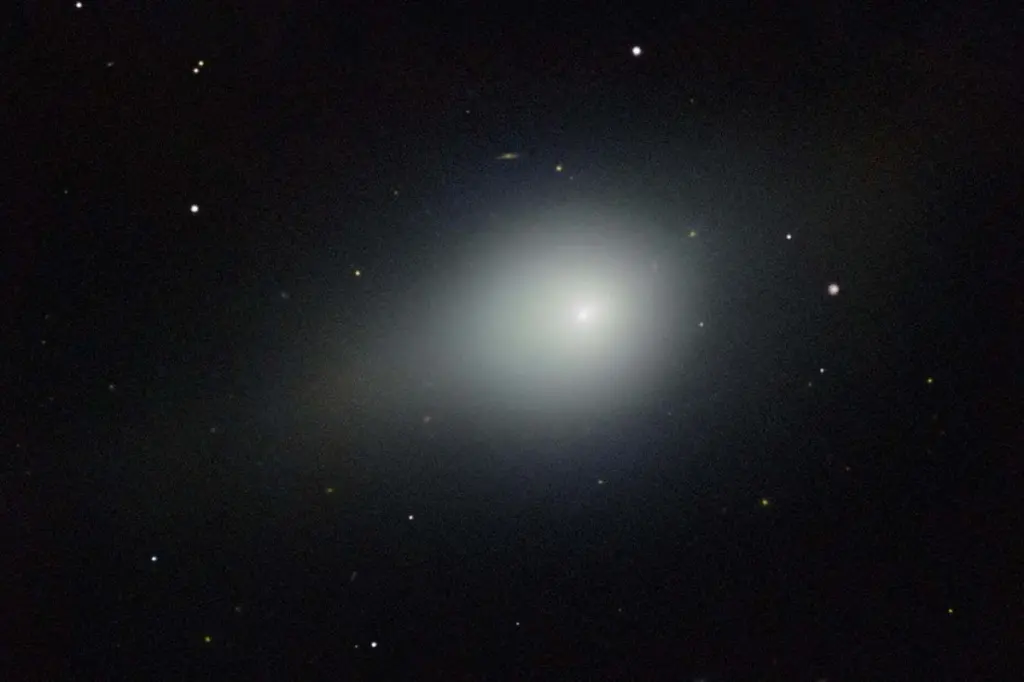
The interstellar comet 3I/ATLAS carries water and carbon molecules in quantities previously unobserved within our solar system. This composition suggests a formation around an exoplanetary star that is not only distinct from our sun but also considerably older.
Astronomers began observing 3I/ATLAS upon its entry into our solar system last year, noting its unusual characteristics. The comet appears to be exceptionally rich in carbon dioxide and water when compared to most other comets encountered. Initial estimates placed its age at approximately 8 billion years, nearing twice the age of our sun.
Further analysis by Martin Cordiner of NASA’s Goddard Space Flight Center in Maryland and his team has identified notably high levels of deuterium, a hydrogen isotope with an additional neutron. These deuterium levels are at least ten times greater than those found in any previously observed comet. While deuterium exists in small concentrations in Earth’s oceans, 3I/ATLAS exhibits levels exceeding 40 times that amount.
“3I/ATLAS continues to astonish us with what it reveals about the similarities and differences of its host system compared with our own solar system,” Cordiner stated. The observations were conducted using the James Webb Space Telescope.
Paul Hartogh from the Max Planck Institute for Solar System Research in Germany commented on the findings, remarking, “It’s really exceptional. This deuterium-to-hydrogen ratio in water is extremely unusual, and nobody would have expected this.”
Ewine van Dishoeck at Leiden Observatory in the Netherlands explained that such elevated deuterium concentrations are typically observed only in the coldest regions of the Milky Way. “That means it’s probably in the very outer part of the disc around whatever star it was circling, and that makes it also easier to kick it out,” Dishoeck noted.
Cordiner’s team also detected relatively low concentrations of carbon-13, a carbon isotope formed after stellar supernovae. These reduced levels, similar to those found in young star-forming clouds, indicate that 3I/ATLAS likely formed during an earlier epoch in galactic history, when supernova events were less frequent. This supports the hypothesis that the comet originated from a star system estimated to be between 10 billion and 12 billion years old, significantly predating our sun.
However, Dishoeck cautioned that the current precision of carbon measurements prevents definitive conclusions about the comet’s precise age.
Journal reference: arXiv DOI: 2603.07026
Journal reference: arXiv DOI: 2603.06911