
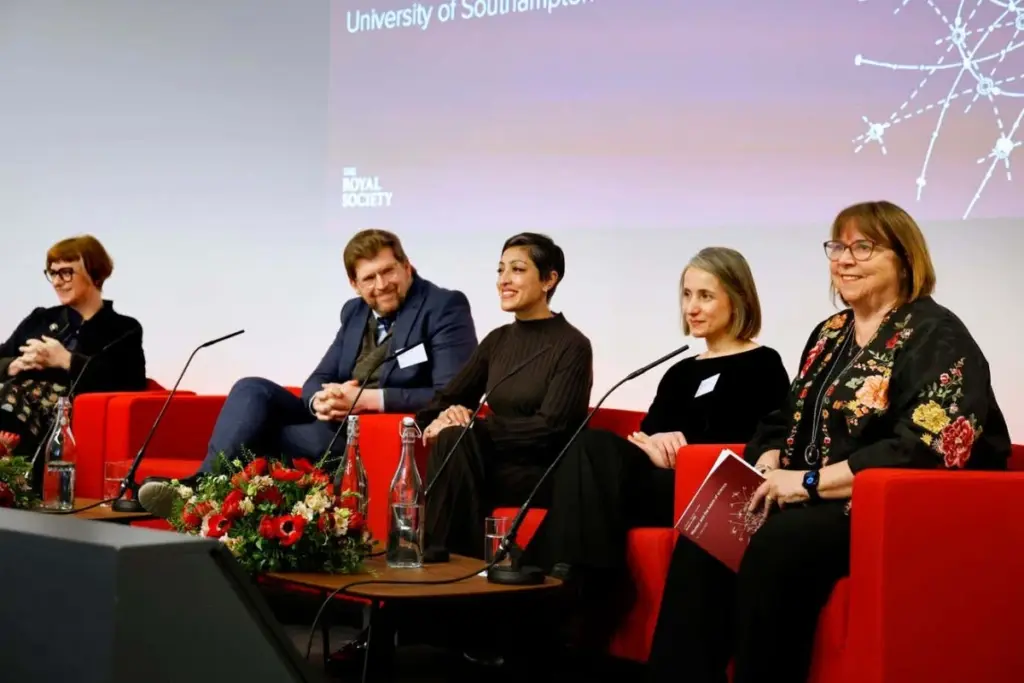
On the second day of the Women and the Future of Science conference at London’s Royal Society, a subtle, yet significant, disruption began to overshadow the proceedings. The AI transcription software, intended to simplify note-taking, repeatedly mistyped a speaker’s name, consistently rendering “Julie” as “Julian.” This linguistic glitch proved particularly ironic, given the session’s focus: artificial intelligence and the alarming trend of women being sidelined in its development.
This issue extends beyond the well-established problem of AI algorithms reflecting the biases inherent in their training data, including gender bias.
The conference session, guided by computer scientist Wendy Hall, aimed to tackle a more fundamental concern: the nearly exclusive male design of new AI technologies, systems poised to profoundly reshape society.
The Male-Dominated Tech Landscape
The technology sector has historically been a predominantly male domain. In the United Kingdom, women constitute only 25 percent of computer science students. However, recent years have witnessed a troubling increase in hostility towards women within Silicon Valley, coinciding with the surge in generative AI’s capabilities.
David Leslie, leading ethics and responsible innovation research at the Alan Turing Institute, observed a regression over the past two years. He stated that the impact of the Trump administration on women in science across generations is undeniable, characterizing the current era as one of backward thinking.
Last year, U.S. President Donald Trump issued an executive order that targeted “woke AI.” This directive recommended that the U.S. National Institute of Standards and Technology revise its AI risk-management framework, specifically calling for the removal of references to misinformation, Diversity, Equity, and Inclusion, and climate change.
Rumman Chowdhury, a data scientist and former U.S. science envoy for artificial intelligence, highlighted that the concept of “woke AI” originated from misogynistic sentiments within Silicon Valley long before Trump’s order. She previously held the position of ethics and accountability lead at Twitter before Elon Musk’s acquisition led to the dismissal of her team.
An AI World Without Women?
When asked by Wendy Hall to depict artificial intelligence without women’s involvement, several panelists suggested that this scenario is not a hypothetical future but a present reality. Chowdhury, operating in the realm of frontier AI, stated, “I am in the world of frontier AI, and that is the world of AI without women.” This view was echoed by Rachel Coldicutt, a researcher specializing in the societal impacts of emergent technologies. She commented, “If we think about what the world looks like without women in AI, I think that’s what we have at the moment. It’s not fantasy at all.”
The consequences of this imbalance are significant. A long history exists of technologies being developed with male physiology and needs in mind, evident in areas ranging from crash test dummies and office air conditioning to astronaut spacesuits and the vast majority of medical research. This phenomenon, termed the gender data gap, can lead to impacts varying from minor inconveniences to life-threatening situations.
AI is set to influence every facet of life, from employment and education to healthcare. Yet, Chowdhury noted that women receive only 2 percent of venture capital funding. Concurrently, less than 1 percent of healthcare research and innovation is directed toward women’s health issues. As Coldicutt aptly put it, “We need to make tech work for 8 billion people, not eight billionaires.”
Pathways Toward Inclusivity
Addressing this challenge requires a multifaceted approach. Coldicutt expressed skepticism about correcting current AI models, which are built upon centuries of biased data. She advocated for the development of “alternative models” and a strategic shift in their priorities. “It’s about cultivating models… that prioritise care for people, for the planet,” she urged.
Chowdhury, co-founder of the non-profit Humane Intelligence, which assists companies in creating more accountable and equitable AI systems, posits that a contributing factor to the present limitations is the emphasis on a false sense of urgency surrounding AI development. She believes the focus on existential risks, such as job displacement or threats to humanity, distracts from essential considerations. “If the narrative is that your house is on fire, ‘you’re not like, ‘What happened to my mother’s jewellery?’” she explained. When individuals perceive a lack of time, they tend to deprioritize elements they deem extraneous, including diversity initiatives.
Leslie stressed the importance of re-evaluating the economic and political frameworks that govern AI development to encourage younger generations to create AI for societal benefit. “We need to start with the basics, start with transforming the incentives,” he advised.
Ultimately, a re-examination of how intelligence is defined within the context of AI may be necessary, incorporating broader and more diverse modes of thought. Much of the foundational work on AI definition, including its very conceptualization, originated from an influential 1950s gathering at Dartmouth College in New Hampshire. “That definition of intelligence comes out of the Dartmouth conference,” Hall remarked, adding, “Which, by the way, was all men.”