
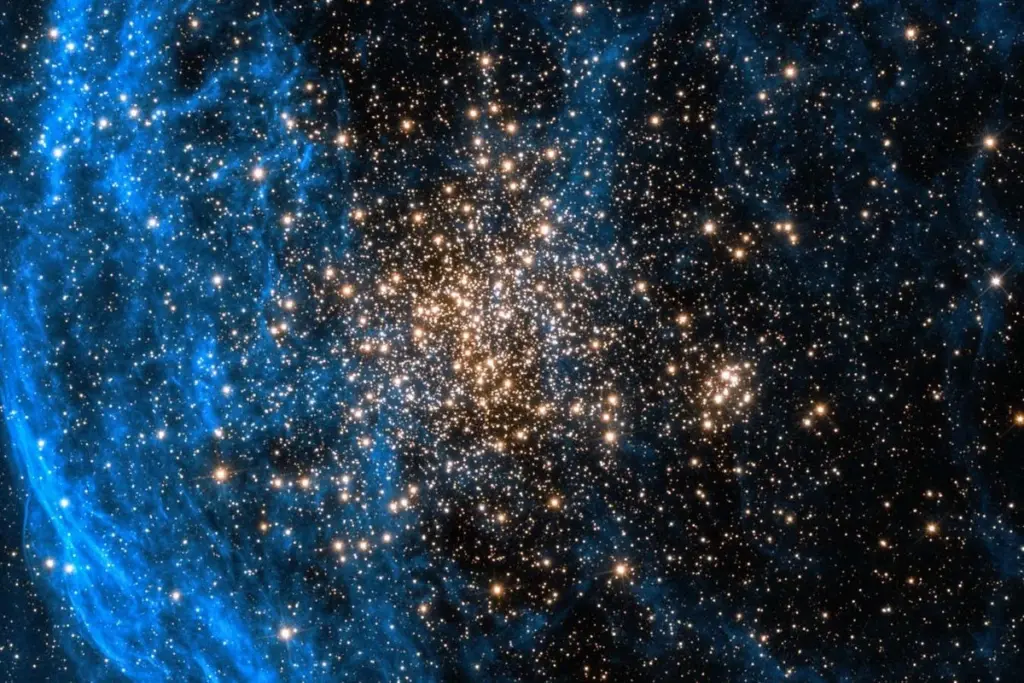
The distinction between a mere collection of stars and a true galaxy is a scientific question currently under active discussion within the astronomical community.
For many outside professional astronomy, galaxies are perceived as distinct, complete celestial formations, akin to finished artistic creations. When observing galaxies through backyard telescopes, spirals radiating the brilliance of billions of stars, sometimes exceeding 100 billion, are visible. Theoretical particle cosmologists understand that these galaxies are enveloped by vast, invisible halos of dark matter extending far beyond their visible boundaries. Astronomical training also reveals that not all galaxies possess spiral structures; some are elliptical, resembling spheres compressed from the top. From this perspective, defining a galaxy appears straightforward.
However, as previously noted, our understanding and classification of galaxies are continuously evolving. While categorizing a celestial body with a clear spiral structure and billions of stars is relatively simple, the classification of a spheroidal object with only millions of stars becomes more complex. Such an object aligns with the basic definition of a globular cluster. These are dense groupings of tens of thousands to millions of stars, gravitationally bound and spanning only a few light-years across. Crucially, they reside within galaxies.
The presence of globular clusters exclusively within galaxies might suggest they are fundamentally distinct from galaxies themselves. Furthermore, globular clusters are compact, whereas galaxies are diffuse and spread out across space. This distinction holds even for dwarf spheroidal galaxies, which are gravitationally bound to the Milky Way. Although smaller than our own galaxy, they are still considerably large and spread out. Dwarf spheroidals also tend to host a more diverse stellar population compared to the more homogeneous stars found in globular clusters. Importantly, dwarf spheroidals are known to be contained within their own dark matter halos, a characteristic not shared by globular clusters.
This situation can be visualized as a series of nested galaxies surrounded by dark matter. The Milky Way possesses a single, large halo. Within it, smaller dwarf spheroidals exist, each enclosed in its own sub-halo. For some astronomers, this characteristic — being encompassed by dark matter — serves as the primary differentiator between galaxies and other celestial structures.
Challenging the Established Definitions
Until approximately 2005, this classification system seemed robust. However, the release of the first dataset from the Sloan Digital Sky Survey (SDSS) introduced new complexities. The SDSS, which surveyed over a quarter of the night sky, cataloged numerous previously unobserved objects. Among these findings were observations of extremely faint, difficult-to-detect collections of stars near the Milky Way. These ultra-faint Milky Way satellites began to challenge the notion that distinguishing between globular clusters and galaxies was a simple matter.
Subsequent observations confirmed that some of these cosmic entities were indeed galaxies, rich in dark matter. This area of research continues, and the task is far from straightforward. Their inherent faintness presents significant observational challenges. These enigmatic objects occupy what Blair Conn and colleagues termed a “trough of uncertainty” in a 2018 paper. They do not present as obvious galaxies, yet their non-galactic status is not definitive.
While one might expect further data to reduce this zone of ambiguity, it has, in some respects, expanded. Recent sky surveys have further complicated matters by revealing an even greater number of exceedingly faint objects. Astronomers now approach these discoveries with a greater awareness that they may indeed be galaxies. Consensus remains elusive; for instance, a 2023 study led by Simon Smith at the University of Victoria identified Ursa Major III, described by the researchers as “the least luminous known satellite of the Milky Way.” Despite the confidence in this assertion, the authors note a significant challenge in substantiating their claim, as observations indicate only about 60 stars within this purported galaxy – a stark contrast to the tens of thousands, millions, or billions typically associated with galaxies.
Implications for Fundamental Physics
Despite its minuscule size, Ursa Major III, if classified as a galaxy, could have a profound impact. Last year, a research team suggested that its existence could potentially rule out certain classes of dark matter models. Therefore, determining whether Ursa Major III and similar compact, ultra-faint Milky Way satellites are indeed galaxies has the potential to significantly influence astrophysics, cosmology, and particle physics.
Progress is being made in addressing this question. A recent report published by William Cerny of Yale University and his collaborators presents the first comprehensive investigation of a substantial group of these objects. Their findings indicate a mixture of classifications, emphasizing the need for additional observational data. Currently, there is no definitive answer regarding their precise nature, a situation that generates considerable research excitement. The scientific community stands at the threshold of new discoveries, actively pushing the boundaries of current knowledge.