
A recent drone strike targeting a British airbase in Cyprus has once again brought the enduring presence of the United Kingdom’s military facilities on the island to the forefront of public discussion.
The incident, which occurred a week ago, saw a drone breach a hangar at RAF Akrotiri. For some in Britain, the damage may represent perceived weaknesses in national defense capabilities. In Cyprus, however, it has been viewed by many as another unwelcome consequence of extensive British military operations.
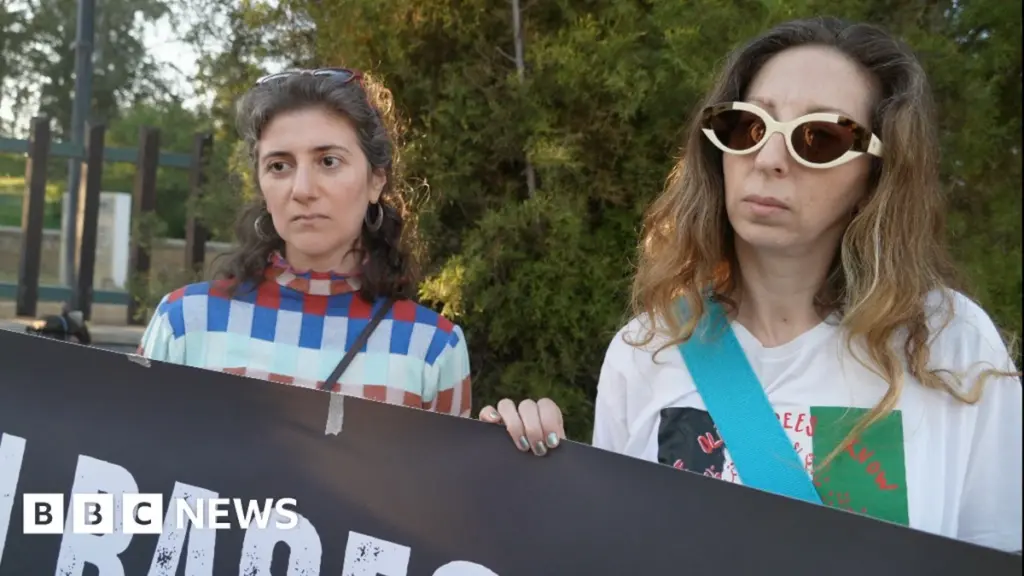
Local business owner Natasha Theodotou, participating in a demonstration outside the presidential palace in the capital, Nicosia, expressed a common sentiment. “We just want to have an independent Cyprus,” she stated, holding a banner that read “British Bases Out.” Theodotou drew a parallel between the current situation and foreign occupation, noting, “Just as we’re occupied by the Turkish government, we are occupied by the UK.” Her aspiration is for a unified nation where Greek Cypriots and Turkish Cypriots coexist.
Under a treaty signed in 1960, which granted Cyprus its independence and concluded its status as a British colony, the UK retained two principal sovereign bases: Akrotiri and Dhekelia, situated in the island’s south and southeast. This followed Turkey’s invasion in 1974, which resulted in Turkish control over the island’s northern third, occurring in the wake of a military coup supported by Greece.
Near the protest site, tourists cross a checkpoint allowing passage into the northern, Turkish-controlled sector of Nicosia. This city, bisected by the UN-patrolled buffer zone known as the Green Line, is sometimes referred to as the world’s last divided capital.
Military intelligence suggests that the drone which struck RAF Akrotiri was launched from Lebanon by Hezbollah, an Iranian-backed militia. The UK government has stated that its Cypriot bases are not being used by American bombers for “defensive” operations against Iranian missile sites. However, reports indicate that the base may have been used by American U-2 spy planes, potentially making RAF Akrotiri a target in retaliation for US-Israeli strikes. Approximately 200 to 300 individuals participated in the march on Saturday, carrying placards with messages supporting Palestine and criticizing both the US and Israel. Chants frequently heard included: “Say it loud, say it clear, British bases out of here.”
The Sovereign Base Areas (SBAs), maintained by the UK, collectively cover approximately 98 square miles (254 sq km) and are overseen by a dedicated police force. These areas remain a persistent point of contention, yet they are also deeply integrated into the island’s fabric and represent a source of employment. The SBAs extend beyond the immediate perimeter of RAF Akrotiri, located at the island’s southern extremity.
“I think that we’d be a lot safer without them here,” said Shona Muir, who joined Natasha in displaying the “British Bases Out” banner. She added, “Their presence alone here makes us more of a target.”
A representative from the Ministry of Defence commented to the BBC, “Our bases in Cyprus play a crucial role in supporting the safety of British citizens and our allies in the Mediterranean and in the Middle East.” The spokesperson further stated, “Just this week, we have flown Typhoon and F-35 fighter jets on sorties around the region, shooting down Iranian drones and defending innocent civilians from Iran’s indiscriminate attacks.”
The Cypriot government has emphasized that the drone attack targeted a UK facility, not Cyprus itself. RAF Akrotiri, serving as a British outpost in the Eastern Mediterranean, has historically supported operations in the Middle East and, more recently, has reportedly been utilized for surveillance flights over Gaza.
“We don’t know what’s happening in [the] British bases,” remarked Stephanos Stavros, another attendee at the Saturday demonstration. He conveyed existing concerns, stating, “There are worries now that there are things there that we were not aware [of].” Stavros believes the treaty establishing the bases should be respected but called for “full transparency.”
Earlier this week, Cyprus’s Foreign Minister, Constantinos Kombos, acknowledged that the issue of British bases has been a long-standing topic. Speaking to BBC Newsnight, Kombos noted, “But I believe this is a conversation that one needs to have after we have a careful reflection as to what has transpired, especially in recent days and hours.” Any potential renegotiation of the base agreements would be exceptionally complex, given that the original accords involved the United Kingdom, Greece, and Turkey, alongside representatives from both the Greek and Turkish Cypriot communities.