
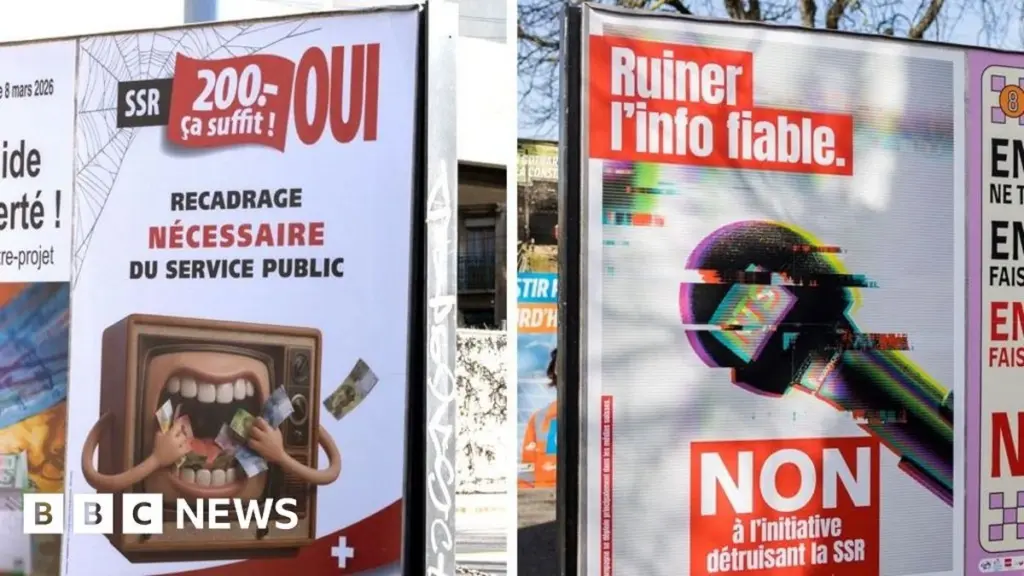
This weekend, Swiss voters are scheduled to participate in a referendum that could significantly curtail the annual licence fee funding their national broadcaster. The Swiss Broadcasting Corporation (SBC) has seen its fee reduced in recent years, but it currently stands at 335 Swiss francs per household annually. This figure exceeds the charges in neighboring Germany and Austria.
If the proposed measure passes, the annual fee for Swiss households would be lowered to 200 francs, with businesses being entirely exempt from this charge. This initiative is being spearheaded by the right-wing Swiss People’s Party.
Arguments for Fee Reduction
The party argues that the current fee is exorbitant, particularly as Swiss citizens grapple with a cost of living crisis. Manfred Bühler, a member of parliament for the Swiss People’s Party, expressed skepticism regarding the SBC’s operational efficiency. He noted that in the 21st century, television and radio programs can be produced at a considerably lower cost than in previous decades. Bühler believes that 200 francs would be a sufficient amount to maintain services.
Compounding these concerns, particularly among younger demographics who increasingly favor streaming services, are questions about the necessity of the SBC’s extensive programming. Early opinion polls indicated a potentially close outcome for the vote.
Counterarguments and Concerns
Opponents of the proposed reduction contend that a substantial portion of the current licence fee is allocated to ensuring representation for all four of Switzerland’s official languages: German, French, Italian, and Romantsch. Each of these languages possesses its own dedicated radio and television channels, broadcasting daily national and local news.
Fabian Molina, a member of parliament for the Social Democrats, raised concerns that a reduction in the licence fee could undermine Switzerland’s “national cohesion.” He emphasized the principle of equal treatment for all regions and linguistic communities. Furthermore, Molina expressed apprehension regarding the potential impact on the SBC’s international news coverage. The broadcaster currently maintains correspondents in numerous locations worldwide, including the US, Russia, China, the Middle East, Latin America, as well as in key European capitals such as Brussels, Berlin, Paris, Rome, and London.
“As a neutral country, we possess a distinct global perspective, and it is solely our correspondents who can convey this back to our citizens,” Molina stated.
Potential Consequences of Cuts
The SBC has issued a warning that approving a reduction in the licence fee could result in hundreds of job losses, alongside a significant decrease in the organization’s coverage of news and sports. Unlike many other European nations, including the UK, where major sporting events like top-tier football often require private subscription fees, the SBC continues to broadcast a wide array of football matches, as well as winter sports in which Switzerland excels.
External Influence and Public Reaction
Until recently, indications suggested that voters might support the fee cut. However, an unexpected intervention altered the landscape. An article published in the German edition of the Russian state-backed news outlet RT, attributed to an individual identified as Hans-Ueli Läppli—a name widely perceived as a pseudonym—urged Swiss citizens to vote in favor of reducing the licence fee.
The author of the article accused the SBC of exhibiting “Russophobia,” engaging in “selective reporting, moralizing on political issues, and ignoring uncomfortable facts,” and of “manipulating” the Swiss populace. This intervention resonated negatively with many voters across the political spectrum.
Switzerland, a neutral nation, has aligned with European sanctions against Russia, characterizing the invasion of Ukraine as a violation of international law. This stance has generated considerable criticism from Moscow. Despite being targeted by several Kremlin-backed disinformation campaigns, Switzerland has not banned RT, which remains accessible online.
However, the article appearing to dictate voting instructions was widely interpreted as blatant interference in Switzerland’s well-established system of direct democracy, prompting significant public anger. Representatives from the campaign committee advocating for the fee reduction have disavowed any connection to the RT article, denied contact with Russian media, and refuted the allegations of selective or manipulative journalism leveled against the SBC.
Susanne Brunner, a member of the campaign committee, reiterated their primary objective: “to reduce the SBC licence fee to 200 Swiss francs, to ease the burden on households and businesses.” Following the publication of the RT story, the debate surrounding the SBC licence fee underwent a shift. Posters emerged from an anti-populist group urging voters not to “do the autocrats any favors,” featuring images of Russia’s Vladimir Putin, Hungary’s Viktor Orban, and former U.S. President Donald Trump.
The context of media control in Hungary, where most independent outlets have been acquired by supporters of its prime minister, and the timing of the RT article, coinciding with mass layoffs announced by the Washington Post, were noted.
Official Stance and Polling Data
The Swiss government, along with all political parties except the Swiss People’s Party, has officially recommended a “No” vote. Numerous sporting associations and cultural organizations are also actively campaigning against the proposed fee cut.
Recent opinion polls conducted in the lead-up to Sunday’s referendum indicate that between 54% and 57% of voters are inclined to maintain the current licence fee structure. Molina commented, “People understand that the cost of living crisis will not be resolved by cutting a relatively small fee that each household has to pay just once a year.”
Other Ballot Proposals
Sunday’s ballot also includes several other proposals for voter consideration. These include plans to establish a multi-billion-dollar climate fund, to constitutionally guarantee the continued availability of cash payments using coins and banknotes, and to modify the system for taxing the income of married couples.