
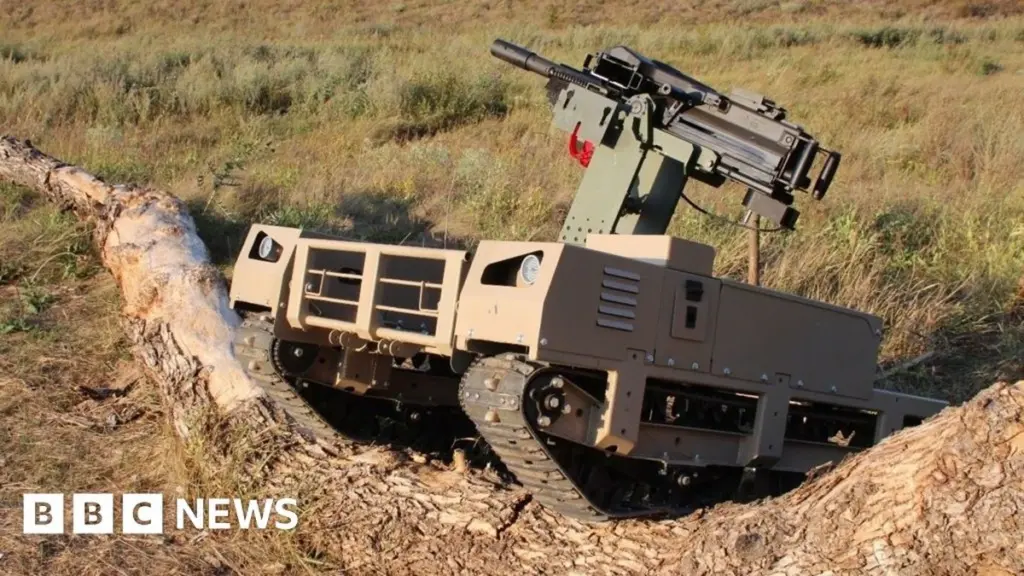
The ongoing conflict in Ukraine has rapidly evolved into a high-technology battlefield since the onset of Russia’s full-scale invasion. While aerial drones—both for reconnaissance and attack—have become ubiquitous, and uncrewed naval vessels have successfully targeted Russia’s Black Sea fleet, a new frontier is emerging: armed ground robots.
Ukraine is now spearheading a significant initiative to deploy uncrewed ground vehicles (UGVs), referred to in Ukrainian military circles as ground robot systems. These robotic systems have swiftly demonstrated their utility on the front lines. Reports indicate successful engagements where UGVs have countered Russian assaults and even captured enemy personnel. The integration of these machines into combat operations has reached a point where clashes between Ukrainian and Russian robotic units, entirely devoid of human intervention in the immediate engagement, are reportedly occurring.
The World’s First UGV Battalion
“Robot wars are already a reality,” stated Oleksandr Afanasiev, a commander in the Ukrainian army’s K2 brigade, which he claims operates the world’s inaugural UGV battalion. This unit frequently utilizes its robots by equipping them with formidable weaponry, such as Kalashnikov machine guns mounted on top. “They engage targets on battlefields where a human infantryman would hesitate to go. A UGV, however, is willing to risk its operational capacity,” explained Major Afanasiev.
Beyond armed patrols, the battalion employs kamikaze UGVs. These battery-powered, explosive-laden robots are deployed to obliterate enemy fortifications and hiding places. Unlike their aerial counterparts, their silent approach offers no auditory warning to opposing forces of an impending strike.
Autonomy and Ethical Boundaries
An officer from the 33rd Detached Mechanised Brigade’s tank battalion, known by the callsign Afghan, recounted instances where a Ukrainian UGV armed with a machine gun successfully ambushed a Russian personnel carrier. He also described a scenario where a robot autonomously defended a Ukrainian position for an extended period, spanning several weeks.
Afghan acknowledged the inherent limitations on the operational autonomy of these “killer robots,” many of which are self-imposed due to ethical considerations and adherence to international humanitarian law. “Modern UGVs operate with partial autonomy,” he clarified. “They can navigate independently and identify potential threats. However, the ultimate decision to engage a target rests with a human operator.” This human oversight is crucial to prevent misidentification of individuals or unintended attacks on civilians.
Consequently, in most combat scenarios involving armed UGVs, operations are remotely controlled by operators situated at safe distances, often via internet connections. Ukraine’s lethal UGVs are adaptable, capable of being fitted with grenade launchers alongside machine guns. They also serve roles in deploying landmines or constructing defensive barriers with barbed wire.
Despite the increasing sophistication of armed UGVs, the primary function for the majority of Ukraine’s uncrewed vehicles remains logistical: transporting supplies and evacuating wounded personnel.
The Future of Drone Swarms and Battlefield Support
Valerii Zaluzhnyi, Ukraine’s former Commander-in-Chief and now Ambassador to the UK, anticipates a dramatic expansion in the role of armed UGVs. Addressing the future of warfare at a London think-tank, Chatham House, he outlined how strike UGVs will increasingly operate not in isolation but as components of large-scale, artificial intelligence-driven drone swarms. “In the near future,” he predicted, “we will witness dozens, even hundreds, of more intelligent and cost-effective drones attacking simultaneously from diverse directions and altitudes, encompassing air, ground, and sea.”
The imperative of battlefield necessity is a significant catalyst for innovation in this domain. The proliferation of aerial drones has substantially heightened the risks for human soldiers on the ground, effectively expanding Ukraine’s “kill zone” to approximately 20-25 kilometers from the front line. Major Afanasiev emphasized that while infantry remains irreplaceable, “it requires support from UGVs.” He added, “Ukraine can absorb the loss of robots, but it cannot afford to lose battle-ready soldiers.”
The Ukrainian army has been contending with substantial manpower shortages, making the recruitment of new soldiers to replace fallen ones increasingly challenging.
Russian Counterpart Developments
Russia too is actively developing its own combat UGVs, exemplified by the Kuryer. Russian media reports suggest this vehicle can be equipped with a flamethrower, a heavy machine gun typically mounted on tanks, and operate autonomously for up to five hours. The Russian military has also deployed Lyagushka, or “Frog,” kamikaze vehicles to target Ukrainian positions.
The Inevitability of Robot-on-Robot Combat
Yuriy Poritsky, CEO of Ukrainian UGV manufacturer Devdroid, which supplied hundreds of “strike droids” to the military last year, believes that encounters between Russian and Ukrainian combat robots are an inevitable consequence of their growing numbers and capabilities. “Sooner or later, we will face a situation where our strike UGV confronts their strike UGV on the battlefield,” he stated. “While ‘robot wars’ might sound like science fiction, the battlefield itself is not. It is our current reality.”
Devdroid is currently developing a system to ensure its ground drones can return autonomously if communication with their human operator is lost. Looking further ahead, the company aims for its machines to be programmed for independent missions: traveling to a designated location, performing tasks such as surveillance and engagement of advancing enemy soldiers if necessary, and then returning to base after a predetermined period.
Escalating Demand and Future Capabilities
Tencore, another Ukrainian UGV manufacturer, produced over 2,000 UGVs for the Ukrainian army in 2025. Its director, Maksym Vasylchenko, forecasts a demand surge to approximately 40,000 units in 2026, with at least 10-15% of these intended to be armed. “Strike drones [UGVs] will become indispensable; there is no doubt about it,” Vasylchenko asserted.
Looking further into the future, Vasylchenko envisions robots engaging in combat in forms resembling human soldiers, stating, “It will no longer be science fiction.”