
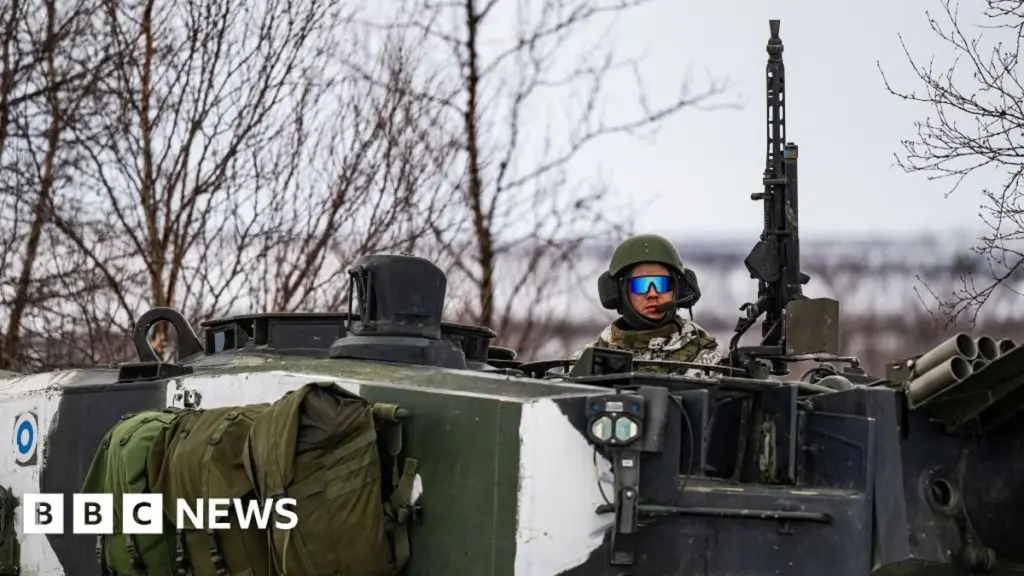
Finland is preparing to remove a long-standing prohibition against hosting nuclear weapons on its territory. This legislative adjustment, according to the Finnish government, aims to align the nation more comprehensively with NATO’s established deterrence policies. Defence Minister Antti Häkkänen stated that Finland’s and Europe’s security landscape has undergone a “fundamental and significant transformation” since Russia’s full-scale invasion of Ukraine commenced in 2022. Consequently, the Nordic nation transitioned from decades of military neutrality to join NATO in 2023, driven by escalating concerns over the threat posed by Russia.
Currently, Finland’s 1987 Nuclear Energy Act strictly forbids the import, manufacture, possession, and detonation of nuclear explosives within Finnish borders, even under wartime conditions. The proposed governmental amendment seeks to alter this by permitting “a nuclear weapon to be brought into Finland, or to transport, deliver, or possess one in Finland, if it is connected to the military defence of Finland,” as described by Minister Häkkänen. He emphasized the necessity of this change, explaining that it would “enable Finland’s military defense as part of the alliance and to take full advantage of NATO’s deterrence and collective defense.”
NATO’s Nuclear Deterrence Framework
The cornerstone of NATO’s strategy is collective defense, an agreement that an attack on any one member nation is considered an attack on all. This principle is intrinsically linked to the alliance’s nuclear deterrence posture. Given that several NATO members possess nuclear capabilities, any direct aggression against an ally introduces the potential for a reciprocal nuclear response. According to the Center for Arms Control and Non-proliferation, U.S. nuclear weapons are currently stationed in various European countries.
Legislative Process and Security Context
The Finnish government’s proposal necessitates amendments to both the nation’s Nuclear Energy Act and its criminal code. The governing right-wing coalition, which holds a parliamentary majority, has initiated a consultation period for the proposal, scheduled to conclude on April 2nd, before its formal submission. Finland shares an extensive 1,340-kilometer (832-mile) border with Russia, the longest among all European Union or NATO member states. Finnish leaders have consistently voiced concerns about the perceived deterioration of the country’s security environment following Russia’s actions in Ukraine.
Following its accession as the 31st NATO member in April 2023, a move widely viewed as a strategic setback for Russian President Vladimir Putin, who had long opposed the alliance’s eastward expansion, Finland’s neighbor Sweden also joined NATO in 2024. Since these enlargements, NATO has bolstered its military presence in the Arctic and Baltic Sea regions, and along its extended eastern flank. This proposed change in Finnish policy occurs within a broader context of European nations intensifying defense cooperation in response to the ongoing war in Ukraine and prevailing global instability.
Broader European Security Trends
The Finnish proposal emerges alongside a series of security-related developments across Europe. Last year, several NATO member states experienced disruptions to air traffic due to drone sightings over airports and airbases, incidents that some European officials attributed to Russian “hybrid warfare.” While Moscow denied direct involvement, these events reignited discussions regarding collective defense mechanisms. More recently, France and Germany announced plans to enhance their collaborative efforts on nuclear deterrence with other European partners. Swedish Prime Minister Ulf Kristersson indicated last week that his country’s traditional stance of not stationing foreign troops or nuclear weapons on its territory might not hold if Sweden faced a “completely different situation.”