
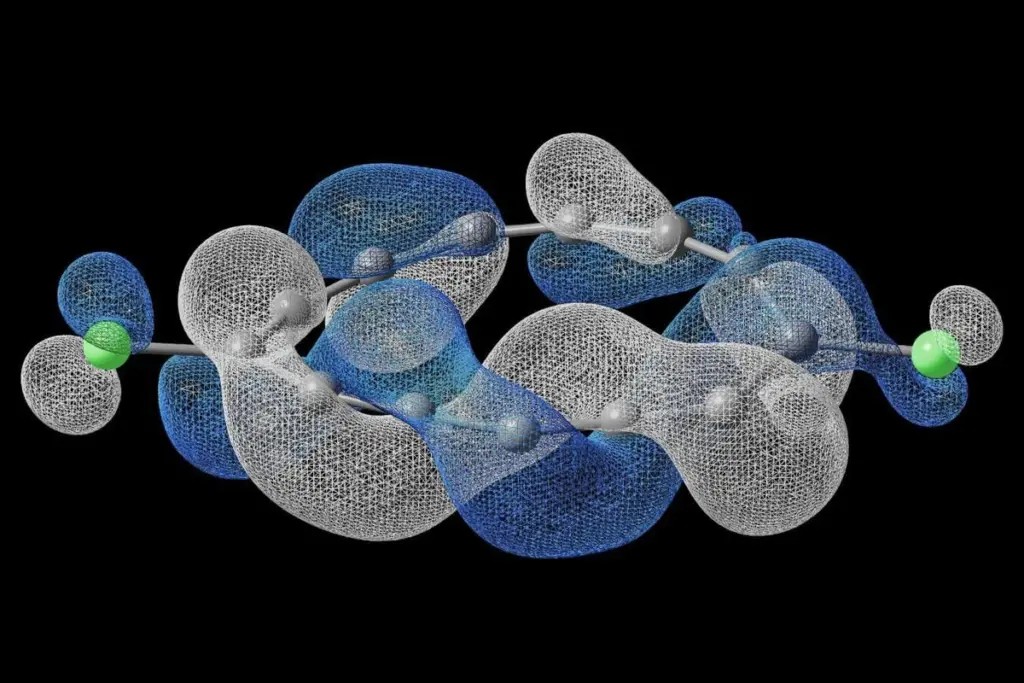
Chemists have identified a new molecular shape that presents a topological complexity twice that of the familiar Möbius strip. The Möbius strip, characterized by its single, twisted surface, requires an entity traversing its loop to complete two circuits before returning to its original position on the same side.
A team led by Igor Rončević at the University of Manchester in the UK has now synthesized a molecule exhibiting an even more peculiar, “half-Möbius” configuration. This experimental achievement represents a potential foundational step toward novel methods for engineering functional molecules by precisely controlling their three-dimensional arrangements, or topology.
“This molecule is very new and very unexpected,” Rončević stated. “The appeal is not just that we created a molecule with an unusual topology, but we also demonstrated that this topology is feasible, a possibility that had not been widely considered.”
Molecular Synthesis and Characterization
The researchers constructed this unique molecule using 13 carbon atoms and two chlorine atoms. These atoms were arranged into a ring-like structure on a thin gold substrate. The experiment was conducted at extremely low temperatures. To manipulate the atoms and analyze the electron properties, two specialized microscopes were employed: an atomic force microscope and a scanning tunneling microscope.
In this molecular class, electrons are not confined to individual atoms. Instead, they are delocalized, forming wave-like distributions across specific regions surrounding the atoms. These delocalized electrons dictated the molecule’s unprecedented twist.
If a theoretical quantum particle were to traverse the atomic path of this molecule, it would require four complete circuits of the ring before it could return to its starting point.
Controlling Molecular Topology
The team demonstrated the ability to actively alter the molecule’s twist. By applying a focused electromagnetic pulse, they could transition the molecular twist from a left-handed orientation to a right-handed one, or even remove the twist entirely. This capability allows for on-demand engineering of molecular topology, offering chemists a new avenue for molecular manipulation.
Quantum Computing’s Role in Understanding Novel Structures
To fully comprehend the structure of the new molecule and the principles governing its existence, the researchers utilized computational simulations. These simulations were performed on both a conventional computer and an IBM quantum computer. The complex interactions between electrons were identified as critical to the molecule’s novel twisting behavior. Simulating these interactions accurately with traditional computers presents significant challenges.
Rončević explained that quantum computers, inherently built upon interacting quantum systems, are better suited for these types of simulations, providing a higher degree of confidence in the results. This experiment highlights the practical applicability of quantum computers to real-world chemical problems, according to team member Ivano Tavernelli from IBM. Gemma Solomon of the University of Copenhagen noted this achievement as “remarkable across a number of dimensions: organic chemistry, surface science, nanoscience and quantum chemistry.” Kenichiro Itami of RIKEN described the study as a “technical tour de force,” praising its ability to vividly translate abstract topological concepts into molecular chemistry.
Potential Applications and Future Implications
Dongho Kim at Yonsei University, a researcher with prior work on Möbius-like molecules, pointed out the particular interest in the molecule’s ability to switch between conformations. This characteristic could pave the way for applications in sensor technology. For example, molecules could be designed to alter their state predictably in response to external stimuli like magnetic fields.
Journal reference: Science DOI: 10.1126/science.aea3321