
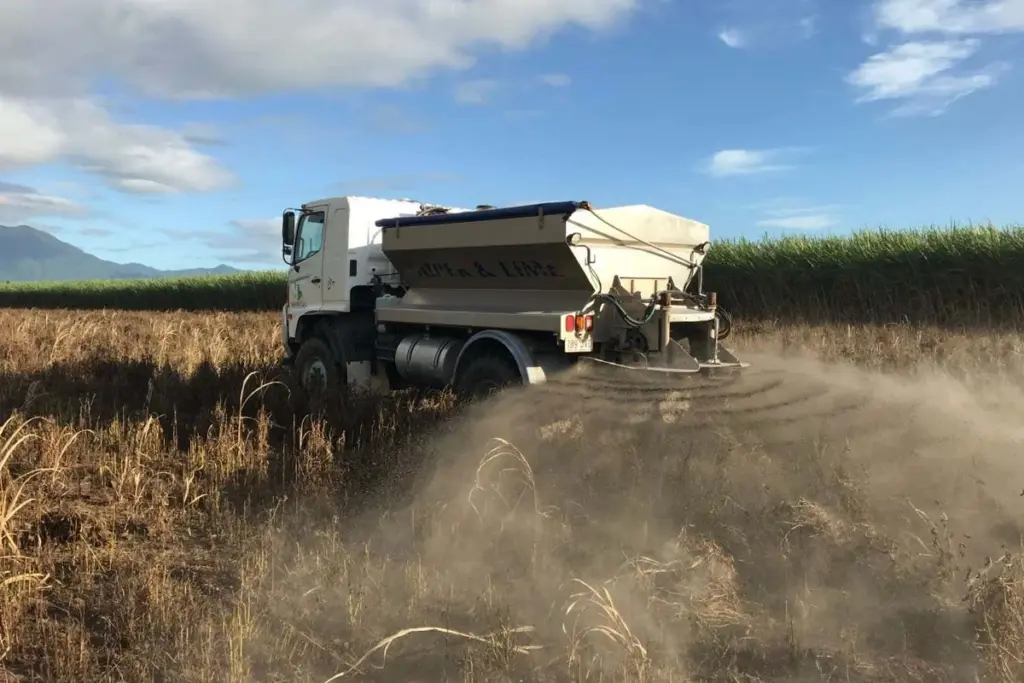
The prospect of spreading finely crushed silicate rocks, such as basalt, across agricultural fields offers a dual benefit: potentially removing substantial amounts of carbon dioxide from Earth’s atmosphere annually while simultaneously boosting crop yields. Recent analyses examining the global potential of this method suggest it could sequester up to 1.1 billion tonnes of CO2 each year. However, these optimistic figures are met with skepticism from some researchers who question their actual achievability.
This technique, known as enhanced rock weathering, essentially accelerates a natural geological process. Rainwater interacts with the rocks, speeding up their breakdown. Historically, over millions of years, this slow breakdown has played a crucial role in transferring atmospheric carbon dioxide to the oceans, contributing to planetary cooling during periods of extreme heat. Farmers, for centuries, have utilized a similar practice by spreading ground limestone on their fields to improve the nutrient uptake of crops.
“The primary advantage lies in addressing atmospheric CO2 through chemical reactions,” explained Chuan Liao from Cornell University in New York. “There are also secondary benefits, such as the addition of magnesium and calcium, which can supplement soil nutrients.”
With global greenhouse gas emissions continuing to rise, the United Nations climate body has emphasized the necessity of carbon removal strategies to limit global warming to 1.5°C above pre-industrial levels. Nations such as Brazil are already embracing enhanced rock weathering as a means to both reduce emissions and lower fertilizer costs. Last year, an Indian startup named Mati Carbon, focused on enhanced weathering, secured the top prize of $50 million in Elon Musk’s XPRIZE competition, recognizing its significant potential for large-scale carbon removal.
The process begins with atmospheric CO2 dissolving in rainwater, forming carbonic acid. This acid then reacts with silicate rocks, specifically the silicon dioxide and associated metals, effectively trapping the CO2 in the form of bicarbonate ions. These bicarbonate ions are subsequently washed into rivers and eventually reach the ocean. Once in the oceanic environment, the carbon can remain dissolved for millennia, or it can be incorporated into the calcium carbonate structures of marine organisms like clams, corals, and sea urchins. The act of crushing the rocks dramatically increases their surface area, making them more vulnerable to rainfall and thus enhancing the rate of CO2 removal.
Previous studies, based on estimations of how much rock could practically be applied to farmland, projected that enhanced rock weathering could achieve CO2 drawdown of up to 5 billion tonnes annually within this century. Liao and his team undertook a “reality check” of these projections. Their analysis incorporated factors such as the adoption rate of other agricultural innovations, like irrigation, and the varying efficiency of weathering processes across different geographical regions.
Their modeling explored scenarios encompassing both limited and widespread implementation of enhanced weathering. The findings indicated that the technique could achieve CO2 removal ranging from 350 million to 750 million tonnes per year by 2050. By 2100, these figures were projected to increase to between 700 million and 1.1 billion tonnes annually. For context, global fossil fuel CO2 emissions in 2025 were estimated to be around 38 billion tonnes.
Initially, Europe and North America were anticipated to be the leading regions for CO2 removal through this method. However, as supply chains for silicate rocks become more established and costs decline, Asia, Latin America, and sub-Saharan Africa are expected to surpass them. The higher temperatures and increased precipitation in these regions accelerate the weathering process, potentially enabling farmers there to generate more carbon-removal credits for each tonne of rock spread.
“For farmers in the Global South, the obstacles to adopting this practice will diminish significantly in the coming decades,” Liao commented.
However, a contrasting perspective comes from Marcus Schiedung at the Thünen Institute of Climate-Smart Agriculture in Germany. In a recent paper, he and his colleagues argue that such projections tend to overlook crucial uncertainties surrounding enhanced rock weathering. For instance, if rainfall is scarce and soil remains dry, the rate of carbon removal can be as much as 25 times slower. Schiedung suggests that the impressive estimate of 1.1 billion tonnes of carbon removal is likely an overstatement.
In soils with high pH levels, rainwater may preferentially weather existing carbonates in the ground rather than the crushed rock. These weathered carbonates eventually convert back to carbonates in the ocean, leading to the release of CO2 and negating any net carbon removal. Conversely, in low-pH soils, naturally occurring acids can react with the crushed rock, preventing carbon from being extracted from rainfall. As soil acidity decreases, there is a corresponding increase in CO2 emissions from microbial activity.
Furthermore, mining and transporting the necessary rock to farms could, in certain circumstances, result in higher carbon emissions than are actually removed, Schiedung noted. “I remain a skeptic,” he stated. “We must be certain that the CO2 is indeed taken up. Otherwise, we risk measuring carbon removal that is, in reality, being released elsewhere. Given the complexity of geochemical systems, this is a likely outcome.”
Concerns also exist regarding the potential introduction of toxins into the food supply as a consequence of enhanced rock weathering. Olivine, a rock type that forms the basis for Liao’s projections, contains heavy metals such as nickel and chromium. David Manning from Newcastle University in the UK pointed out that leftover rock material at most existing mines is often contaminated with metals. Consequently, countries might need to establish numerous new basalt quarries, a process that would demand considerable time and financial investment.
“Removing one gigatonne of CO2 per year necessitates 5 gigatonnes of rock annually, and this presents a significant hurdle, as the source of such vast quantities of rock is not clearly established,” Manning explained. “This represents a major impediment to scaling the process.”