
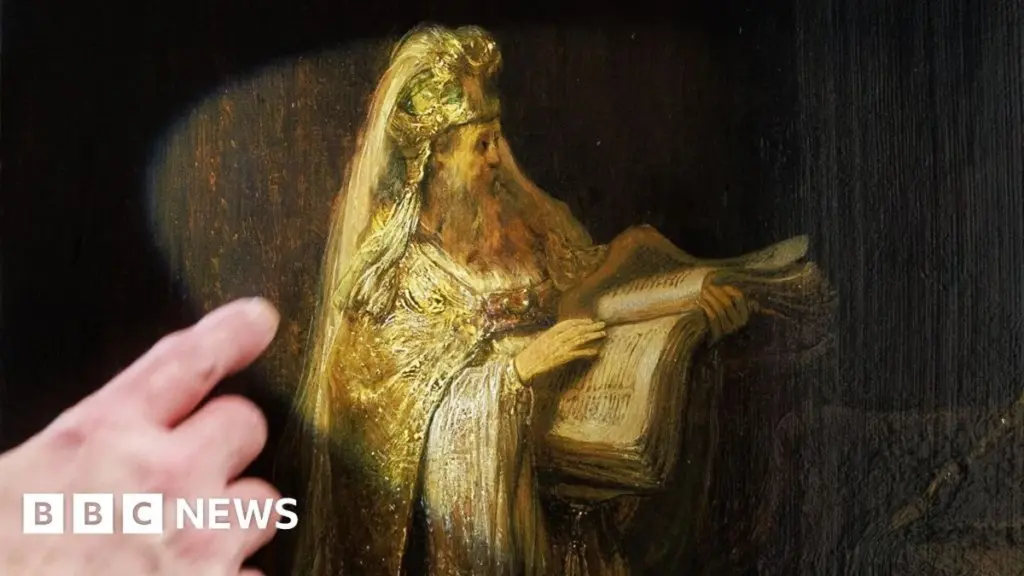
A significant painting by the Dutch master Rembrandt, lost to public view for over six decades, has recently been rediscovered and confirmed as authentic by art experts. The artwork’s whereabouts had remained unknown for decades after its disappearance from a private collection.
The painting, titled “The Vision of Zacharias in the Temple,” was created by Rembrandt in 1633. It was notably omitted from a comprehensive list of the artist’s works compiled in 1960. The piece subsequently vanished from public record after it was sold to a private collector the following year, marking the beginning of its long hiatus from the art world.
Its reappearance occurred when the current owners submitted the artwork for scientific examination at the Rijksmuseum in Amsterdam. This institution undertook a rigorous, two-year assessment to ascertain its provenance and authenticity.
Insights from the Rijksmuseum
Taco Dibbits, the director of the Rijksmuseum, shared his initial reaction upon seeing the restored painting. “When I saw it in our studio when it was restored, I was immediately struck by the incredible power it has,” he stated. Dibbits further explained that the museum frequently receives inquiries about paintings inherited or acquired by individuals. However, with this particular submission, there was an early indication that it might be something extraordinary. “It came to us via email and one of our curators thought, this is really an interesting image. We’ve known about the painting for over 100 years but we’ve never seen it.”
The museum’s confirmation of authenticity was based on a detailed analysis of the materials used. The investigation found that the pigments and paints employed were consistent with those Rembrandt utilized during that specific historical period. Furthermore, the painting technique and the layering of paint application were found to be comparable to his other early compositions.
Evidence of Authenticity
Researchers involved in the authentication process confirmed that the signature on the painting is original. They also verified that the wooden panel on which it is executed dates back to the correct period. The gallery issued a statement affirming, “Materials analysis, stylistic and thematic similarities, alterations made by Rembrandt, and the overall quality of the painting all support the conclusion that this painting is a genuine work.”
Dibbits noted that the painting exhibits all the characteristics of Rembrandt’s work from what he described as the “peak” of the early phase of his career. He elaborated on its quality, contrasting it with some of Rembrandt’s more prolific portrait works: “It’s very high quality. Sometimes with Rembrandt’s portraits you feel that he’s producing in quantity, but with this painting you really feel that he dedicated his soul to it.”
The Rijksmuseum plans to make the rediscovered painting available for public viewing starting on Wednesday.
Artistic Context and Innovation
Rembrandt was 27 years old when he completed this painting. It depicts a scene from the Bible where the High Priest Zacharias receives a divine message from the Archangel Gabriel, informing him that despite his and his wife’s advanced age, they will conceive a son who will become John the Baptist.
According to the museum, Rembrandt infused this biblical narrative with a novel approach. Rather than explicitly illustrating the Archangel Gabriel, he chose to subtly suggest the angel’s presence. This artistic decision marked a departure from established visual conventions for depicting such subjects, introducing a new method of representation.
The artist deliberately selected the critical moment just before Gabriel’s identity is fully revealed. This historical painting is among the few works of its genre that Rembrandt created during this particular period of his career. At the time, his primary focus was on portraiture, a practice that proved to be highly profitable.