
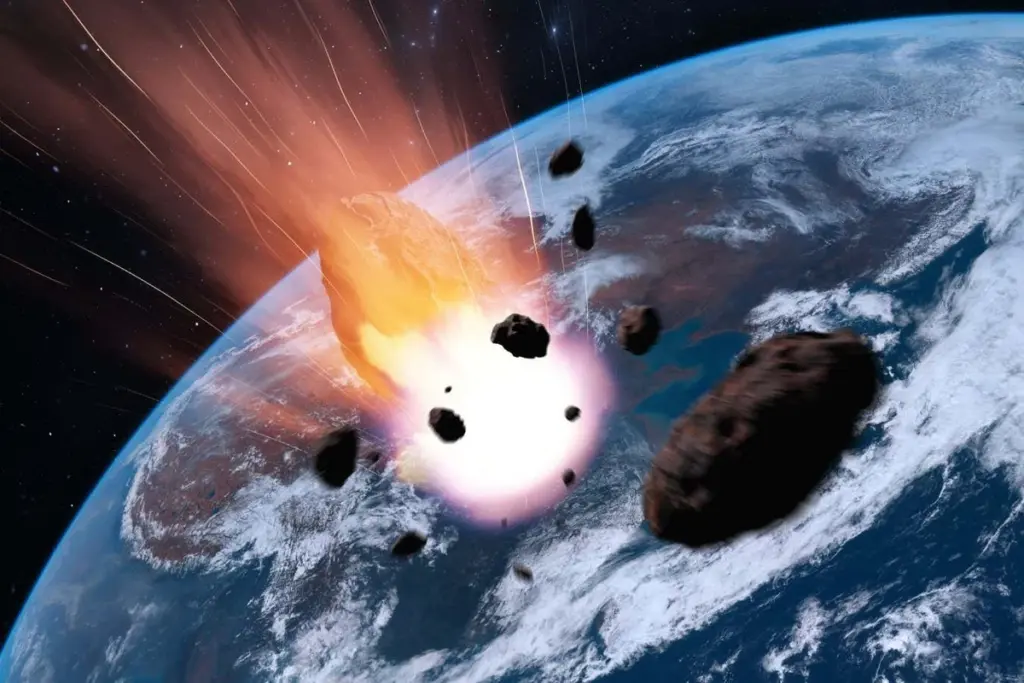
Deep within the vast emptiness of space travels a celestial body, a rocky mass posing a significant threat to life on Earth. The question arises: is this a predetermined fate? Can humanity devise a method to avert such a catastrophe, or will we ultimately share the extinction event that befell the dinosaurs?
The asteroid responsible for the dinosaur extinction 66 million years ago measured at least 10 kilometers in diameter. Such an impact would have triggered colossal tsunamis, ignited widespread forest fires, and plunged the planet into prolonged darkness. Scientific estimates, derived from the geological record of impact craters, suggest that Earth experiences collisions from asteroids of this magnitude approximately every 60 million years. For asteroids in the next size category, those around one kilometer in width, impacts are thought to occur roughly once every million years, with the most recent such event occurring approximately 900,000 years ago. These statistical probabilities are enough to provoke considerable concern.
However, a distinguishing characteristic of human civilization compared to the reptilian era is our capacity for observational astronomy and data interpretation. Consequently, researchers globally have leveraged this ability to assess the population of asteroids and identify those on potentially hazardous trajectories. Encouragingly, among the thousands of near-Earth objects (NEOs) currently under observation by astronomers, only about 35 have a greater than one-in-a-million probability of impacting Earth within the next century. Furthermore, the likelihood of any of these impacting is exceedingly small, and most measure less than 100 meters across. Therefore, the probability of an apocalyptic asteroid strike during our lifetimes is highly improbable.
Nevertheless, astute readers will recognize the embedded qualifications: “of the asteroids we’re tracking,” “small chances,” “nearly,” and “almost.” These subtleties suggest that a complete sense of relief may be premature. This caution stems from the inherent uncertainty in detecting every single asteroid. This uncertainty is periodically highlighted by sensationalized headlines announcing an imminent Earthbound asteroid, though these are typically near misses that pass without incident.
To estimate the proportion of asteroids that have been identified, astronomers employ three key metrics: the number of detected asteroids, the volume of celestial space surveyed, and the observational power of their telescopes. Based on these parameters, it is calculated that all asteroids measuring 10 kilometers or larger, posing a significant threat, have been accounted for. This allows for a degree of reassurance, making a repeat of the dinosaur extinction event due to such a large impact deeply unlikely. Regarding asteroids approximately 1 kilometer in diameter, around 80 percent have been detected, diminishing the possibility of unexpected arrivals. Smaller objects, less than 100 meters, present a negligible risk; they would likely disintegrate in the atmosphere or cause limited damage upon impact, similar to the 2013 Chelyabinsk event. The 100-meter “city-killer” class poses a greater concern, as less than half of potentially hazardous objects in this size range have been identified and are therefore the most concerning targets for surveillance.
Fortunately, another human capability sets us apart from the dinosaurs: our advancements in space technology. The primary protective measure involves space-based telescopes diligently monitoring for any celestial bodies on a collision course with Earth. While various telescopes contribute to this surveillance during their regular observational duties, a dedicated mission named NEO Surveyor is scheduled for launch next year. This specialized instrument is expected to significantly enhance our ability to track a greater number of asteroids.
A secondary protective strategy arises from our capacity for space exploration. In the event that an impactful object is detected, spacefaring technology offers viable solutions. NASA’s Double Asteroid Redirect Test (DART) conducted in 2022 successfully demonstrated the feasibility of altering an asteroid’s trajectory. By impacting a target asteroid, the mission proved that it is possible to nudge such cosmic bodies off course. If an asteroid is detected with ample warning – typically at least a couple of years – its path can be adjusted to ensure a safe passage past Earth.
If an asteroid were to approach Earth, is disaster preventable?
From the threat of nuclear conflicts to the concept of colossal impact deflection systems, this section delves into mechanisms designed to avert celestial collisions. It also presents scenarios for readers to test their decision-making capabilities in preventing catastrophic events.
Should preventative measures fail and an asteroid impact Earth, it would constitute a natural disaster, albeit one that could be anticipated. There is a high probability that such an impact would occur in the ocean or in an uninhabited region. Statistics from the World Economic Forum indicate that less than 15 percent of the Earth’s land surface, and even less of its total surface area, has been significantly altered or permanently settled by human activity. If an asteroid were projected to strike one of the few populated areas, response strategies would align with those for any major natural disaster: evacuation, mitigation efforts, or seeking shelter. Enhancing our general disaster preparedness capabilities would serve to address this potential eventuality, while also improving our response to numerous other natural disasters that are both more frequent and less predictable.
Returning to the initial questions, the inevitability of an asteroid impact is certain. However, the existence of a potential solution is highly probable. Whether humanity will ultimately face extinction similar to the dinosaurs is a consideration for the very distant future, if at all. Anxiety over such an event has no bearing on its outcome. Instead of succumbing to worry, focusing on improving our general preparedness for natural disasters is a more constructive approach, while entrusting the vital task of celestial surveillance to astronomers.