
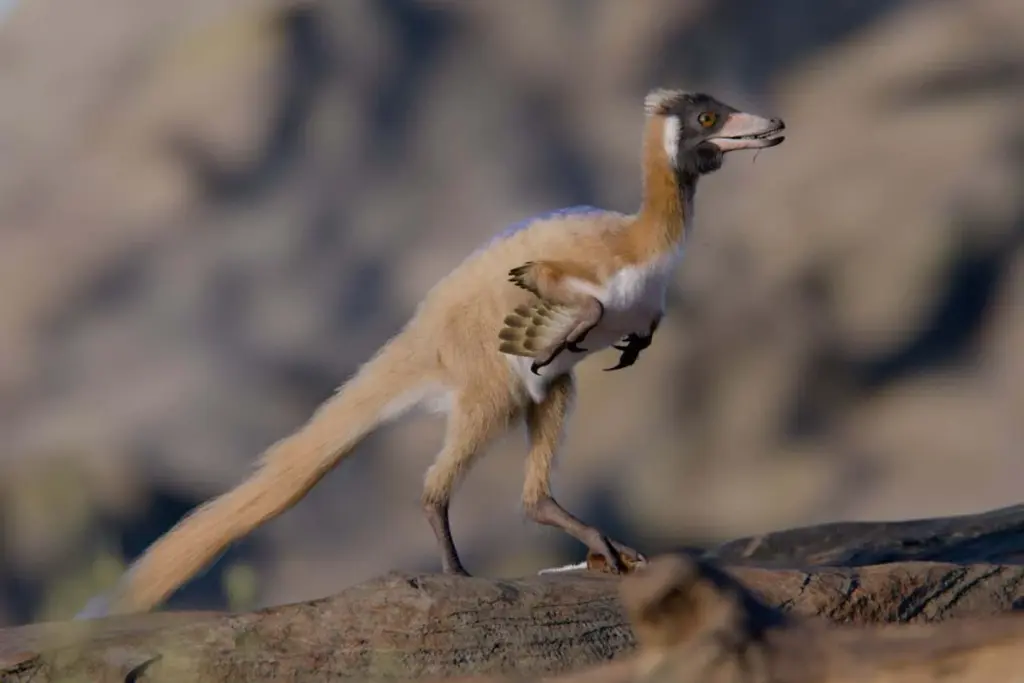
A nearly complete skeleton of a dinosaur, weighing less than a common chicken, has recently offered fresh perspectives on the evolutionary path of alvarezsaurs. This group represents some of the smallest dinosaurs known to have existed.
The fossilized remains of Alnashetri cerropoliciensis were unearthed in 2014 at the La Buitrera site, situated in northern Patagonia, Argentina. Dating back approximately 95 million years, this discovery marks a significant find.
The initial discovery related to Alnashetri, made in 2012, comprised only an incomplete set of hindlimb bones. According to Peter Makovicky from the University of Minnesota, who was involved in the study of the new fossil, the fragmentary nature of the earlier find meant that definitive classification beyond “likely an alvarezsaur” was not possible. He noted the uncertainty regarding whether the specimen was juvenile or fully grown.
The availability of an entire skeleton has dramatically altered the understanding of this species. “With a whole skeleton, we suddenly had all the information to understand how Alnashetri was similar or differed from other species, and a key to understanding how the unusual anatomy of alvarezsaurs evolved,” Makovicky stated. This comprehensive specimen provided the necessary details to unravel evolutionary relationships.
This newly discovered fossil exhibits remarkably long and slender hind limbs. It also possesses surprisingly elongated forelimbs, which still retain three well-developed fingers. An in-depth analysis of the fossilized bones confirmed that the dinosaur had reached adulthood, likely at least four years old. Its estimated weight when alive was a mere 700 grams, making it “truly tiny, smaller than a chicken,” as described by Makovicky.
Historically, alvarezsaurs were sometimes considered early avian ancestors. However, current understanding clarifies that, despite potential superficial resemblances to birds, Alnashetri and all alvarezsaurs are indeed non-avian theropods. “The new discovery certainly underscores this,” Makovicky remarked, reinforcing the classification.
Previous hypotheses suggested that all the diminutive alvarezsaurs possessed notably short, robust forelimbs characterized by a large thumb and reduced side digits, alongside tiny teeth. Paleontologists theorized that these anatomical traits evolved in conjunction with their shrinking body size, as their diet was believed to consist solely of ants and termites. However, Alnashetri challenges this established pattern. “But Alnashetri does not fit that mould – it is among the smaller alvarezsaurs, but neither its teeth nor its forelimbs are reduced, because it represents a much earlier branch on the alvarezsaur evolutionary tree,” Makovicky explained.
In reality, its forearms more closely resemble those of other theropods, indicating it was not a specialized ant-eater. “Alnashetri is tiny but is otherwise built like a more typical theropod – given its small size, it probably ate its fair share of invertebrates, but probably had a wider range of prey,” he added. This suggests a more varied diet than previously assumed for such small dinosaurs.
Consequently, paleontologists are still working to fully comprehend the reasons behind the miniaturization of these dinosaurs. “We’re left with only a vaguer sense that alvarezsaurs were successful at occupying the niches of very small predators,” Makovicky concluded, highlighting the ongoing mystery surrounding their evolutionary trajectory toward smaller body sizes.