
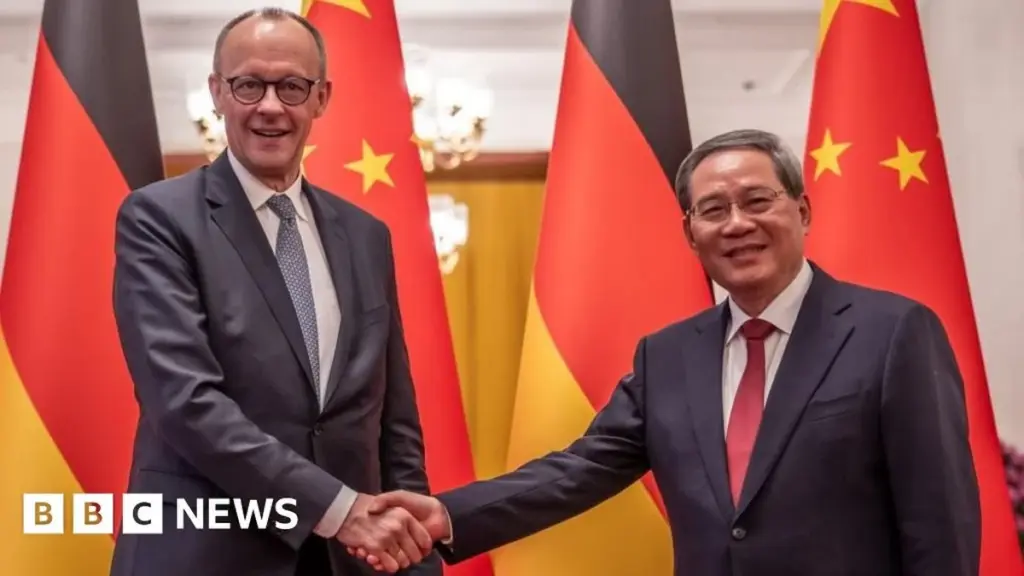
The German chancellor has arrived in Beijing for his inaugural journey to China. This visit comes as German businesses express significant concern over a widening trade deficit with the Asian nation.
Last year, imports into Germany from China were more than double the value of goods exported back to China. This stark imbalance was highlighted by federal statistics, prompting calls for a more equitable economic relationship.
“We seek a partnership with China that is balanced, reliable, regulated, and fair,” stated Friedrich Merz prior to his departure for Beijing. He is also anticipated to engage China on leveraging its influence with Moscow to facilitate an end to the conflict in Ukraine. The substantial trade gap, however, casts a long shadow over these discussions, especially given the significant business delegation accompanying the chancellor.
The Deepening Trade Deficit
Behind the headline of the visit lies a deeply concerning imbalance for Germany, the European Union’s largest economy. In 2025, goods valued at €170.6 billion (£148.8 billion; $200.9 billion) entered Germany from China. This represented an annual increase of 8.8%. Conversely, German exports to China saw a decline of 9.7%, falling to €81.3 billion.
This situation is actively “eroding the core of German industry, particularly in the automotive, machinery, and chemical sectors,” according to Jürgen Matthes of the German Economic Institute (IW). Matthes, who heads the IW’s International Economic Policy division, attributes these distortions primarily to “massive” state subsidies provided by China and its currency’s under-valuation.
“Chinese price advantages cannot solely stem from greater innovation and efficiency,” he communicated. Beijing, in its past responses to allegations of currency manipulation, has stated its commitment to a free-floating exchange rate system, guided by market forces but subject to management when necessary. Furthermore, China insists that its subsidy policies are transparent and fully compliant with international trade regulations.
The “China Shock” Effect
The escalating trade deficit, which is impacting the entire EU, is increasingly being referred to as the latest “China shock.” This trend has been partly exacerbated by the global disruptions caused by the pandemic and Russia’s full-scale invasion of Ukraine, which led to increased production costs within Europe, as noted by Bruegel, an economic think tank based in Brussels.
“During the same period, China entered an extended deflationary period,” the think tank observed, “resulting from over-investment in manufacturing, which has created the overcapacity we are now witnessing.” Consequently, European leaders are grappling with strategies to counteract the economic impact of inexpensive Chinese goods. This challenge arises at a time when the continent has already faced significant economic turbulence due to the tariff policies implemented by former U.S. President Donald Trump.
“No one in Europe desires a two-front trade war with the world’s two superpowers,” commented Noah Barkin, a visiting senior fellow at the German Marshall Fund. Barkin, who also serves as a senior adviser at the Rhodium Group, suggests that Europe does possess leverage, noting that “China needs markets to sell its products. It faces a significant issue with overcapacity.”
German Industry’s Concerns
The influx of these goods is generating considerable anxiety within Germany. Historically a powerhouse of the European economy, Germany has experienced several years of economic stagnation. Its once dominant automotive industry, for example, is currently undergoing a challenging transition to electric vehicles, a sector where China holds a leading position, leading to job losses.
German business associations are urging Chancellor Merz to convey a firm message during his first official trip to China. The Federation of German Industries has indicated that the chancellor must address issues such as “distortions” in fair competition and export restrictions on crucial rare earth elements. Similarly, the German Engineering Federation has called for Europe to take action to “restore fair competitive conditions” if necessary.
Merz’s underlying free-trade principles, aligned with the transatlantic approach, are reportedly at odds with the current global economic landscape. “France supports a protectionist agenda, while Germany is more hesitant,” observed Barkin from the German Marshall Fund. The European Union has initiated numerous anti-dumping proceedings against China and is exploring proposals to bolster domestic production and reduce foreign dependencies.
“I believe the Commission faces difficulties with traditional trade defense mechanisms like tariffs,” Barkin added. “Unlike the United States, which can employ tariffs much more flexibly.” For Berlin, this complex situation represents another strategic setback for its long-standing policy of fostering “change through trade” with countries such as China and Russia. Former Chancellor Angela Merkel frequently faced criticism for prioritizing economic ties with Beijing over human rights concerns.
Navigating De-Risking and Decoupling
The deep interdependencies and economic ties established over years are not easily dismantled. Prior to boarding his flight on Tuesday night, Chancellor Merz stated that Germany would persist with its broader de-risking strategy, but cautioned that “it would be a mistake for us to attempt to decouple ourselves from China.”