
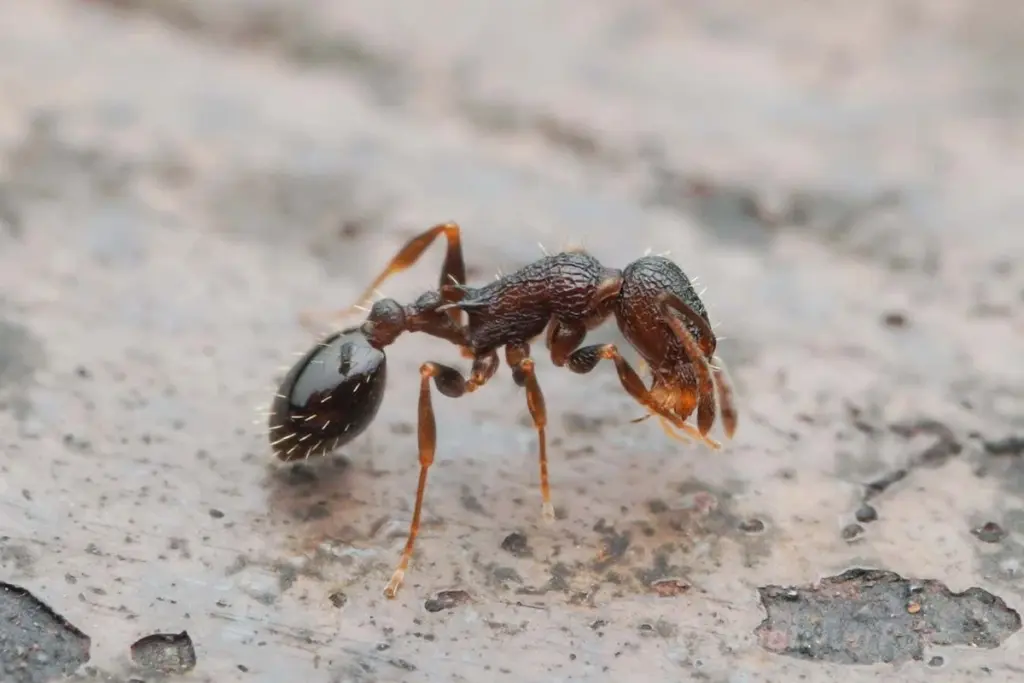
A parasitic ant species native to Japan has been identified as the first of its kind to completely abandon the typical division of labor, producing neither males nor female workers. Instead, every individual within this species develops into a queen, actively seeking to usurp the nests of other ant species.
Traditional ant colonies are structured around a central queen, her female worker offspring, and short-lived males whose sole purpose is reproduction before they perish.
Parasitic Ant’s Unique Reproductive Strategy
For over four decades, scientists have theorized that the unusually rare parasitic ant, Temnothorax kinomurai, might exclusively produce queens. However, concrete evidence supporting this hypothesis remained elusive until recent investigations.
Young queens of this parasitic species employ a distinct strategy to establish themselves: they infiltrate the nests of a closely related species, Temnothorax makora. Upon arrival, they eliminate the resident host queen and several workers through stinging. Subsequently, these invading queens reproduce asexually. This process, known as parthenogenesis, results in the creation of cloned offspring. While parthenogenesis is uncommon among ants, it is observed more frequently in certain other insect groups.
Remarkably, the existing workers of the T. makora species are manipulated into nurturing the developing T. kinomurai queens, effectively assisting in their own colony’s demise.
Laboratory Confirmation of Queen-Only Reproduction
Jürgen Heinze, a researcher at the University of Regensburg in Germany, along with his team, conducted experiments using artificial nest boxes. They collected six colonies inhabited by T. kinomurai queens and maintained them under laboratory conditions. During this period, they successfully bred and raised 43 queen offspring from these colonies.
Detailed examination of the reproductive organs of these offspring confirmed the absence of any male individuals. The reproductive output was exclusively female queens.
Successful ‘Coups’ and Further Asexual Reproduction
These 43 queens were then presented with opportunities to seize control of T. makora colonies. Out of these attempts, seven queens managed to survive the takeover and achieve their objective. These successful usurpers then proceeded to produce an additional 57 offspring, all of which were again confirmed to be exclusively female queens.
Heinze noted that this peculiar social organization represents an entirely novel form of social structure, adding a significant new dimension to the understood complexity of ant societies. He described it as an exciting development in the study of these insects.
Risks and Advantages of the Parasitic Strategy
The act of invading established colonies of other species is inherently fraught with danger, a fact underscored by the high rate of failure observed among the queens in this particular study. However, when an entire generation consists solely of queens, the potential for establishing new reproductive ventures increases considerably.
Heinze explained that if parthenogenesis arises through random mutation, as is believed to be the case with T. kinomurai, a queen can potentially produce 100 daughters. Crucially, these daughters do not require mating to reproduce, thereby creating 100 individuals with the potential to found new colonies. He asserted that the likelihood of success for these parthenogenetic queens is inherently higher than for their sexually reproducing counterparts.
According to Heinze, this species could be viewed as representing an advanced stage in the evolution of social parasitism. It notably highlights the remarkable adaptability found in the life cycles of social insects.