
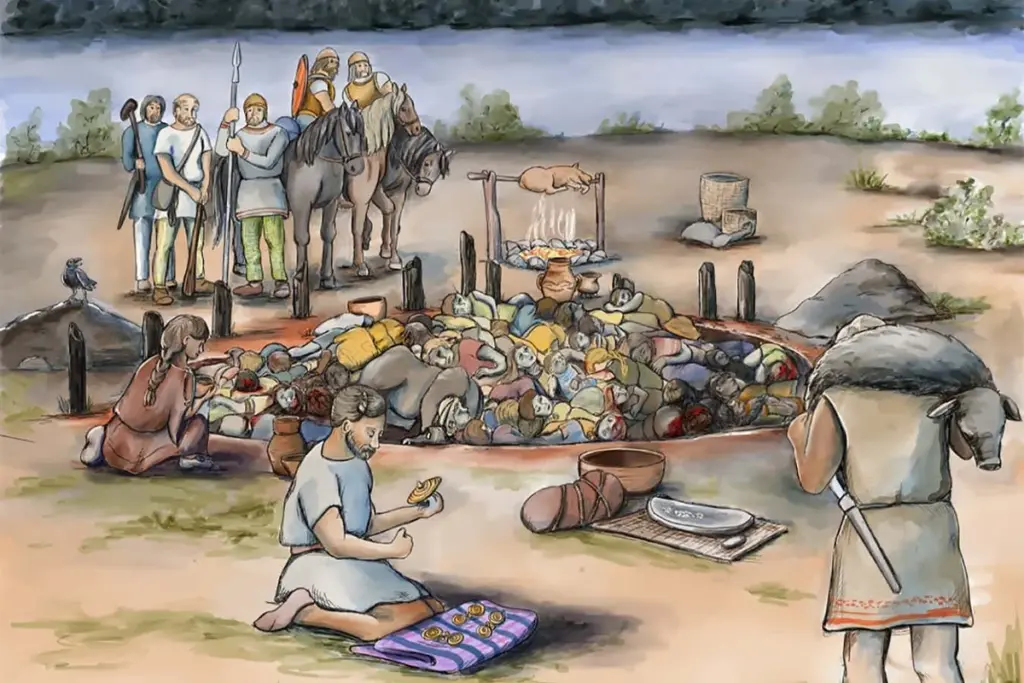
Evidence from a large prehistoric burial site in Europe indicates that women and children may have been intentionally targeted in one of the earliest discovered mass killings. The remains of 77 individuals, found together in a single grave and dating back over 2800 years, show signs of violent deaths, suggesting a deliberate act.
This mass grave was unearthed at Gomolava, an early Iron Age settlement located in the Carpathian Basin, which is present-day Serbia. The site itself is an artificial mound, known as a tell, created by centuries of human habitation dating back to the late 6th millennium BC. This accumulation includes remnants of mud-brick structures, pottery, and organic materials. Researchers are now examining the skeletal remains stored at the Museum of Vojvodina in Novi Sad, Serbia, employing DNA and isotope analysis to reconstruct the events leading to the burial.
Skeletal Analysis Reveals Violent Fatalities
Among the 77 individuals interred, a significant majority – 51 – were children and adolescents. Of the 72 individuals for whom biological sex could be determined, 51 were female. A previous analysis in 1976 had attributed the deaths to a pandemic. However, a more recent skeletal examination revealed unhealed injuries consistent with violent trauma, evidence of defensive wounds, and damage from projectiles.
Linda Fibiger from the University of Edinburgh, a lead researcher in the study, commented on the nature of the injuries. “A lot of the injuries are to the head and most seem to be close-contact injuries,” she explained. “The size of the injuries speaks of uninhibited force, so intentional killing, not accidental killing. I think it was quite a brutal event.”
Unrelated Individuals with Divergent Childhoods
The team’s investigation involved analyzing DNA from 25 individuals and examining the ratios of strontium, oxygen, and carbon isotopes in the dental enamel of 24 people. These isotopic analyses provide insights into the environmental conditions experienced during their childhoods. The findings revealed that most of the sampled individuals were not closely related and had diverse dietary backgrounds during their early lives.
Barry Molloy of University College Dublin noted the lack of close kinship, stating, “Most weren’t even related going back 12 generations.” He posits that these individuals were likely part of a broader societal group that shared common cultural practices, but did not necessarily form partnerships within their immediate communities.
Context of Conflict and Social Dynamics
The massacre occurred in the 9th century BC, a period marked by the arrival of mobile pastoralists from the Eurasian steppe who utilized the lands seasonally, crossing the Carpathian mountains. Concurrently, local populations were re-establishing themselves at older tell sites, constructing fortified settlements, and cultivating the surrounding land, according to Molloy. This situation created a clash between different land-use strategies.
“You’ve got these two conflicting ways of using landscape,” Molloy stated, suggesting that territorial disputes may have ignited conflicts between groups and led to displacement.
The pattern of victims, primarily women and children, deviates from typical interpretations of warfare. “That it was women and children suggests to us that something quite different was happening here from our usual reading of violent warfare. It’s normally focused on the battlefield,” Molloy observed. He proposes that the perpetrators might have targeted these individuals to signify a strong message to neighboring communities, aiming to quell any resistance and assert dominance over the territory. Alternatively, the younger children may have been intended for enslavement, with their killing serving as a deterrent.
Complex Burial Practices and Interpretations
Pere Gelabert from the University of Vienna acknowledged the difficulty in definitively interpreting the massacre. “The Iron Age was a period of extreme instability across Europe, a period of multiple armed conflicts, or wars as we would call them nowadays,” he commented. He suggested that the mass burial could have stemmed from a ritualistic killing targeting women and children specifically, or it might be that only these individuals perished because the men were absent at the time.
However, the context becomes more intricate with the discovery of personal belongings buried alongside the bodies. These included bronze jewelry and ceramic vessels used for drinking and food storage. Animal remains, such as a butchered calf, were also interred with the human victims. Additionally, stone tools for grinding grain and burnt seeds were found placed on the grave. “It’s the entire food cycle, all deposited alongside them,” Molloy remarked.
These arrangements suggest a deliberate and symbolic burial ritual. Molloy proposed that the perpetrators of the violence and those who conducted the funeral rites might have been distinct groups.
Journal reference: Nature Human Behaviour DOI: 10.1038/s41562-025-02399-9