
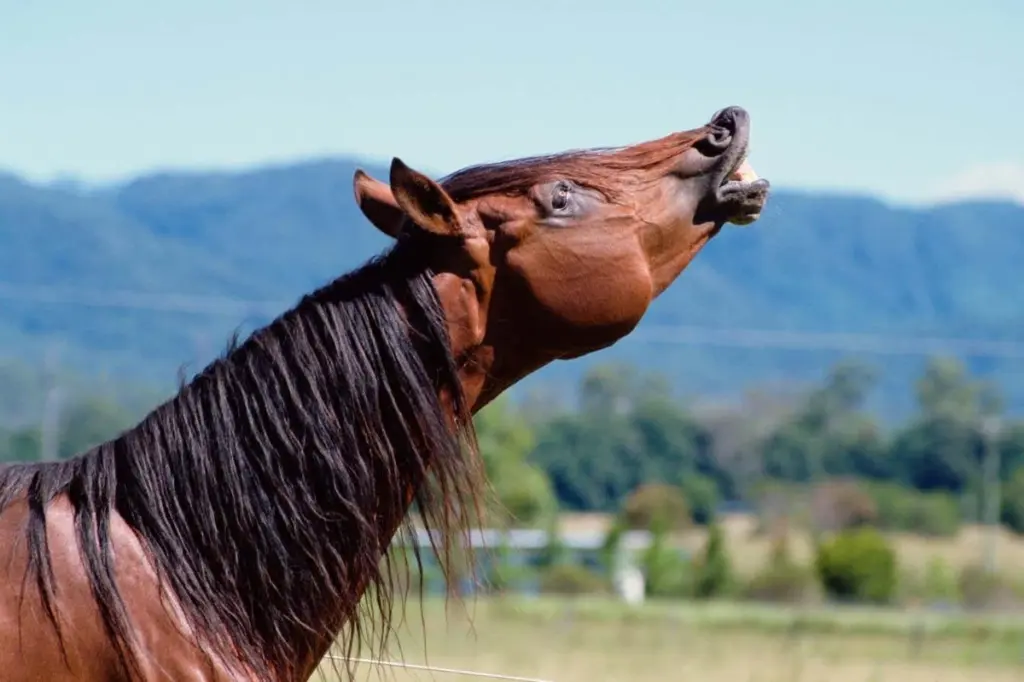
A horse’s whinny is a complex vocalization, possessing a unique ability among animals to produce two distinct sounds concurrently. This characteristic sound combines a low-pitched noise, akin to a cow’s moo, with a high-pitched whistle originating from the horse’s throat.
For a considerable time, it has been understood that a horse’s whinny comprises two frequency components: a lower frequency, typically around 200 hertz, and a higher frequency, exceeding 1000 hertz. This phenomenon is scientifically recognized as biphonation. The lower-frequency element finds a straightforward explanation in the vibrations of the laryngeal vocal folds, a mechanism similar to that used in human speech or singing.
However, the production of the high-frequency sound, especially for an animal of a horse’s size, has remained an enigma. “Despite humans and horses sharing a close relationship and co-evolving for approximately 4000 years, our understanding of their communication remains incomplete,” stated Tecumseh Fitch from the University of Vienna, Austria.
To address this puzzle, Fitch and his research team embarked on a series of investigations. They conducted various tests, utilized imaging scans, and performed experiments on horse larynges that were sourced from a horse meat supplier.
“Initially, when we passed air through these larynges, only the low-frequency component was produced,” Fitch explained. “However, with some adjustments and manipulation, we succeeded in generating the high-frequency component as well.”
This crucial finding demonstrated that both sound components are generated within the larynx itself. This stands in contrast to human whistling, which is achieved through the manipulation of the lips.
To further substantiate the whistling mechanism, the researchers introduced two gases of differing densities – air and helium – through the larynges. By comparing the auditory outcomes when using these gases, the team could ascertain whether the high-frequency sound was a result of whistling or vibrations within the laryngeal tissues.
“The low-frequency component is created by the vibration of the vocal folds, much like human singing or a cow’s moo. This component did not change when we switched between gases,” Fitch noted. “Conversely, the high-frequency component shifted significantly to a higher pitch when helium was used, precisely as would be expected for whistles.”
Subsequent endoscopic examinations of live horses revealed that at the commencement of a whinny, specific muscles surrounding the larynx contract. This muscular action leads to a constriction of the glottis, the vital area of the larynx containing the vocal folds. Such constriction causes the vocal folds to tilt and increases the resistance within the airway. This physical alteration forces air through a narrow, slit-like opening at a high velocity.
While mice and rats are also capable of producing laryngeal whistles, the frequencies they generate are typically too high for human auditory perception.
“Horses are unique among mammals for their ability to utilize the larynx to produce two simultaneous frequencies, one of which is a whistle. In fact, besides humans, they represent the only large mammal that incorporates whistles into its standard vocal repertoire,” Fitch elaborated.
“This represents the first robust experimental evidence detailing the aerodynamic production of a laryngeal whistle in any animal outside the rodent family,” commented Ben Jancovich from the University of New South Wales in Sydney, Australia.
Fitch and his collaborators propose that the high-frequency whistle might serve to enhance the noticeability of the whinny and potentially aid in its transmission over greater distances. However, these specific hypotheses have yet to undergo empirical testing.