
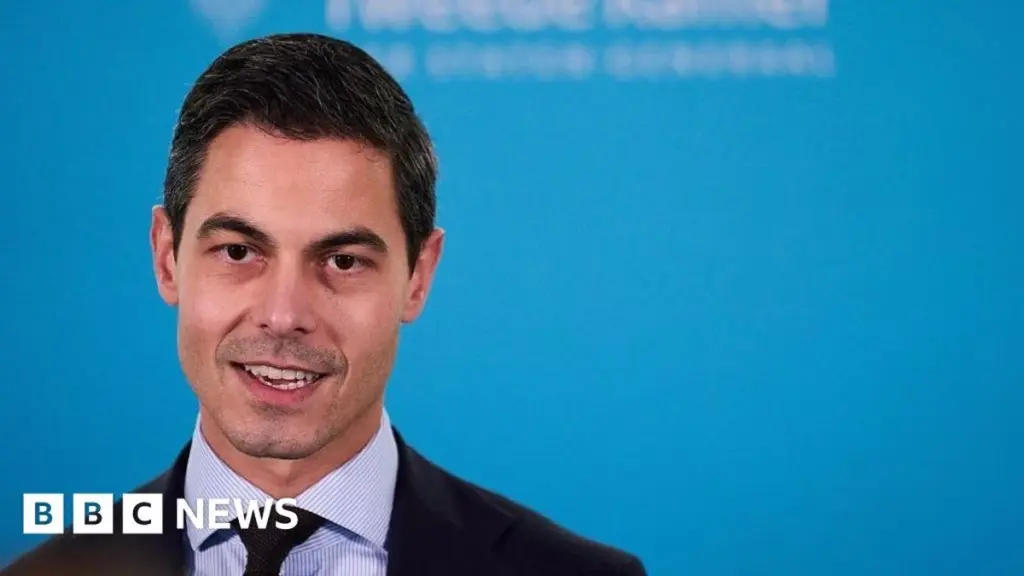
Rob Jetten has made history in the Netherlands, assuming the role of the nation’s youngest prime minister and the first to openly identify as gay. His minority government officially commenced its term following a swearing-in ceremony.
At 38 years old, Jetten led his Democrats 66 (D66) party to victory in the general election held in October. The election was exceptionally close, with D66 narrowly defeating the anti-Islam populist Geert Wilders.
Jetten subsequently established a center-right minority government, a coalition formed with the People’s Party for Freedom and Democracy (VVD) and the Christian Democratic Appeal (CDA). This configuration means that significant reforms outlined in the coalition agreement—ranging from an additional €19 billion allocated to defense to necessary reductions in healthcare and benefits—will require individual parliamentary approval in both houses of the Dutch legislature.
A key plank of the coalition’s agenda involves reducing the number of asylum seekers. Their proposal stipulates that refugees seeking asylum must do so from outside of Europe, rather than upon their arrival in the country.
The issue of asylum migration has been a particularly contentious point in Dutch political discourse, directly contributing to the collapse of the two preceding coalition governments.
Within the new administration, D66 is set to provide seven ministers, while VVD will contribute six and CDA five. Each party will also appoint three state secretaries, who serve as junior cabinet members.
The formal confirmation of Jetten’s appointment was conducted by King Willem-Alexander at Huis ten Bosch Palace in The Hague on Monday.
Ahead of his swearing-in, Jetten shared a selfie on X, expressing his pride in undertaking this role collaboratively. He noted the commencement of a new phase marked by significant responsibility and a commitment to serving all citizens of the Netherlands. His message emphasized a forward-looking approach, focused on improvement rather than dwelling on existing problems, a stance he believes requires both courage and cooperation.
Transition to Public Service
Jetten, previously known for a somewhat scripted public persona, has dedicated years to shedding the moniker “Robot Jetten,” a nickname acquired from his perceived stiffness and over-rehearsed television appearances. The contrast was palpable on election night. Addressing supporters in a crowded music venue in Leiden, he appeared remarkably composed, confident, and polished, while the audience erupted in cheers.
For many individuals interviewed by BBC News at the event, the D66 leader represented a stark alternative to Wilders. He was perceived as younger, optimistic, supportive of the European Union, and socially liberal—a fresh face presented against an older, hard-right political establishment.
Standing alongside the King on the palace steps, Jetten presented the image of a carefully prepared and capable leader. Following his official swearing-in, he posted the ceremonial photograph on Instagram with a concise caption: “Let’s get to work.”
Geert Wilders, who dissolved his own right-wing coalition in June, has indicated his intent to oppose any legislative proposals put forth by Jetten’s government. Meanwhile, other political parties have registered reservations regarding the policy plans presented thus far.