
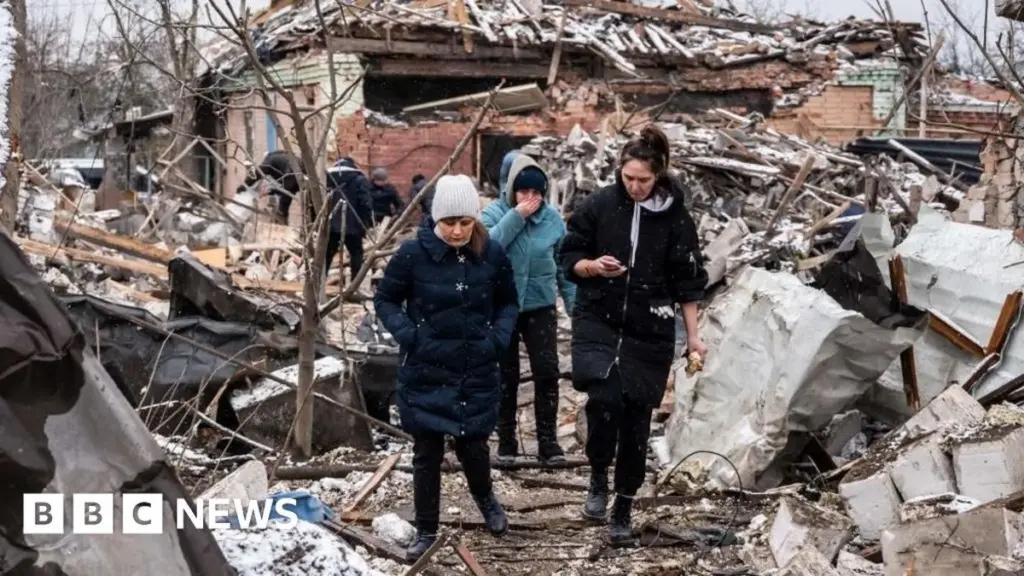
When Russian President Vladimir Putin initiated the deployment of up to 200,000 soldiers into Ukraine, his objective was swift: a rapid advance into the capital, Kyiv, within days. The underlying aim was to dismantle the nation’s pro-Western administration and reintegrate Ukraine into Russia’s sphere of influence. This initial strategic goal, however, proved elusive. Four years later, a substantial portion of Ukrainian territory remains under Russian control.
During this period, then-US President Donald Trump actively advocated for a peace settlement. Despite a scheduled meeting with Putin in Alaska in August and multiple negotiation sessions involving both Ukrainian and Russian delegations, these efforts failed to produce any significant breakthroughs. Moscow continues to insist on Ukraine ceding sovereign territory, a condition that Kyiv finds entirely unacceptable.
The Genesis of the 2022 Invasion
Launching what was then the largest military operation in Europe since the conclusion of World War II, Putin delivered a forceful televised address. In it, he articulated his objectives as the “demilitarisation and denazification” of Ukraine. This narrative has been a recurring theme, with Russia frequently portraying contemporary Ukraine as a Nazi state, a stance widely regarded as a gross distortion of historical facts.
Prior to this, eight years earlier, Putin had already facilitated the annexation of Ukraine’s Crimean peninsula. This followed a popular revolution that led to the ousting of Ukraine’s pro-Russian president and his replacement with an administration more aligned with Western interests. Subsequently, Putin instigated a protracted, lower-intensity conflict in Ukraine’s eastern Donbas region. Pro-Russian proxy forces occupied territory, establishing breakaway rebel states with substantial backing from Moscow.
The scale of the 2022 invasion, however, represented a significant escalation. Immediately before initiating the full-scale offensive, Putin formally recognized the self-proclaimed rebel states as independent entities. As the invasion commenced, he publicly stated that the populations within these territories, many of whom are Russian speakers, required protection from the Kyiv “regime.”
A day into the operation, Putin directly addressed Ukraine’s military, urging them to “take power into your own hands” and target the “gangs of drug addicts and neo-Nazis” allegedly running the government. He later appended another stated objective: ensuring Ukraine’s neutrality. Putin accused the Western defensive alliance, NATO, of attempting to establish a presence within Ukraine, thereby positioning its forces closer to Russia’s borders.
The Russian leader has a history of questioning Ukraine’s legitimacy as a sovereign nation. He has frequently asserted that “modern Ukraine was entirely created by Russia” following the Bolshevik Revolution in 1917. In a lengthy essay published in 2021, he even posited that “Russians and Ukrainians were one people” with historical roots tracing back to the late 9th Century. More recently, in 2024, he reiterated to US talk show host Tucker Carlson that Ukraine was an “artificial state.”
These pronouncements have led many to conclude that a primary objective of the invasion was, in essence, the dissolution of the Ukrainian state itself. Russia’s state-run RIA Novosti news agency explicitly stated that “denazification is inevitably also de-Ukrainisation,” seemingly linking the objective of dismantling Ukraine to the stated goal of denazification.
It is important to note that Ukrainian culture and identity have, in fact, existed independently of Russia for centuries.
The Fate of President Zelensky
Putin has long harbored a desire to remove Ukraine’s democratically elected, pro-Western President, Volodymyr Zelensky. Zelensky was reportedly a direct target from the outset of the war. According to claims by Zelensky’s advisor, Russian forces executed two attempts to storm the presidential compound shortly after the invasion began, with the Ukrainian leader stating that the objective was his assassination.
“The enemy has designated me as target number one; my family is target number two,” Zelensky stated publicly.
Later, Zelensky revealed that Putin’s initial strategy involved replacing him with Viktor Medvedchuk, a wealthy businessman and the head of a pro-Russian party. Medvedchuk faced treason charges in Ukraine and subsequently relocated to Russia. Even at the present time, Putin has not engaged in peace negotiations with Zelensky. His officials have characterized the Ukrainian leader as a “loser” and a “clown.” Putin has also publicly questioned President Zelensky’s “legitimacy,” a narrative that has been echoed by former US President Donald Trump.
As justification for these claims, Putin points to the postponement of Ukraine’s scheduled March 2024 presidential election. However, it is precisely due to Russia’s ongoing war that Ukraine is currently under martial law, a condition that constitutionally prohibits elections. Conversely, Putin’s own re-election in 2024 has faced questions regarding its fairness, given that prominent Russian opposition figures are either in exile or have died.
The Role of NATO Expansion
For years, Putin has voiced strong objections to NATO’s eastward expansion, viewing it as a significant security threat. He has consistently characterized any possibility of Ukraine joining the alliance as a critical “red line.” Prior to Russia’s 2022 invasion, Putin formally demanded that NATO withdraw multinational military deployments from Central and Eastern European nations that had joined the Western alliance after 1997.
However, it was Russia that initiated military actions in Eastern Europe, first by invading Georgia in 2008 and subsequently annexing Crimea in 2014. Following the annexation of Crimea, NATO established a permanent military presence on its eastern flank, positioned closest to Russia. NATO has consistently emphasized that the alliance’s fundamental purpose is the defense of member territories, explicitly stating that it harbors “no aggressive intentions.” Sweden and Finland, for instance, joined NATO in the preceding two years primarily in response to the perceived Russian threat.
Ukraine’s constitution includes provisions for joining both the European Union and NATO. Nevertheless, at the time the full-scale invasion commenced, there was no immediate or realistic prospect of Ukraine achieving NATO membership. President Zelensky himself acknowledged this two weeks into the conflict, stating, “NATO is not prepared to accept Ukraine.” He has since indicated a willingness to consider resigning in exchange for NATO membership. Conversely, Donald Trump has publicly advised Kyiv to “forget about” joining the Western alliance.
Putin has accused NATO of complicity in the conflict, citing the increasing provision of military hardware by member states to Ukraine. This includes tanks, fighter jets, air defense systems, missile systems, artillery, and drones. While NATO has provided security assistance and training to Ukraine, the alliance maintains that these actions do not render it a direct participant in the war.
Putin’s specific grievances concerning NATO appear to date back to 1990, when he asserts that the West made assurances against expanding “an inch to the East.” This claim, however, was made before the dissolution of the Soviet Union and was based on informal understandings with then-Soviet President Mikhail Gorbachev. Gorbachev himself has stated that “the topic of NATO expansion was never discussed” at that time.
Potential Avenues for Conflict Resolution
The most probable pathway towards resolving the conflict lies in direct diplomatic negotiations. Nevertheless, previous rounds of talks between the involved parties yielded minimal progress concerning a ceasefire. In August, President Putin received an invitation to a summit in Alaska with the US President. This meeting, however, did not result in any discernible progress toward a peace accord, and the conflict persisted.
Further American-mediated discussions involving Russian and Ukrainian delegations, including two rounds of trilateral talks in early 2026, also failed to bridge the significant divide between Moscow’s demands and the compromises Kyiv was prepared to consider. The Kremlin has also dismissed Donald Trump’s persistent calls for a Putin-Zelensky meeting, arguing that the necessary conditions for such a dialogue were not yet in place.
Russia has expressed a desire for direct talks to address the “root causes of the conflict.” This phrase echoes Putin’s “maximalist” demands articulated at the outset of the war in March 2022. These initial demands included Ukraine adopting a neutral status, significantly curtailing its military capabilities, and relinquishing its aspirations for NATO membership.
Furthermore, Russia seeks international acknowledgment of its territorial acquisitions within Ukraine as part of any future agreement. This specifically pertains to the annexation of Crimea and four eastern regions. Putin also insists on the immediate scheduling of presidential and parliamentary elections.
Kyiv, however, maintains that it will never recognize its sovereign territory as belonging to Russia, even if it acknowledges that these areas may be temporarily lost. Ukraine also seeks robust Western security guarantees to ensure that Russia does not re-initiate an invasion of its territory.
Assessing Blame and Historical Narratives
In the initial months of his presidency, and prior to his return to the White House, Donald Trump suggested that Ukraine’s president bore responsibility for the war with Russia. “Zelensky should never have let the war start; that war’s a loser,” Trump stated in October 2024.
In reality, the conflict commenced in 2014 with Russia’s seizure of Crimea and the subsequent occupation of parts of eastern Ukraine by Russian proxies. At that time, Volodymyr Zelensky had not yet entered political life. Putin then ordered Russia’s full-scale invasion eight years later, following months of meticulous planning and denials of any such intentions.
However, the public messaging from the former US president has not been entirely consistent. At various points, his stance appeared to harden against Russia. “We thought we had [the war] settled numerous times, and then President Putin goes out and starts launching rockets into some city like Kyiv and kills a lot of people,” he remarked last month.
Trump announced the imposition of secondary tariffs on countries trading with Russia. Ultimately, a 25% secondary tariff was applied only to India’s exports to the US as a penalty for purchasing Russian oil, though these were later rescinded as part of a trade agreement. Later in 2025, he implemented direct sanctions on Rosneft and Lukoil, two major Russian oil companies, following the stalemate in peace talks.
Examining Claims of Nazism and Genocide
At the commencement of the 2022 invasion, Putin declared his intention to shield individuals in occupied areas of eastern Ukraine from eight years of Ukrainian “bullying and genocide” that occurred during the conflict in the east. Between 2014 and 2022, over 14,000 individuals perished on both sides of the front lines. However, Russian assertions of Ukrainian Nazis perpetrating genocide in the occupied regions lacked substantiation, and no international body has recognized such claims. The German Chancellor described the allegation as “ridiculous.”
The Russian characterizations of Kyiv being controlled by Nazis are also inaccurate. Modern Ukraine does not have far-right parties represented in its parliament, as they failed to secure sufficient votes in the 2019 elections. Importantly, President Zelensky is Jewish, and many of his relatives were victims of Nazi atrocities during World War II. Putin’s condemnation of Zelensky as a “disgrace to the Jewish people” is directly contradicted by the US Holocaust Memorial Museum, which rejects his claims, stating that he has “misrepresented and misappropriated Holocaust history.”
In 2024, Putin himself faced accusations of war crimes from the International Criminal Court, allegations that have been refuted by the Kremlin.
Timeline of Russian Aggression
Russia’s efforts to prevent Ukraine from exiting its sphere of influence date back several years. The initial invasion commenced in 2014, following the ousting of pro-Russian President Viktor Yanukovych after months of widespread protests. Yanukovych had rescinded an EU association agreement under pressure from Putin, sparking demonstrations that concluded with dozens of protesters being fatally shot by snipers. Yanukovych subsequently fled to Russia.
Putin swiftly moved to seize Ukraine’s Crimean peninsula. Concurrently, pro-Russian forces took up arms against the government, occupying portions of the eastern Luhansk and Donetsk regions. Two attempts were made to de-escalate the conflict, but both proved unsuccessful.
These efforts were known as the Minsk agreements, brokered by France, Germany, and Russia itself. While they temporarily reduced the intensity of the violence, President Zelensky has described them as a “trap” that perpetuated a frozen conflict on Russia’s terms. Both sides accused the other of violating the agreements. The Kremlin later suggested that the failed accords were a precursor to Moscow’s full-scale invasion.
The Ukrainian leader has cautioned the Trump administration against trusting Putin, stating, “He broke the ceasefire; he killed our people.”
Assessing the Current Military Situation
After more than three years of coordinated offensives and counter-offensives, Russian and Ukrainian forces are engaged in a war of attrition along an active front line exceeding 1,000 kilometers (approximately 629 miles). Neither side currently possesses a realistic prospect of achieving outright victory. Russia is attempting to secure additional territorial gains during a summer offensive.
Russia formally annexed four regions in eastern and southern Ukraine following staged referendums in 2022. However, it can realistically claim full control of only one of these regions, Luhansk. In 2022, Ukrainian forces successfully liberated substantial areas in the north and parts of the south. More recent counter-offensives, however, have not yielded comparable successes.
Ukrainian forces remain active in a very small section of Russia’s Kursk region after launching an offensive there in August 2024. Despite this, they have lost control of all major settlements in the area. Ukrainian troops have also ceded ground in the east. A significant portion of Russia’s military effort has been concentrated on the Donetsk region, where towns and villages are being systematically destroyed in a slow and grinding advance.
The protracted conflict is imposing a severe strain on Russia’s economy, characterized by high interest rates and inflation. Defense spending this year is projected to constitute at least 33% of the federal budget. Ukraine has suffered significant losses to its economic wealth due to Russian occupation and destruction, particularly in its industrial east. Economic growth has been further hampered by attacks on its energy infrastructure.
Despite facing high inflation and interest rates, Ukraine has secured substantial financial aid from Western partners to address its budget deficit.
Human Cost of the Conflict
Tens of thousands of individuals have lost their lives since President Putin initiated the deployment of troops in 2022. Ukraine’s President has reported approximately 55,000 Ukrainian military fatalities. However, the open-source analysis website ualosses.org estimates that this number exceeds 92,000.
According to United Nations figures, more than 14,500 civilians have been killed in Ukraine. The UN also indicates that the actual death toll is likely considerably higher. The year 2025 was recorded as the deadliest for civilians since the conflict began in 2022.
Russia rarely discloses its military losses. However, BBC analysis estimates that Russian fatalities could range between 243,000 and 352,000. The war has compelled over six million Ukrainians to seek refuge abroad. An additional 3.7 million have been internally displaced within Ukraine, according to UN data.
At the onset of the invasion, Putin refrained from referring to the events as a “war,” instead labeling it a “special military operation.” By 2024, he acknowledged it as a war but attributed its instigation to Kyiv or its “Western handlers.”
Historical Interconnections Between Ukraine and Russia
President Putin appears to believe that Ukraine should remain within Russia’s sphere of influence due to the deep historical connections between the two nations. From 1922 to 1991, Ukraine was an integral part of the Soviet Union. Many Ukrainians speak Russian, particularly in the eastern regions, including President Volodymyr Zelensky, who is a native Russian speaker.
Many Russians view Crimea as historically their own. It was annexed by Catherine the Great in 1783 and later transferred to Ukraine by Soviet leader Nikita Khrushchev in 1954. Ten years prior to that transfer, Khrushchev’s predecessor, Joseph Stalin, had forcibly deported Crimea’s Tatar population, leading to an ethnic Russian majority on the peninsula.
Since 1991, Ukraine has existed as an independent state. In 1994, it relinquished its nuclear arsenal in exchange for security assurances from Russia, the United Kingdom, and the United States – assurances that Moscow subsequently failed to uphold. In the aftermath of the war, a significant number of Ukrainians have distanced themselves from the Russian language. President Zelensky himself now avoids using it in public appearances.