
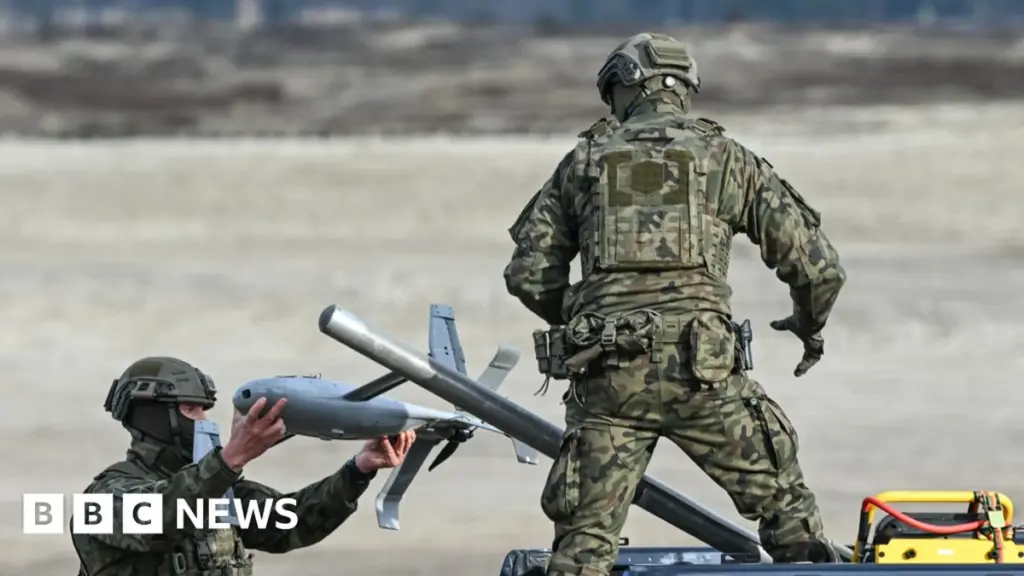
Great Britain will collaborate with the European Union’s four largest military powers on the development of novel air defence weaponry. This initiative aims to strengthen ties with the European defence industry.
Manufacturers based in the United Kingdom, Germany, France, Italy, and Poland are expected to present proposals for the creation of cost-effective missiles and autonomous drones. The participating nations are committed to a swift development process for these collaborative projects.
The undertaking draws inspiration from Ukraine’s successful deployment of inexpensive drones to counter Russian aerial assaults. This strategic shift in defence capabilities has proven vital in the ongoing conflict.
According to the UK’s Ministry of Defence (MoD), the program will concentrate on producing a “lightweight, affordable” surface-to-air weapon system. The initial project is slated for delivery by the end of next year.
This accord, announced during a gathering of the five nations’ defence ministers in Krakow, Poland, represents a significant advancement for UK-European defence relations. It follows the collapse of discussions last year regarding the UK’s involvement in the EU’s substantial €150 billion (£130 billion) defence fund.
Had the earlier negotiations succeeded, British defence firms would have secured greater opportunities to participate in joint ventures financed by the EU fund. However, the talks faltered after the UK declined to meet the EU’s demand for a multi-billion euro entry fee.
Funding and Strategic Alignment
While specific financial allocations for this new drone defence plan have not been publicly disclosed, Defence Minister Luke Pollard indicated to journalists in Poland that each participating country is making a commitment worth “millions of pounds, millions of euros” to the scheme.
The MoD has highlighted Ukraine as a key source of inspiration, noting the rapid establishment of a substantial domestic drone manufacturing sector since Russia’s full-scale invasion commenced four years prior. The widespread use of low-cost drones has become instrumental in defending the nation against attacks, which often involve hundreds of drones, rendering traditional missile defence systems increasingly impractical and expensive.
Re-evaluating the Economics of Warfare
“To effectively counter relatively low-cost missiles, drones, and other threats we face, it is essential that we align the cost of defence with the cost of the threat,” stated Pollard following the meeting.
He further explained that this drone defence initiative, agreed upon on Friday, is anticipated to be the first of several ventures by the group of five allies, known as the E5. These initiatives aim to fundamentally alter the “economics of warfare” in response to the persistent threat from Russia.
The MoD has yet to release a detailed blueprint for accelerating drone development. However, it has pledged to enhance cooperation with smaller technology firms and to simplify the operational requirements for participation in these collaborative projects.
Europe currently faces considerable pressure to augment its defence spending. This is a direct consequence of the war in Ukraine and growing uncertainties regarding the steadfastness of the United States as a NATO ally.
The E5 group, which convened its inaugural meeting in autumn 2024 following Donald Trump’s re-election, has now met on seven occasions. It has emerged as a significant platform for fostering European defence cooperation outside the more extensive frameworks of the European Union.
Enhancing the utilization of autonomous drones, capable of independently identifying targets through artificial intelligence without direct human control, was a central element of a comprehensive review of UK military capabilities. This review was revealed in the summer of last year.
During that review, the MoD committed to introducing “more permissive” regulations for such autonomous systems. This action signals a potential departure from the previous stance, which emphasized the necessity of “context-appropriate human involvement” in weapons deployment.