
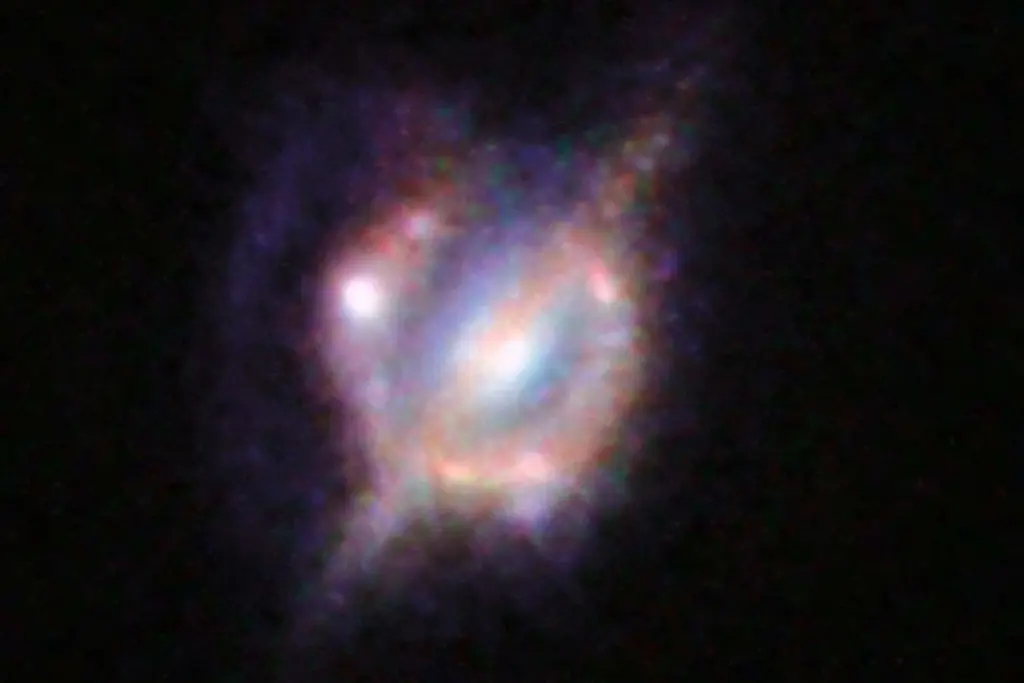
Astronomers have detected a powerful, laser-like beam of microwaves originating from the collision of two galaxies. This phenomenon represents the brightest and most distant example of its kind ever observed.
The process that creates a laser involves preparing atoms. These atoms must first be moved into an unstable, higher-energy state. Subsequently, particles of light, known as photons, are directed at these prepared atoms. This interaction prompts the atoms to return to a more stable state, releasing their own photons. This release triggers a chain reaction, generating a multitude of additional photons.
Because each atom releases identical photons, all the light produced shares the same frequency. This coherence results in a focused beam of light.
Galactic Collisions and Maser Formation
A similar mechanism can occur when galaxies collide. The interaction compresses gas from both galaxies, leading to the formation of more stars and, consequently, more light. After this light navigates through clouds of dust, it can energize hydroxyl ions—molecules composed of hydrogen and oxygen atoms—pushing them into elevated energy states.
When these energized ions are bombarded by radio waves, potentially originating from a supermassive black hole, they can rapidly transition back to a lower energy state. This transition results in the emission of an intensely bright and focused beam of microwave radiation, a phenomenon known as a maser.
Discovery of the Brightest and Most Distant Maser
A team led by Roger Deane at the University of Pretoria in South Africa has identified a maser in the galaxy H1429-0028, located nearly 8 billion light-years from Earth. This detected maser is the brightest and most remote one found to date. The light emanating from H1429-0028 appears magnified due to gravitational lensing, an effect caused by a large galaxy situated between it and Earth that acts like a cosmic magnifying glass.
Deane and his colleagues utilized the MeerKAT telescope in South Africa for this discovery. This instrument comprises 64 interconnected radio telescopes functioning as a single, large dish. They were initially searching for galaxies rich in molecular hydrogen, which emits light at a specific frequency. However, upon directing MeerKAT towards H1429-0028, they observed a strong emission at a higher frequency, a signature indicative of powerful masers.
“We performed a quick check at the 1667 megahertz [frequency] just to see if it was detectable, and there was this enormous, booming [signal]. It was immediately a record,” Deane commented. He described the finding as a matter of serendipity.
Potential for “Gigamasers” and Future Observations
The observed light beam from H1429-0028 is so intense that the maser might necessitate its own classification, potentially termed a “gigamaser.” This designation would distinguish it from the “megamasers” previously observed in galaxies closer to Earth, indicating a significantly greater power output.
“This is about 100,000 times the luminosity of a star, but in a distant galaxy, concentrated into a very, very small part of the [electromagnetic] spectrum,” Deane explained.
Matt Jarvis of the University of Oxford anticipates that similar masers will be detectable at much greater distances once the Square Kilometre Array (SKA) in South Africa becomes fully operational. The SKA, a far larger and more sensitive instrument than MeerKAT, is expected to come online in the coming years.
According to Jarvis, these extremely distant galactic masers will originate from some of the universe’s earliest formed galaxies. They could provide precise insights into galaxy merging processes billions of years ago. He elaborated, “[Masers] require very specific conditions. You need this radio continuum emission and you need this infrared emission, which you primarily get from dust heated around forming stars. To achieve these very particular physical conditions necessary for the maser to form in the first place, you need merging galaxies.”