
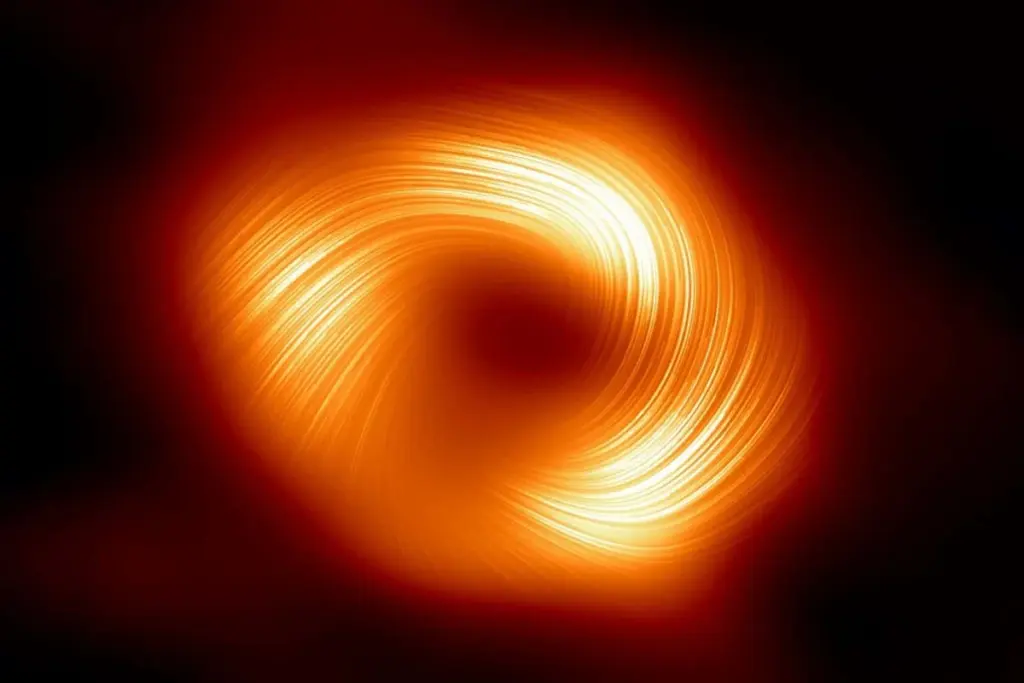
At the heart of our Milky Way galaxy resides Sagittarius A*, a supermassive black hole. However, a recent proposal from a research team suggests a radical alternative: this object, along with other similarly sized galactic centers, might actually be dense accumulations of dark matter.
Dark matter, so named because it exhibits gravitational interaction but seemingly none with light or ordinary matter, constitutes approximately 85 percent of the universe’s total matter. Despite its prevalence, our knowledge about it remains limited. We understand that most galaxies are enclosed within a halo of this substance, inferred from observations of galactic rotation patterns. The precise nature of dark matter remains unknown, particularly its behavior at galactic cores. “We know it has to be at the outskirts of galaxies, but we don’t know what happens at the very centre,” notes Valentina Crespi from the National University of La Plata (UNLP) in Argentina.
Crespi and her colleagues developed a model of a galactic core composed of dark matter in the form of extremely low-mass particles known as fermions. Their findings indicate that such fermionic dark matter could coalesce into a mass and density so substantial that, when viewed from a distance, it would appear remarkably similar to a supermassive black hole.
Carlos Argüelles, also from UNLP and part of the research team, explained the visual resemblence. “From Earth, you would see something very similar to what you would see in the black hole scenario – but if we went in a ship towards the centre, we could go through with no problem. You will not die by being eaten by the black hole; you will go through peacefully.”
Since direct exploration through the galactic center is currently unfeasible, the team’s model relies heavily on analyzing the orbital paths of stars and gas clouds in proximity to Sagittarius A*. The model also aligns with measurements of the entire galaxy’s rotation and the 2022 image of Sagittarius A* captured by the Event Horizon Telescope (EHT). This EHT image displays a luminous ring of superheated matter surrounding the central object, which the researchers suggest could also be a consequence of the gravitational influence exerted by a dark matter core.
Despite the alignment of this dark matter hypothesis with existing observations, its definitive truth remains unconfirmed. Gaston Giribet of New York University expressed a common perspective: “Based on the fact that it is a simpler answer that fits the evidence, I personally believe that the celestial body at the center of our galaxy is very likely a black hole. However… all possibilities must be analysed, and this is certainly an interesting one.”
One significant question arises concerning the model’s fidelity at extremely close proximity to the event horizon. While the dark matter core model appears consistent with the orbits of objects several light-hours away from the inferred event horizon, its accuracy “at the very doorstep of the event horizon” is uncertain, according to Shep Doeleman of Harvard University, the EHT project’s founding director. He points out that the observed spiral pattern of magnetic fields in that region seems particularly consistent with the properties of a black hole.
Another challenge lies in the theoretical mass limit for fermionic dark matter clumps. These structures, according to current models, could not exceed approximately 10 million solar masses. While this limit might initially seem to support the idea, suggesting these clumps could form and then collapse into black holes and thereby explain the origin of supermassive black holes, it presents a complication when considering other galactic objects. The EHT image of M87*, a black hole with an estimated 6.5 billion solar masses, appears remarkably similar to Sagittarius A*. This similarity makes it difficult to accept that Sagittarius A* would be a dark matter clump with a significantly smaller mass limit.
The researchers acknowledge that their dark matter core hypothesis is not necessarily more probable than the black hole explanation, and may indeed be less likely. “Nowadays, with the instruments available, it is not yet possible to 100 per cent discriminate if it’s indeed dark matter or not,” stated Crespi. To achieve such certainty, Argüelles explained, would require imaging at resolutions far exceeding even future generations of the EHT, potentially taking decades or longer.
However, if Sagittarius A* were confirmed to be dark matter, the implications would be profound. A core of fermionic dark matter would challenge the prevailing standard model of cosmology, which currently favors candidates that are heavier and move more slowly. Such a discovery would not only reshape our understanding of galactic centers and black holes but could fundamentally alter our comprehension of the entire universe.