
Mounting evidence suggests that Elon Musk’s decision to revoke Russian forces’ access to his Starlink satellite internet service has significantly hampered Moscow’s offensive capabilities. This move has reportedly caused confusion among Russian soldiers and provided a critical advantage to Ukraine’s defenders.
The full extent of this change, which took effect at the beginning of February, is still being assessed. However, initial reports indicate a noticeable decrease in Russian assaults and drone activity in certain sectors of the front, particularly east of Zaporizhzhia. A Ukrainian drone operator, known as Giovanni, stated that the loss of Starlink has diminished the Russian military’s ability to control the battlefield, estimating a potential 50% reduction in their offensive capacity.
This development followed a request from Ukraine’s Defence Minister, Mykhailo Fedorov, to SpaceX. The request came as reports surfaced of Russian forces utilizing Starlink terminals, some attached to drones, to conduct increasingly precise attacks using real-time video guidance. SpaceX’s satellite communication system had been a vital tool for both armies throughout the conflict. It is widely believed that a notable Russian strike on a passenger train in the Kharkiv region involved a drone equipped with a Starlink terminal.
Shift in Access and Exploitation by Ukrainian Activists
As of February 1st, SpaceX deactivated all Starlink terminals in Ukraine unless they were on a “white list” approved by Kyiv. Private users were required to re-register their devices with personal identification numbers to regain service. This situation was exploited by Ukrainian online activists from the volunteer group InformNapalm. They successfully conducted a phishing operation, tricking Russian soldiers into revealing details about their Starlink terminals.
Mykhailo Makaruk, a spokesperson for InformNapalm, explained that their group directed interested individuals to closed chat groups to maintain an element of secrecy. Through this effort, they managed to identify 2,425 Starlink terminals spanning from Crimea to Gomel in eastern Belarus. Some Russian soldiers, believing they were nearing reconnection, were deceived into making online payments totaling $5,000.
Once the locations of terminals near the front lines were pinpointed, many became targets for Ukrainian artillery and drone strikes. Amid reports of Russian soldiers attempting to bribe Ukrainian collaborators for terminal registration, InformNapalm identified approximately 30 individuals willing to share their data. Ukraine’s Security Service (SBU) announced it was actively countering Russian attempts to recruit Ukrainian citizens for the illegal registration of Starlink systems. The SBU issued a stern warning to all Ukrainians to remain vigilant and refrain from such provocations, emphasizing that collaboration with Russia constitutes high treason.
Makaruk noted that Russia’s FSB Security Service has also issued warnings to its soldiers against falling for the scam. Nevertheless, the phishing operation has had a significant psychological impact, fostering distrust among Russian ranks, as evidenced by captured messages detailing concerns about keeping Starlink terminals in close proximity.
Observable Changes on the Battlefield
Ukrainian soldiers have also observed a tangible difference on the battlefield. Deprived of Starlink’s high-speed, jam-resistant internet, their Russian adversaries are reportedly resorting to alternative communication methods, including radio. This shift has made it easier for Ukrainian forces to anticipate enemy movements.
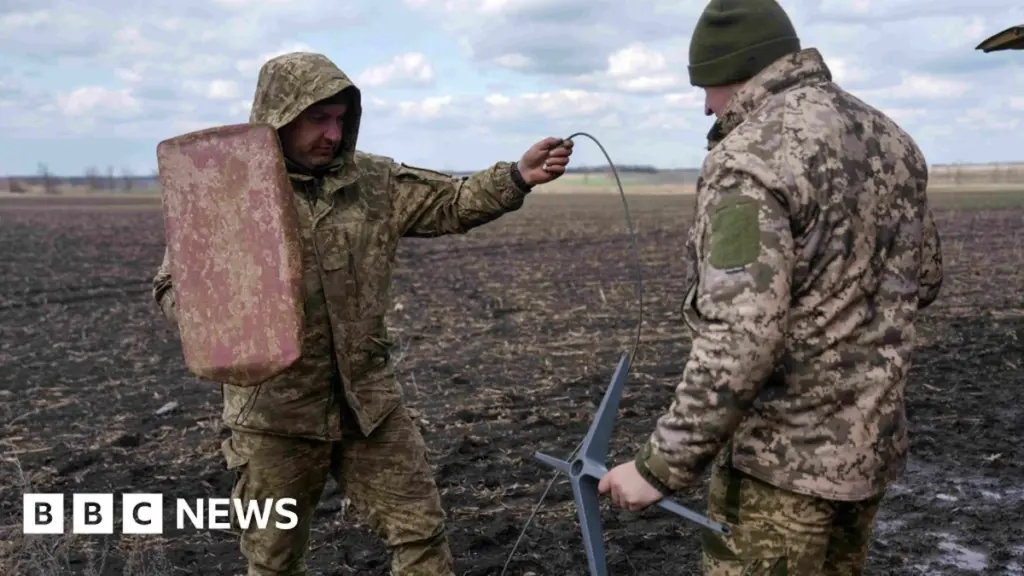
Across the front line, hasty adaptations by Russian forces are apparent. One soldier noted that Russians are now urgently switching to wired communication. Artem, an engineer, stated that Russian opponents are struggling to guide their drones as effectively as before, impacting critical infrastructure protection, logistics, and control points. Many frontline communications for Russian forces have reportedly been severed.
Strategic Implications and Ukrainian Opportunities
Ukrainian military analysts highlight the crucial impact on drone strikes targeting Ukrainian logistics and positions far from the front. Serhii Kuzan, chairman of the Ukrainian Security and Co-operation Centre, pointed out that Russian drone operators can no longer control and directly strike targets located 100-250 kilometers from the front line with the same efficacy.
In a conflict where communication speed is paramount, some Ukrainian soldiers perceive this as a significant opportunity. A slight advantage in command transmission time, even five to ten seconds, can be a game-changer on the front. Ukraine’s military intelligence (HUR) has released alleged intercepted Russian communications, suggesting frustration with the inadequacy of domestic communication systems in compensating for the loss of Starlink. One intercepted message purportedly dismisses a Russian-developed terminal as “total crap.”
HUR concluded that the Starlink shutdown has already led to severe issues with unit coordination, logistics, and the deployment of various unmanned systems. Unverified videos circulating on social media allegedly show Russian soldiers being targeted by Ukrainian drones while attempting to establish alternative Wi-Fi connections via electrical infrastructure. However, not all Ukrainian soldiers report a dramatic shift, with some noting little change or attributing battlefield dynamics to other factors like weather and troop rotations.
Russian Official Responses and Ukrainian Countermeasures
In Moscow, Russian military officials, speaking on state television, claimed the loss of Starlink has not affected their operations, with one dismissing its use as primarily for “misleading the enemy.” Despite these assertions, Giovanni, a Ukrainian soldier positioned near Pokrovsk, anticipates that Russian forces will eventually adapt and find solutions, though the timeline remains uncertain.
In the interim, Ukrainian forces are aiming to maximize their advantage by expanding the “grey zone” or “kill zone” between opposing lines. Vlad Voloshyn, spokesperson for the army’s Southern Command, stated their objective is to strike at enemy positions wherever they are found, disputing reports of a major counter-offensive. Their immediate goals, he clarified, are more focused on preventing enemy entrenchment and disrupting their assault groups.
Former Ukrainian intelligence officer Ivan Stupak suggests the Ukrainian military likely has a window of a few months to exploit the current situation, describing Russian ground forces as partially incapacitated. He speculates that sustained frustration and demoralization could potentially enable a counter-offensive on a scale comparable to 2022. While a repeat of the swift territorial gains from the summer and autumn of 2022 appears unlikely, Stupak believes any territorial advancements would bolster Ukraine’s negotiating position.