
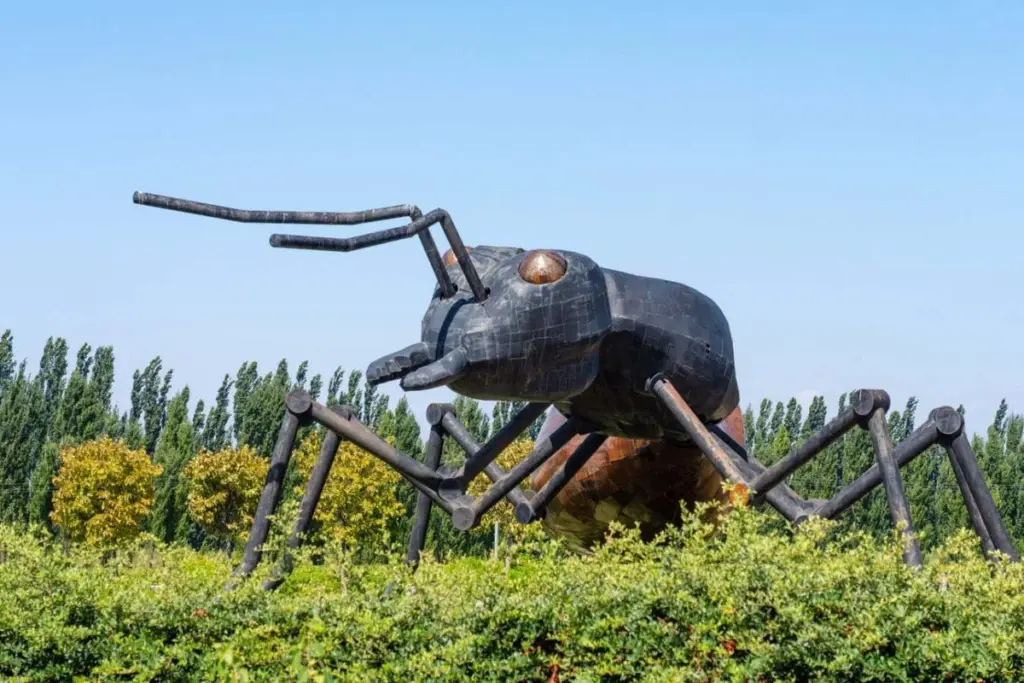
Urban pollution is rendering many cities increasingly unlivable for humans, but its damaging effects extend to the intricate social structures of ant colonies.
Ants typically identify their kin through a subtle chemical signature, a specific blend of hydrocarbons found on their exoskeletons that broadcasts their colony’s unique “scent.” However, recent research indicates that ozone emissions can fundamentally alter the composition of these hydrocarbons. When ants are exposed to ambient urban air containing approximately 100 parts per billion of ozone, their nestmates can no longer recognize them. Consequently, some ants face aggression from their own colony members, while others fail to receive care for exposed larvae, leading to their demise.
Considering the vast population of ants on Earth, estimated at around 20 quadrillion, human industrial activities are inadvertently causing widespread societal disruption across these insect communities on an immense scale.
This narrative, while evoking a sense of horror, relies on anthropomorphism – the projection of human characteristics onto non-human beings. The comparison of ant colonies to human families serves as an illustrative example. Although many scientists caution against anthropomorphism due to its potential for misinterpretation, others find value in drawing parallels between ants and humans to illuminate evolutionary processes, from altruism to the development of complex social networks.
A notable advocate for such comparisons was entomologist E.O. Wilson. He utilized ant behavior as a cornerstone for his theory of “sociobiology,” proposing that many animal behaviors stem from evolutionary imperatives. By observing how biological factors influenced ant actions, Wilson argued, humanity could gain insights into how biology has shaped human achievements and societal progress.
Evolutionary biologist Stephen Jay Gould stood as a vocal critic of Wilson’s hypothesis, labeling it “biological determinism.” He warned of its potential to foster eugenic social policies or worse. Disagreements concerning the influence of biology on human society persist within academia, with sociobiology now more commonly discussed as evolutionary psychology.
However, a significant shift has occurred in scientific discourse regarding ants. In the early 21st century, Stanford University biologist Deborah Gordon observed that ant behavior operates on algorithmic principles. Years of studying carpenter ants and other species led her to collaborate with computer scientists. Together, they explored how ants manage task allocation within their colonies using what are essentially distributed signaling networks.
For instance, if a worker ant discovers an abundant food source, it leaves a pheromone trail to guide other ants. As she returns to the nest, she encounters nestmates who can detect her pheromone and realize she has found more food than a single ant can transport. These ants then quickly assess the situation, understanding that more foragers are needed. They abandon their current activities to join the collective effort of gathering food.
This coordination is not directed by a single leader or a management hierarchy. Instead, it emerges through direct communication between individual ants, with messages passed along to recruit workers until a task is completed. Gordon aptly named this phenomenon “the anternet,” drawing a parallel to how distributed computer networks manage bandwidth for data transmission. In this case, however, the ants are not allocating bandwidth but rather distributing themselves to meet task demands.
Gordon’s research appears to mark a departure from Wilson’s perspective, as she likens ant behavior to computer networks rather than human interactions. Yet, this coincides with an era where artificial intelligence companies are investing heavily in the belief that human cognition can be replicated through software algorithms. While algorithmic determinism has seemingly replaced biological determinism, the outcome for ants remains similar: they continue to be employed as analogies for understanding animal behavior and even computational systems, often without full appreciation for their distinct ant-like qualities.
This brings us back to the study on how human-generated pollution impairs ants’ ability to recognize one another. Gordon’s “anternet” relies on ants from the same colony interacting, sharing information, and then collectively deciding whether to assist their nestmates with a task. However, when ozone oxidizes the hydrocarbons on ant cuticles, colony sisters lose their ability to identify each other, hindering their coordination on essential jobs. This breakdown in communication can ultimately lead to colony collapse.
From a human perspective, this might not seem immediately impactful. Humans do not rely on olfactory cues from each other’s bodies to determine needs for food acquisition or childcare. We do not operate within vast, decentralized networks where individuals collectively manage their environment and support one another. Yet, we share the planet with remarkable wild animals that do operate this way.
If ozone pollution is not curbed, the intricate societies of these creatures could face destruction. Perhaps it is time to shift our focus from using ants as mere metaphors for ourselves or our machines and instead, cultivate a genuine understanding and concern for their unique existence.
What I’m reading
H.G. Wells’s *War of the Worlds*, where the Martians are depicted as cyber-vampires (a surprising twist).
What I’m watching
My Life Is Murder, an enjoyably charming detective series starring Lucy Lawless.
What I’m working on
Securing a new place to live in a city unfamiliar to me.
Annalee Newitz is a science journalist and author. Their most recent book is *Automatic Noodle*. They co-host the Hugo Award-winning podcast *Our Opinions Are Correct*. They can be followed on Twitter at @annaleen, and their website is techsploitation.com.