
Representatives from Russia and Ukraine convened in Geneva for a new round of negotiations, brokered by the United States, approximately one week prior to the fourth anniversary of Russia’s full-scale invasion of Ukraine. Hopes for a significant breakthrough remain subdued, primarily due to Russia’s persistent adherence to its maximalist territorial demands concerning Ukraine.
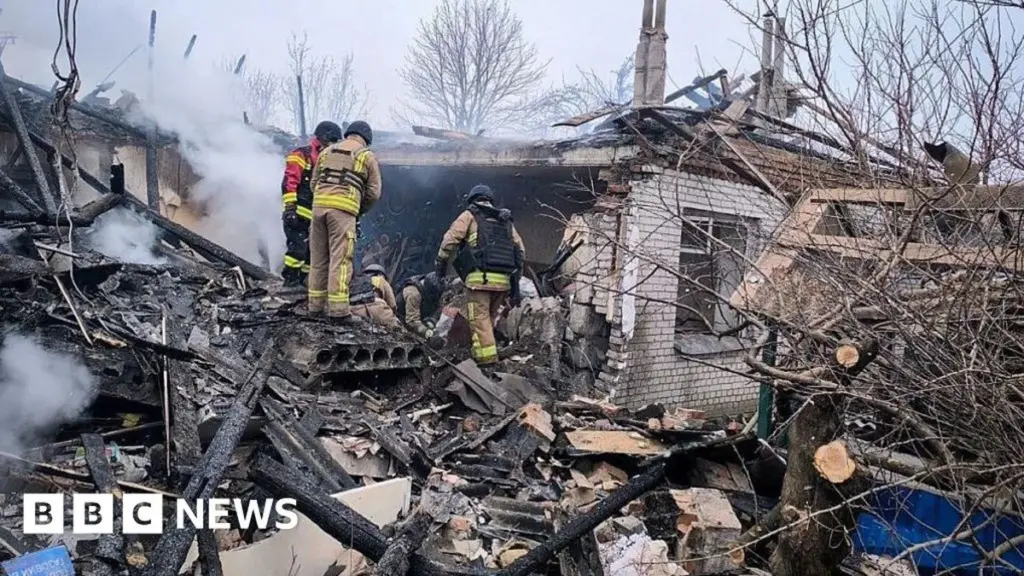
Simultaneously, missile and drone attacks across Ukraine continued on a nightly basis. These strikes have exacerbated the damage to the nation’s already strained power grid, particularly as the country endures sub-zero temperatures. The ongoing aerial assaults underscore the precarious state of Ukraine’s infrastructure and the human cost of the conflict.
Just hours before the delegations’ meeting in Switzerland, Moscow launched a substantial combined aerial attack targeting 12 Ukrainian regions. The assault involved approximately 400 drones and nearly 30 missiles, resulting in at least three fatalities. Ukrainian Foreign Minister Andrii Sybiha commented on these attacks, stating they demonstrated the “extent to which Russia disregards peace efforts.”
In response to the aerial bombardment, Russia reported that its air defense systems had intercepted over 150 drones. Separately, an oil refinery caught fire following a reported Ukrainian drone strike. These events highlight the dynamic and often retaliatory nature of the conflict.
Negotiation Participants and Background
The talks held in Geneva were facilitated by Steve Witkoff, the special envoy appointed by Donald Trump, and Jared Kushner, who served as US President Donald Trump’s son-in-law. The Ukrainian delegation included National Security Council Secretary Rustem Umerov and Kyrylo Budanov, the chief of staff to President Volodymyr Zelensky. Representing Russia were Vladimir Medinsky, an aide to President Vladimir Putin, alongside several figures from military intelligence.
Kremlin spokesman Dmitry Peskov expressed low expectations for immediate outcomes, stating, “I don’t think we should expect any news today,” and indicated that discussions would extend into Wednesday. On Tuesday, Donald Trump, speaking from Air Force One, advised Ukraine to “come to the table fast,” reflecting his previous expressions of impatience regarding the protracted nature of the conflict.
The territorial implications of the conflict remain a central point of contention. Russia currently occupies approximately 20% of Ukraine, encompassing significant portions of the eastern Donbas region. The Russian government’s demand for Ukraine to cede the remainder of this region has been unequivocally rejected by Kyiv.
From Ukraine’s perspective, the prerequisite for any settlement with Russia involves the establishment of robust security guarantees from Western nations, including the United States. This demand underscores Ukraine’s focus on future security arrangements as a basis for peace.
Impact of Recent Attacks
The latest wave of Russian attacks had severe consequences. Near Slovyansk, a frontline city, at least three energy workers were killed in overnight strikes on Monday, according to Ukraine’s Deputy Energy Minister Artem Nekrasov. President Zelensky reported that an additional nine individuals, including children, sustained injuries across the country. More than 10 residential buildings and significant railway infrastructure also suffered damage.
In a statement on X, President Zelensky asserted that “Russia must be held to account for its aggression” and emphasized that “for peace to be real and just, action must target the sole source of this aggression.” Ukrainian authorities reported that 12 regions were affected, leading to infrastructure damage and power outages for thousands in the southern port city of Odesa.
DTEK, Ukraine’s largest private energy company, described the damage to Odesa’s power infrastructure as “incredibly serious,” forecasting a lengthy period for restoration. The nation is currently grappling with an acute energy crisis, a direct result of sustained Russian attacks on vital infrastructure throughout a freezing winter.
Ukraine has also conducted its own retaliatory actions against Russian territory. Officials confirmed that a fire erupted at the Ilsky oil refinery in the southern Krasnodar region following a drone strike. A reservoir containing oil products also caught fire. The Belgorod border region continued to be a target, with Ukraine launching numerous drones that caused considerable damage to power infrastructure.
Context of the Talks
These recent discussions in Geneva follow a trilateral meeting held in Abu Dhabi the previous month. That engagement marked the first three-way negotiation between Russia, Ukraine, and the United States since Russia’s full-scale invasion commenced in February 2022. While the discussions in Abu Dhabi concluded without a formal breakthrough, they were shortly followed by the first prisoner-of-war exchanges in several months.