
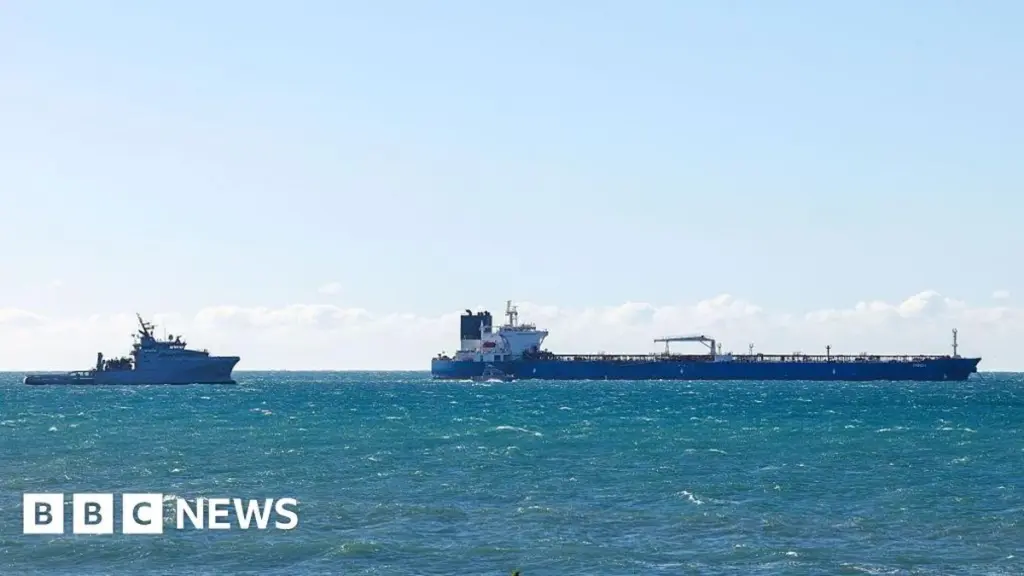
France has announced the release of an oil tanker, believed to be part of Russia’s sanctions-evading ‘shadow fleet’. This action followed the payment of a substantial fine by the vessel’s owner.
French Foreign Minister Jean-Noël Barrot confirmed the tanker, known as the Grinch, was departing French territorial waters on Tuesday. The release was contingent upon a penalty amounting to “several million euros”.
The vessel was intercepted by French authorities in the Mediterranean Sea in January. It was subsequently diverted to the port city of Marseille. Officials indicated the tanker had originally set sail from Murmansk in northern Russia and was sailing under a Comoros flag.
Understanding the ‘Shadow Fleet’
Russia’s designated ‘shadow fleet’ refers to a clandestine network of oil tankers. These ships are employed to circumvent Western sanctions imposed on Russian oil exports. The strategy often involves utilizing older tankers with obscure ownership structures or dubious insurance arrangements.
Following Russia’s full-scale invasion of Ukraine in 2022, numerous Western nations implemented sanctions targeting Russian oil. The ‘shadow fleet’ operates as a means to counteract these economic restrictions.
“Circumventing European sanctions comes at a price,” stated Barrot via a post on X. He added, “Russia will no longer be able to finance its war with impunity through a ghost fleet off our coasts.”
Barrot further elaborated, “The tanker Grinch will leave French waters after shelling out several million euros and three weeks of costly immobilization at Fos-sur-Mer. Let’s keep it up.”
A joint statement from the public prosecutor’s office and regional maritime authorities indicated that the company owning the vessel had been subjected to a financial penalty, including confiscation, as part of a guilty plea procedure. The Marseille judicial court handed down this sentence.
The precise sum of the fine levied against the tanker’s owner was not publicly disclosed.
The Growing Shadow Fleet Phenomenon
The use of ‘shadow fleets’ is becoming an increasingly prevalent tactic. A significant and growing number of tankers involved in transporting oil from Russia, Iran, and Venezuela are employing various methods to conceal their identities and bypass Western sanctions.
While figures vary, data compiled by the monitoring group TankerTrackers.com suggests the current size of this fleet stands at 1,468 vessels. This represents a threefold increase compared to the fleet’s size at the time of Russia’s full-scale invasion of Ukraine approximately four years prior.
These vessels characteristically exhibit age and often suffer from inadequate maintenance. Ownership and management details are intentionally obscured, with vessel names, identification numbers, and flags frequently altered.
In recent months, there has been a noticeable intensification of efforts to address the issue of ‘shadow fleets’. This has resulted in the seizure of a number of sanctioned tankers.
Previous Seizures
In January, British armed forces collaborated with a US operation to seize a Russian-flagged tanker in the Atlantic Ocean. US officials stated the tanker had contravened sanctions by carrying oil destined for both Venezuela and Russia.
Moscow publicly criticized this action. The Russian government asserted that no single state possessed the authority to employ force against vessels lawfully registered under the jurisdictions of other nations.