
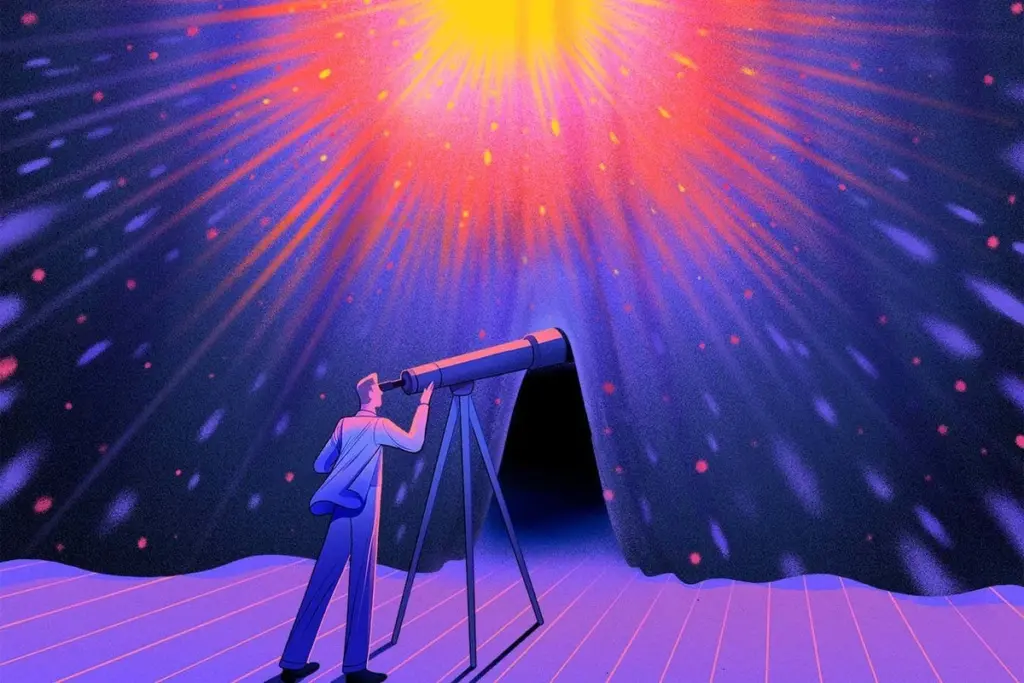
Visualize, for a moment, the entire history of the universe captured on film. Rewinding this cosmic movie would initially present a familiar scene: a vast, intricate network of galaxies and nebulae. As the tape winds back further, everything would condense, shrinking progressively until it reaches an infinitesimally small point of energy. This is the point commonly identified as the Big Bang.
Beyond this moment, the screen turns blank. Inquiring about what preceded it is met with skepticism from both scientists and philosophers, akin to asking what lies north of the North Pole – a question deemed nonsensical and unanswerable.
Or is it truly unanswerable? In recent years, a cadre of physicists has devised methods to lift this veil, offering glimpses into what might have existed prior. Their approach hinges on the realization that while precisely solving the equations describing this primordial epoch is beyond our current capabilities, approximations can still yield valuable insights. Eugene Lim, a leading proponent of these concepts at King’s College London, notes that this area of numerical relativity is beginning to illuminate previously intractable questions. This work not only clarifies theoretical ambiguities surrounding the Big Bang’s immediate aftermath but also suggests the intriguing possibility of other universes predating, and perhaps even colliding with, our own.
The initial concept that would eventually lead to the Big Bang theory emerged from the mind of a Belgian priest. In 1927, Georges Lemaître observed that galaxies appeared to be moving away from us. He proposed that this expansion implied the universe itself was growing. Extrapolating this observation, he posited that an expanding universe must have originated from a single point, which he termed the “primeval atom.” The scientific community debated this idea rigorously until 1964, when Arno Penzias and Robert Wilson detected the cosmic microwave background (CMB). This faint radiation, often referred to as the afterglow of the Big Bang, bathes the entire sky and provided definitive evidence that the universe began in an intensely hot, dense state.
The Limits of Current Physics
Despite these advancements, our understanding of the universe’s earliest moments encounters a fundamental barrier. We can trace the universe back approximately 13.7 billion years to a phase of extreme energy density, known as the hot Big Bang. However, venturing further back leads us into uncharted territory. While some people colloquially envision the Big Bang as a point of infinite density where time began, there is no empirical evidence to support this notion of a singularity, nor are there equations capable of describing it. (See “A Very Short History of the Very Early Universe” below for context.)
A Very Short History of the Very Early Universe
The Singularity
In extrapolating backward, some physicists hypothesize that the universe commenced as a point of infinite density, termed a singularity. This moment is theorized as the origin of time and space, though its interpretation remains challenging and unproven.
Inflation
This theoretical period is estimated to have lasted for an incredibly short duration – a billionth of a trillionth of a trillionth of a second. During this epoch, the universe underwent a colossal expansion, increasing in size by a factor of 1026, growing from the scale of a subatomic particle to approximately that of a grapefruit.
The Hot Big Bang
Following the inflationary period, the universe experienced a phase of slower, though still rapid, expansion. This phase lasted for about 380,000 years, by which time the universe had cooled sufficiently for the first subatomic particles to start forming.
The reason we cannot probe beyond the hot Big Bang lies within the framework of Albert Einstein’s theory of space and time. His equations meticulously describe the geometry of spacetime. However, these equations are notoriously difficult to solve precisely, except in the most straightforward scenarios. In circumstances involving overwhelmingly powerful gravitational forces, such as those near a black hole or during the Big Bang itself, exact solutions become unattainable.
Nevertheless, since the late 1950s, physicists have explored methods for approximating solutions to these equations. Initially, the goal was to predict the characteristics of gravitational waves – ripples in the fabric of spacetime. It wasn’t until 2005 that scientists successfully achieved this, ushering in a new era of gravitational wave astronomy. This field culminated in the direct observation of gravitational waves in 2016.
Eugene Lim envisioned applying this same methodology to address deeper cosmological puzzles. The concept involved inputting specific initial conditions into the equations and tasking supercomputers with finding approximate solutions. This process would then be repeated with marginally altered conditions, thereby revealing how spacetime would behave under previously inaccessible circumstances. Initially, Lim believed simple computer code would suffice, but the endeavor evolved into the creation of an ambitious model for these calculations. He wryly notes, “We wanted to build a small, one-man fighter to destroy the Death Star, but ended up building the Death Star instead.”
Testing the Theory of Inflation
In recent years, Lim and his colleagues have employed this numerical approach to scrutinize inflation, the prevailing hypothesis for the events preceding the hot Big Bang. Proposed in the 1980s by Alan Guth, Andrei Linde, and others, the theory of inflation sought to explain the remarkable uniformity of matter and energy distribution across the vast scales of the universe. Such a homogeneous state is statistically improbable for a nascent universe, and inflation was theorized as a mechanism to smooth out initial irregularities. In this framework, the universe expanded so rapidly that any initial inhomogeneities were stretched to insignificance.
However, inflation faces significant challenges. A prominent critique is the inability to explain what initiated inflation and then caused it to cease almost instantaneously. To address this, physicists invoke the hypothetical “inflaton field.” Central to this concept is the field’s “potential,” which can be analogized to gravitational potential. Just as a higher gravitational potential exists at the top of a mountain compared to a chair, the inflaton field required a high potential to initiate inflation and subsequently needed to decrease rapidly for inflation to end.
Further complicating matters, the shape of the inflaton field across space could have been either concave or convex, with varying degrees of steepness or shallowness. The specific shape has profound implications for how inflation unfolded and whether it aligns with our understanding of subsequent cosmic history. Observations of the CMB have suggested a gently concave inflaton field, though current measurements lack the precision for definitive conclusions.
In 2020, Lim and Katy Clough at Queen Mary University of London, along with their collaborators, utilized numerical relativity to investigate these aspects. By defining initial configurations for spacetime and matter, their simulations demonstrated how these evolve over time, specifically identifying conditions conducive to spacetime inflation. Intriguingly, their findings indicated that convex fields were generally more likely to induce inflation than concave ones, presenting a potential discrepancy with CMB data.
These results both advance our comprehension of the pre-Big Bang era and introduce new complexities. They might suggest that inflation is a less robust explanation for the early universe than previously assumed. Nevertheless, Lim and Clough identified certain convex models, known as alpha-attractor models, that did facilitate inflation. In a subsequent paper, currently awaiting peer review, Lim and his team have extended their numerical relativity methods to predict the specific types of gravitational waves that such models would generate. The hope is that gravitational wave observatories will be able to detect these waves, providing concrete evidence of the inflationary epoch’s precise characteristics. Lim states, “If you know the potential, you can calculate the gravitational waves and vice versa.”
David Garfinkle at Oakland University in Michigan, who also conducts research in numerical relativity, acknowledges these simulations as “beautiful pieces of work.” However, he points out that the current simulations cannot trace the inflationary process all the way to the present-day universe, creating uncertainty about whether these models accurately lead to the universe we observe.
Bouncing Universes: An Alternative Scenario
Should numerical relativity significantly challenge the inflation hypothesis, an alternative scenario awaits: the “bounce.” This theory posits that the universe did not begin with a bang but rather initiated from a contraction that subsequently rebounded outward. In this model, there was no singularity and no inflation; instead, a preceding universe condensed to a minuscule size before expanding to form our own.
Garfinkle and his research group have been exploring this concept using numerical relativity, collaborating with individuals like Paul Steinhardt at Princeton University, who has proposed a specific model for such a cyclic universe. In a recent publication, they demonstrated that the contraction phase in a cyclic universe can achieve a level of cosmic smoothness comparable to that produced by inflation. Garfinkle explains, “We can come up with initial conditions where there is smoothing through contraction, but not under inflationary expansion.”
Another study, conducted by William East at the Perimeter Institute in Waterloo, Canada, and his colleagues, delved into the complex question of what would happen to black holes existing in a prior universe. Physicists have expressed concern that a cosmic bounce might have subjected these entities to such extreme compression that it could violate the cosmic censorship hypothesis, a fundamental principle stipulating that the interior of a black hole must always remain hidden behind an event horizon. East’s research suggests this concern may be unfounded. Clough notes, “While the event horizons may shrink, they still persist – so the singularity at their centre remains hidden.”
These encouraging findings regarding bouncing universes align with another significant development in physics. Data from the Dark Energy Spectroscopic Instrument, released in March 2025, revealed a deceleration in the universe’s expansion rate. If this rate were constant, as previously assumed by scientists, a future contraction of the universe would be highly improbable.
Despite these advancements, convincing skeptics of the bounce theory, of whom there are many, remains a challenge. A bounce scenario necessitates unusual phenomena, such as negative energy density, which appear to contravene established laws of physics. Garfinkle commented, “I think the fact that inflation doesn’t need a separate bounce mechanism is definitely a mark in its favour.”
Colliding Universes and the CMB
Remarkably, numerical relativity also offers avenues to explore even more speculative ideas, again linked to the theory of inflation. In the theory’s early stages, researchers recognized the possibility that the inflaton field could cease its activity in some regions while continuing in others. This would have resulted in the formation of “bubbles” of relatively slow-expanding space amidst the intense inflationary process. These bubbles could have originated from a common singularity, but due to the rapid expansion of the space between them, they would have become irrevocably separated universes.
In 2011, Hiranya Peiris at the University of Cambridge and her colleagues employed numerical relativity to model the effects of such a cosmic collision. Their simulations indicated that these impacts should have left circular imprints, or “scars,” on the CMB. Using these predictions, they searched for such patterns and identified four regions in the sky that were consistent with this hypothesis. This led to the intriguing question: could these be evidence of other universes colliding with our own?
However, the findings were accompanied by significant uncertainty. The models used by Peiris were more specialized than the general “Death Star” codes later developed by Lim and his team. Furthermore, the rate and conditions under which bubbles would have formed during inflation were not precisely known, requiring the team to make certain assumptions. Peiris is currently working to gain a more detailed understanding of bubble collisions, information that could be used to refine numerical relativity codes and enhance the precision of the results. She stated, “We are trying to firm up the physics that goes into these predictions. I don’t think it will invalidate our old result.”
Researchers in Canada have made progress in determining the conditions that favor bubble formation. Their theoretical work suggests that bubbles tend to emerge in areas of high density, meaning their occurrence would vary across space. This kind of information could be incorporated into the simulation code to more accurately predict where bubbles are likely to form, thereby influencing the probability of collisions.
Peiris is also involved in a laboratory experiment that simulates colliding universes by creating bubbles within an exotic fluid-like material composed of ultracold potassium atoms. Lim, Clough, and Josu Aurrekoetxea at the University of Oxford recently published a review of numerical relativity, aiming to assist cosmologists in leveraging its capabilities more effectively. Clough described it as an exciting period for the field, as scientists are migrating their simulation codes to newer, faster processors. She noted, “Simulations that used to take two weeks could now be done in about a day.”
A Potential Path to a Theory of Everything
There is even a possibility that numerical relativity could guide the search for a unified theory of everything. Lim has already initiated explorations in this direction. Consider the work he and his colleagues conducted on the configuration of the inflationary field. Many of the potential shapes they identified as necessary for inflation clashed with prevailing models of string theory. Lim explained, “If you randomly let string theory generate potentials, they tend to be jagged rather than smooth and gentle.” However, the alpha-attractor models, which they demonstrated align with observational data, can also be derived from specific variations of string theory.
Could this suggest that these particular aspects of string theory are on the right path? Perhaps. What remains evident is that lifting the veil on the Big Bang era has already unveiled a wealth of surprising discoveries.