
Facing a profound demographic challenge, Ukraine is implementing measures to support its fighting force, including providing subsidized sperm freezing for soldiers.
Maxim, a soldier serving with Ukraine’s National Guard, speaks candidly about the importance of fertility preservation, emphasizing its connection to the nation’s survival. “Our men are dying. The Ukrainian gene pool is dying. This is about the survival of our nation,” he stated during a phone conversation from the eastern front.
The 35-year-old soldier recounted his recent leave, during which his wife encouraged him to visit a clinic in Kyiv. There, he deposited a sperm sample, which was cryopreserved free of charge. This initiative is part of a program designed to assist active service members. Should Maxim be killed, his wife would have the opportunity to use the sample to conceive the child they have always desired.
However, Maxim highlighted that the utility of his frozen sperm extends beyond such tragic circumstances. “Whether you are right on the ‘zero point’ of the frontline, or 30 or even 80 kilometres back, there is no guarantee that you’re safe,” he explained, citing the persistent threat posed by Russian drones. This constant menace, he noted, contributes to stress, which can negatively impact reproductive capabilities. “So we have to think about the future and the future of our Ukrainian nation.”
Private fertility clinics initiated cryopreservation services for servicemen and women in 2022, coinciding with the outset of Russia’s full-scale invasion. These clinics offered the freezing of sperm or eggs at no cost for individuals who might sustain injuries in combat or experience fertility-related consequences.
The following year, the Ukrainian parliament enacted legislation to formally regulate this practice and allocate state funding. MP Oksana Dmitrieva, who helped draft the law, explained the rationale: “Our soldiers are defending our future, but may lose their own, so we wanted to give them that chance. It’s to support them, so they can use their sperm later.”
Initial legislative efforts encountered public disapproval when a stipulation mandated the destruction of all donated samples upon the donor’s death. This provision came to light when a war widow was denied the chance to use her deceased husband’s frozen sperm to conceive. Subsequently, the law was amended. Currently, all soldiers’ sperm samples are preserved free of charge for up to three years post-mortem, with partners able to utilize them following prior written consent.
This program also aims to address a pre-existing demographic crisis exacerbated by the large number of Ukrainian men lost in combat, many of whom were young and fit.
Furthermore, millions of individuals, primarily women, have sought refuge abroad. After four years, many remain overseas due to the ongoing difficulties in Ukraine. This reality was underscored during a meeting with MP Dmitrieva in a Kyiv hotel lobby, where conversation occurred without removing coats due to Russia’s sustained missile strikes on the power grid, leaving thousands without heating.
“We’re also thinking about the future and all the young people we’ve lost. We need to replace them,” Dmitrieva stated. “This is one tiny step to improve the demographic situation.”
During her visits to frontline positions, the MP actively encourages soldiers to discuss their sexual health and fertility concerns, advocating for sperm freezing. “At first they’re really embarrassed, but we talk and I tell them to tell others, and then they come and they do it,” she shared. “If they have this chance, then why not? It doesn’t hurt!”
Kyiv’s state-run Centre for Reproductive Medicine began participating in the “frozen sperm” program in January. While only a small number, around a dozen, have enrolled thus far, the clinic anticipates an increase in demand as awareness grows.
“We expect big demand. We have high hopes,” said Director Oksana Holikova, leading a tour of the laboratory facilities where biomaterial is collected, prepared, and stored. Within a chamber resembling dry ice, long, slender tubes filled with sperm were visible suspended in giant vats.
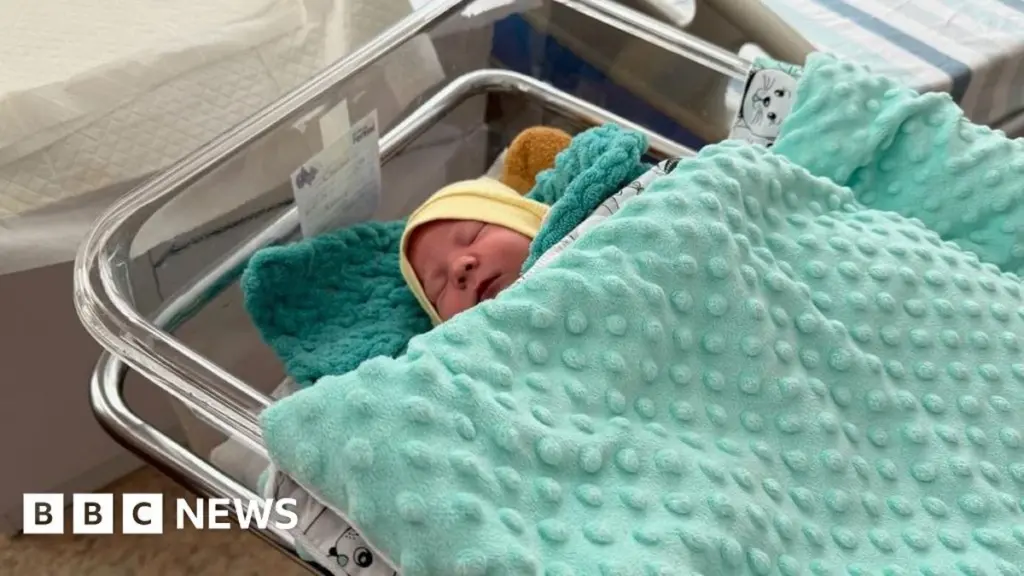
The clinic’s corridors revealed the war’s less visible impacts: a single infant in a crib and one woman in labor. The number of pregnant patients seen by the clinic has halved since the full-scale invasion began.
“If women are stressed, they [can] have problems with their periods. It’s all linked,” Holikova observed. “About 60% of my patients are on anti-depressants, including people with panic attacks because of the missiles and drones.”
Others experience what she described as “delayed life syndrome,” postponing significant life decisions, including having children. “Women are scared of getting pregnant if they’re going to end up running to bomb shelters.”
Consequently, Ukraine urgently needs every newborn child possible. However, legislation aimed at supporting military families has not always functioned seamlessly.
Katerina Malyshko and her husband, Vitaly, had been trying to conceive for some time. Katerina believes their difficulties in conceiving naturally were intensified by the war, citing “all the stress and sleepless nights.” “Every night is like a lottery: you don’t know whether you’ll wake up,” she recounted.
The couple would have marked their fourth wedding anniversary this year, potentially with a new baby. Last winter, they had three viable embryos at the fertility clinic, and Katerina was scheduled for their transfer. Tragically, Vitaly was killed by a direct bomb strike.
“It was a direct hit with a guided bomb, he had no chance,” Katerina stated.
She spoke openly about her profound struggle to continue living without her husband. This grief was compounded when the clinic informed her that she had no right to proceed with treatment using the frozen embryos or Vitaly’s sperm. “They would store it,” she said, “But I couldn’t use it.”
MP Oksana Dmitrieva has intervened in specific cases to ensure soldiers’ families receive treatment, but she acknowledges that the new law still requires refinement. Amendments are slated for a parliamentary vote in the spring.
However, Katerina, driven by desperation and grief, pursued legal action. After six emotionally taxing months, a judge ruled in her favor. “I read the ruling and sat there and cried. Because it was our family. We had waited to long for that and been through so much,” Katerina shared. “I felt joy and grief at the same time because I’d had to fight for my rights. But I wanted to do it, to honour my husband.”
Katerina is not yet ready to pursue pregnancy, feeling too emotionally fragile. She harbors no illusions that the war will end soon, allowing her to give birth in a peaceful nation.
“If we compromise now, then what did so many people die for?” she asked, responding to the notion that Ukraine might cede territory for which Vitaly died, in exchange for a halt to the Russian invasion.
Nevertheless, Katerina wishes to retain the option of having her husband’s child when she feels emotionally prepared. “I think the children of our soldiers who’ve been killed should have a chance to live: they have the right to live in the country their parents died for.”
Back on the frontline, amidst constant danger, Maxim echoes this sentiment. “That’s why I did it, and it’s great!” he exclaimed over the phone. “Because maybe tomorrow, I’m suddenly gone. But my wife will have my sperm and can use it. It’s one less thing for me to worry about.”
Maxim identifies the primary challenge as persuading men to participate in the program. Oksana Horlikova, the Kyiv clinic director, recalled speaking with a war veteran who reported soldiers coming to him in tears due to difficulties in having sex with their partners or conceiving.
“Men are secretive, but there are lots of psychological problems,” Maxim admitted.
He suggested that men could be required to freeze their sperm upon conscription, similar to providing DNA samples for identification in case of death. “All that’s holding people back is that we need to talk about this more and explain why it’s important,” the soldier concluded. “Because we men won’t do anything, unless you shove it in our face – and make us.”