
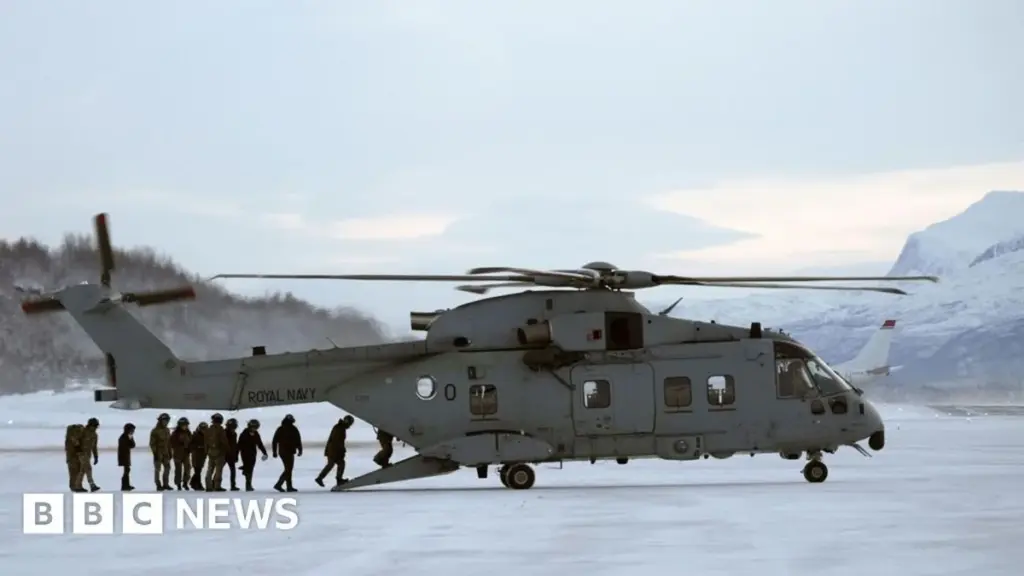
The United Kingdom is set to significantly increase its military personnel stationed in Norway. Over the next three years, the number of British troops deployed to the Arctic nation will be doubled, a move driven by growing apprehension regarding Russian activities in the High North.
John Healey, the Defence Secretary, confirmed that the armed forces contingent in Norway will grow from approximately 1,000 to 2,000 individuals. This decision comes amid heightened concerns among NATO allies about Russia’s expanding military presence and infrastructure development in the Arctic, including the reactivation of former Cold War installations.
Healey articulated the strategic rationale, stating, “Demands on defence are rising, and Russia poses the greatest threat to Arctic and High North security that we have seen since the Cold War.” The Defence Secretary is scheduled to meet with his NATO counterparts at the alliance’s headquarters in Brussels to deliberate on these security proposals.
Enhanced Surveillance and Arctic Drills Planned
Foreign Secretary Yvette Cooper has put forward a proposal named “Arctic Sentry.” This initiative is designed to strengthen surveillance capabilities and bolster security throughout the region. The model for Arctic Sentry is based on existing NATO frameworks like Baltic Sentry and Eastern Sentry.
As part of this reinforced commitment, an contingent of 1,500 Royal Marine Commandos will participate in NATO’s Exercise Cold Response. This large-scale military exercise, slated for March, will span across Norway, Finland, and Sweden. Its primary objective is to train allied forces in operating effectively under demanding Arctic environmental conditions.
Furthermore, in September, the UK-led Joint Expeditionary Force will conduct an exercise dubbed Lion Protector. This operation will involve air, land, and naval forces drawn from several European nations. The exercise aims to enhance the readiness of armed forces to defend critical infrastructure against potential attacks and sabotage across Norway, Iceland, and the Danish straits.
Addressing Threats to Undersea Infrastructure
Both the United Kingdom and its NATO partners have voiced increasing concern about the potential risks posed by Moscow to vital undersea infrastructure, such as communication cables and pipelines. These anxieties have been amplified by heightened geopolitical tensions following recent international events.
In response, the UK and Norway formalized a defense pact last year. This agreement is specifically focused on safeguarding undersea cables and involves the navies of both nations coordinating to monitor Russian submarine movements. According to the Ministry of Defence (MoD), Russian submarine activity in UK waters has seen a 30% increase over the past two years.
The MoD has also indicated that submarine activity by Russia in the North Atlantic has now returned to levels comparable to those observed during the Cold War era.