
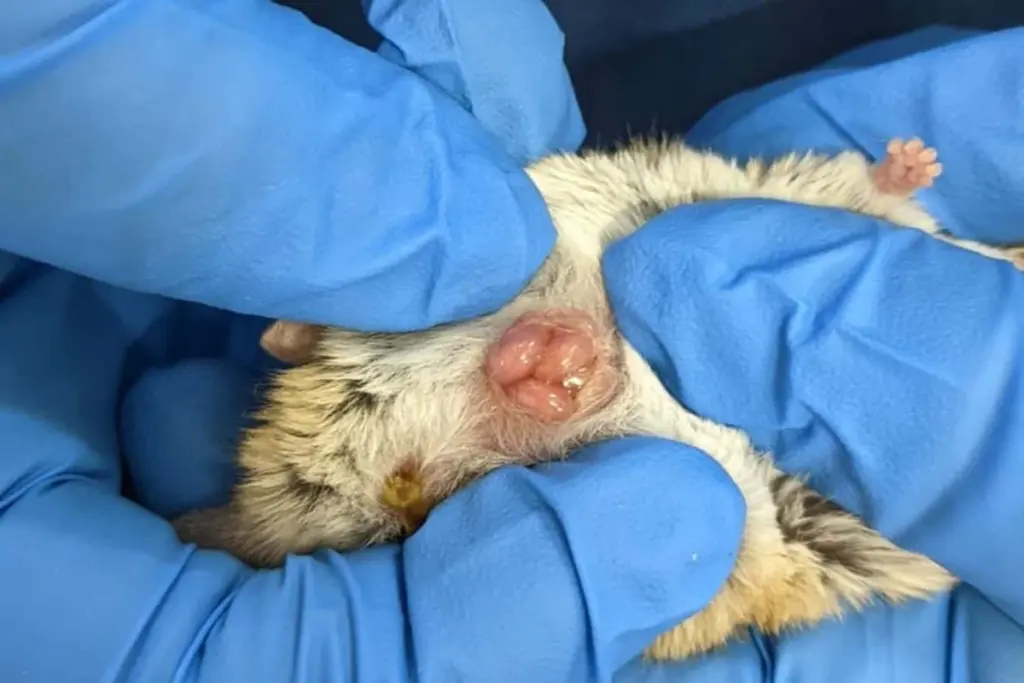
For the first time, scientists have captured footage of minuscule marsupial newborns, weighing less than a grain of rice, as they navigate the journey towards their mother’s pouch.
Unlike placental mammals that deliver more developed offspring, marsupials undergo exceptionally short gestation periods. Their young are born in a highly immature state, requiring immediate relocation to a pouch. There, they latch onto a teat and continue their growth and development.
This critical post-birth process remains largely a mystery for many of Australia’s smaller, rarer marsupial species. The challenge persists even for those populations maintained in controlled captive environments, according to Brandon Menzies of the University of Melbourne.
The Fat-Tailed Dunnart and a Scientific Puzzle
Menzies and his team manage a substantial colony of hundreds of fat-tailed dunnarts (Sminthopsis crassicaudata). These small marsupials are recognized as close evolutionary relatives of the now-extinct Tasmanian tiger, or Thylacinus cynocephalus. His research is conducted in partnership with Colossal Biosciences, a firm aiming to potentially resurrect the Tasmanian tiger, or a similar form, through advanced gene-editing techniques applied to dunnarts.
Remarkably, despite the colony’s existence for decades and close monitoring of female reproductive cycles, direct observation of pouch young birth or their journey to the teats had never been achieved. This oversight persisted even with intense observation of the animals.
Obstacles to Observation
Several factors contributed to the long-standing observational gap. As Menzies explained, a reliable pregnancy test for this species is unavailable. Furthermore, dunnarts are nocturnal, giving birth during nighttime hours. The estimated duration for each neonate’s scramble to the pouch is a mere thirty seconds, a process occurring over a 12 to 24-hour period when multiple young are born in batches.
A breakthrough occurred in 2024 when a team member observed blood within one of the dunnart enclosures. Upon carefully examining the female dunnart, researchers detected incredibly small neonates, weighing approximately 5 milligrams, actively moving towards their mother’s pouch.
“We just saw the pouch young sort of waving their arms and crawling and wriggling,” Menzies recalled. “It’s very much a freestyle-swimming type of crawl, or a commando crawl.”
Recognizing the unprecedented nature of this discovery, Menzies successfully recorded 22 seconds of footage. The mother was then returned to her enclosure upright, as gravity is believed to be a significant directional cue for the newborns.
During the filmed segment, the young dunnarts were observed making arm movements at a rapid pace, estimated at around 120 movements per minute.
The Gauntlet of Early Survival
The journey to a teat is only the initial hurdle in a challenging existence for young marsupials. Many species are born with more offspring than available teats. Fat-tailed dunnarts can produce up to 17 young, but their mothers are equipped to nurse only 10. This attrition rate is considerably less severe compared to Tasmanian devils, which can give birth to as many as 30 young despite possessing only four teats.
Menzies highlighted the extraordinary developmental capabilities of fat-tailed dunnarts. He noted that after a mere 14 days of gestation, they produce offspring capable of moving their limbs and navigating to locate a teat. This impressive mobility led to the prior assumption that such tiny newborns must have been expelled directly into the pouch.
“The fact that they can crawl on their own to the pouch highlights the species’ incredible developmental capacity,” he stated. “Only 10 days earlier, they were just a zygote made up of a few cells.”
The research detailing these findings was published in Royal Society Open Science, with DOI: 10.1098/rsos.251970.