
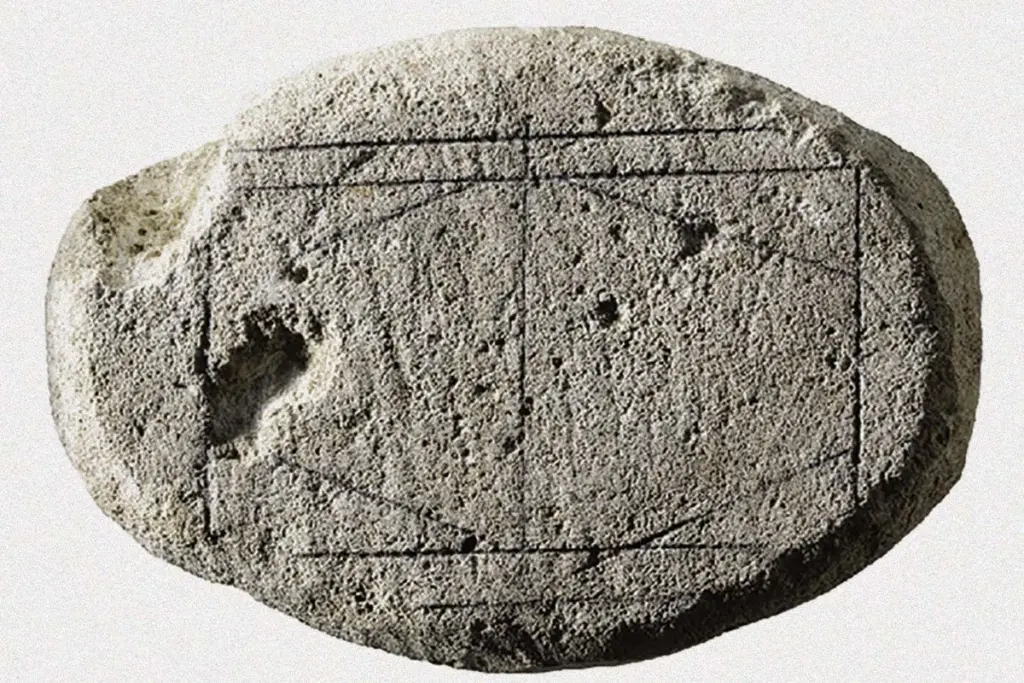
A flat stone, intricately carved with a geometric pattern of straight lines, has emerged as a potential candidate for a previously undocumented Roman board game. Through extensive artificial intelligence simulations, researchers have explored how sliding game pieces could have created the observed markings.
These simulations suggest the artifact represents an early form of a blocking game. This game mechanic, where players aim to obstruct their opponent’s moves, was not formally documented in Europe until centuries later, during the Middle Ages. The discovery offers a fascinating glimpse into the lesser-known pastimes of Roman society.
Roman Pastimes: Known and Unknown
Historical records and archaeological findings confirm that Romans engaged in a variety of board games. Among the documented pastimes are Ludus latrunculorum, known as the game of soldiers, which centered on capturing opponents’ pieces. Another was Ludus duodecim scriptorum, translating to the game of 12 signs, often considered an precursor to backgammon. Simpler games, akin to modern tic-tac-toe, also existed, where the objective was to align three symbols in a row on a grid.
However, the extent of Roman gaming is likely far greater than what is currently known. Many games may have disappeared without leaving a trace, or their nature might be unrecognizable due to missing documentation or the lack of surviving physical evidence. This absence leaves room for such intriguing discoveries.
The Heerlen Artifact: A Closer Look
The artifact in question was discovered at the Roman Museum in Heerlen, Netherlands. Walter Crist, affiliated with Leiden University in the Netherlands, encountered a flat stone measuring approximately 212 by 145 millimeters. Its upper surface bore a distinctive geometric pattern etched into the material.
The stone originated from the Roman settlement of Coriovallum, a site now located beneath modern-day Heerlen. The limestone used for its construction was commonly imported from France, a practice often associated with decorative architectural elements during the period between AD 250 and 476.
Initially, Crist harbored some skepticism due to the unfamiliarity of the pattern. Upon closer inspection requested from the museum staff, he observed signs of wear on the stone’s surface. This wear appeared consistent with the movement of stone or glass game pieces along the carved lines.
The pattern of wear was not uniform; a notable concentration of abrasion was found along a specific diagonal line. This distinctive marking prompted further investigation into its possible origins.
AI Simulations Shed Light on Gameplay
To understand the potential mechanics behind this unusual wear pattern, Crist and his colleagues employed an artificial intelligence system named Ludii. This system facilitated thousands of simulated games between two AI agents. The simulations explored variations in the number of starting pieces and incorporated 130 rule sets drawn from various ancient European board games, including haretavl from Scandinavia and gioco dell’orso from Italy.
The outcomes of these simulations were illuminating. The analysis revealed that nine distinct blocking game scenarios could plausibly account for the observed wear on the stone. In these games, the player with a greater number of pieces attempts to prevent their opponent from making moves.
The research team has tentatively named the potential game Ludus Coriovalli, signifying its origin from Coriovallum.
Expert Opinions and Future Possibilities
Tim Penn from the University of Reading, UK, cautiously supports the interpretation, stating, “I’m not convinced we can ever know for sure, but the analysis shows that this object certainly could be a game board.”
However, Ulrich Schädler of the University of Fribourg in Switzerland expresses reservations. While acknowledging the approach as interesting, he is not fully convinced the object served as a game board. Schädler points to the seemingly imprecise nature of the geometric pattern and the fact that this is the sole known instance of such a design. Typically, multiple variations of game boards tend to surface when a particular game gains popularity.
Crist acknowledges the inherent uncertainty surrounding the artifact’s definitive function. He suggests the possibility that it might have been an experimental prototype game, or one that was traditionally played by scratching marks into the earth, thus leaving no enduring physical record.
Historical Context and Broader Implications
Blocking games are documented in Europe from the Middle Ages onwards. If Ludus Coriovalli is indeed a blocking game, its existence would push back the known timeline for such games in the region by several centuries. While similar game concepts may have existed earlier in South and East Asia, and some Roman-era graffiti exhibits patterns suggestive of blocking games, precise dating proves difficult.
The integration of archaeological methods with AI analysis, as demonstrated in this case, holds promise for uncovering insights into other enigmatic ancient games. Penn suggests that similar analytical approaches could be applied to other artifacts, such as markings found on a potential game board from the Roman legionary camp at Vindonissa in Switzerland. These markings, resembling a square with an internal X and small holes at the intersections of lines, might yield further understanding through this methodology.
Journal reference: Antiquity DOI: 10.15184/aqy.2025.10264