
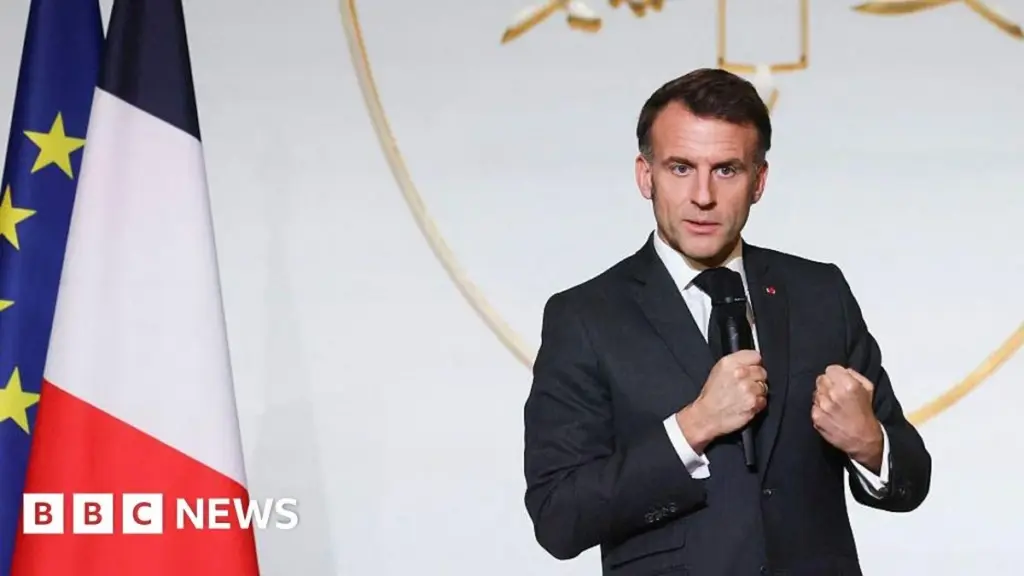
French President Emmanuel Macron has issued a strong call for Europe to project greater influence on the world stage, emphasizing that the time has arrived for the continent to genuinely act as a “power.”
Speaking to a consortium of European newspapers, Macron articulated that the continent is facing a critical “wake-up call” amidst escalating challenges posed by China, Russia, and increasingly, the United States. He posed the fundamental question: “Are we ready to become a power?” This inquiry, he stressed, spans critical domains including the economy, finance, defense, security, and the robustness of democratic systems.
Reflecting on historical contexts, Macron mused that in another era, the current juncture might have been described as the moment to “assume our majority.” This sentiment precedes an upcoming European Union summit in Brussels later this week.
Macron reiterated his advocacy for pan-European mutualized loans, a mechanism he believes is essential to mobilize the hundreds of billions of euros required for industrial investment. “The time has come to launch a shared debt capacity to fund our future expenses – eurobonds for the future,” he stated. “We need large European programs to finance the best projects.”
Economic Foundations and Past Skepticism
Previous proposals along these lines have encountered resistance, notably from Germany and other member states. These nations often perceive French initiatives as an attempt to offload financial responsibilities that France itself, due to its own reform challenges, is unable to fully address.
Macron acknowledged France’s historical economic trajectory, admitting that it “has never had a balanced model, unlike certain economies of the north, which are built more on a sense of responsibility.” He also pointed out the absence of reforms akin to those undertaken in Portugal, Spain, Italy, and Greece during the 2010s, reforms that are now yielding positive results.
Despite these challenges, he highlighted a growing appetite in global financial markets for mutually guaranteed European debt. Currently, the EU lacks the infrastructure to adequately meet this demand.
“The world markets are increasingly afraid of the American greenback [dollar],” Macron observed. “They want alternatives…” He further elaborated, “For investors everywhere, a democratic state of law is a huge attraction. And when I look at the world as it is, we have the authoritarian regime that is China, and on the other side, we have the US distancing itself further and further from a state of law.”
Investment Needs and Strategic Openness
Macron estimates that the 27-member European Union requires an annual investment of €1.2 trillion (£1 trillion; $1.4 trillion) to bolster critical sectors such as security, defense, clean energy, and artificial intelligence.
He urged the EU to adopt a more protective stance towards these and other key industries. “The Chinese do it, the Americans too,” he said. “Europe today is the most open market in the world. In the face of that, I am not saying we should be protectionist. It’s more a question of being coherent – in other words, not imposing on our own producers rules which we do not impose on non-Europeans.”
Navigating a World in Disorder
“Today, Europe faces a massive challenge, in a world of disorder,” Macron stated. He pointed to the accelerating impact of climate change. The security assurances once provided by the United States are now uncertain. Russia’s provision of affordable energy, once assumed, ceased three years ago. China, he added, has evolved into an increasingly formidable rival.
“Today, we Europeans are on our own,” he declared. “But we have each other. We are 450 million people. It’s huge. For me, [becoming a power] is the fulfillment of the European adventure.” He traced the historical purpose of European integration, noting, “We came together to stop war, we came together to build a market. But we always forbade ourselves to think of power.”
Lessons from International Relations
Addressing the recent confrontation with Washington concerning Greenland, after which U.S. President Donald Trump appeared to retract threats of annexation, Macron cautioned against complacency. “At the end of a crisis, there is a cowardly tendency to sit back and say ‘phew’,” he remarked. “There are threats and intimidation, and then suddenly Washington gives way. And people think it’s over.”
“Don’t believe it for a single second,” the French leader concluded, underscoring the ongoing need for vigilance and a firm grasp of Europe’s evolving global position.