
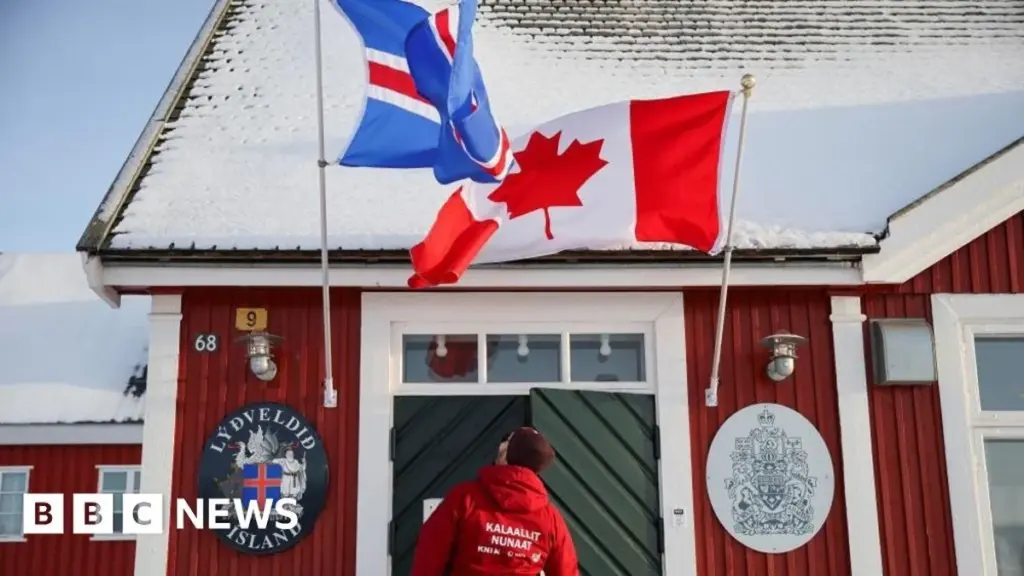
Canada has inaugurated its first diplomatic presence in Greenland, a significant gesture of support following recent declarations by U.S. President Donald Trump regarding potential control of the territory.
A distinguished Canadian delegation, including Governor General Mary Simon and Foreign Minister Anita Anand, journeyed to Nuuk. They formally inaugurated Canada’s consulate on Friday, with a Canadian Coast Guard vessel accompanying them.
During a flag-raising ceremony, Minister Anand articulated that the consulate signifies Canada’s enduring dedication to “standing in solidarity with the people of Greenland and Denmark.”
This visit coincided with a parallel initiative by French officials, who also opened their respective consulate in Greenland on the same day.
The establishment of both Canadian and French missions represents a substantial enhancement of international engagement in Greenland. Prior to this week, only Iceland and the United States offered formal consular services in Nuuk.
This development also signals ongoing backing from NATO allies for Greenland, a stance taken after President Trump repeatedly voiced the U.S. need to “own” the territory for national security reasons.
The President has since revisited his remarks, indicating an exploration of potential agreements following discussions with Denmark, European allies, and Canada.
Greenland has been a point of consideration for Canada for some time. The consulate was initially announced in early 2024 during Ottawa’s review of its Arctic foreign policy. The planned opening for late 2025 was subsequently postponed due to adverse weather conditions.
The consulate’s presence now carries amplified significance, according to Michael Byers, a professor at the University of British Columbia and an author specializing in the Arctic. Byers expressed his lack of surprise, citing the integral connections between Greenland and Canada’s Arctic region.
He highlighted that Iqaluit, the capital of Canada’s northern territory Nunavut, is merely an hour’s flight from Nuuk. Furthermore, Inuit communities in Canada share robust ties with their Greenlandic counterparts, a connection notably underscored by Governor General Simon’s own Inuk heritage.
“Her visit is an affirmation at the highest level of the cultural and ethnic connections between Arctic Canada and Greenland,” Byers commented. “It’s a very powerful statement.”
Governor General Simon, who was raised in Nunavik, northern Quebec, is the first Canadian Governor General to visit Greenland since 1982. However, her engagement with the Arctic territory commenced decades ago. She recounted hearing Greenlandic Inuit songs as a child through her grandmother’s shortwave radio.
“She would say: ‘These are our relatives who live in faraway lands. We are all one people,'” Simon recalled at the annual Arctic Frontiers conference held recently in Norway, shortly before her trip to Nuuk.
Natan Obed, president of Inuit Tapiriit Kanatami, an organization representing Canadian Inuit, informed the BBC that the consulate’s establishment is the culmination of years of advocacy by his community aimed at fostering closer relationships.
Obed indicated that approximately 50 Canadian Inuit were scheduled to arrive in Nuuk via a chartered flight from Montreal to attend Friday’s inauguration ceremony.
Canadian Inuit perceive the U.S. assertions concerning Greenland as particularly impactful, given their shared history of colonization and Trump’s public statements regarding Canada itself.
“We do worry that the United States may return to its more serious overtures around annexing Canada and Canada being the 51st state,” Obed stated. “And we do worry that Inuit Nunangat, our homeland, is one of the pivotal reasons for the U.S. to consider that sentiment.”
President Trump has previously justified potential U.S. acquisition of Greenland by citing Denmark’s alleged failure to adequately safeguard the island against Russian or Chinese threats.
Recent weeks have seen him privately express similar concerns about Canada’s Arctic region, according to a report published by NBC News in mid-January.
The Arctic has been identified as a vulnerable frontier by successive Canadian administrations. Obed acknowledged the ongoing limitations in Arctic infrastructure, such as highways and electrical connectivity, which negatively affect both national security and the residents of these northern regions.
The government under Prime Minister Mark Carney has committed to establishing a year-round military presence in the Arctic and has allocated over C$1 billion (approximately $730 million USD or £540 million GBP) for northern infrastructure projects intended for joint civilian and military use.
Foreign Minister Anand has characterized Arctic defense as “an unquestionable national security priority of this government.”
“It is not a secondary concern, it is not a regional issue, but central to how we protect Canada in our front yard and how we contribute to global security,” she remarked at a recent Nordic-Canadian Arctic Symposium.
In addition to the consulate opening, Governor General Simon engaged in discussions with Greenland’s Prime Minister Jens-Frederik Nielsen. Minister Anand held a meeting with her counterpart, Vivian Motzfeldt.