
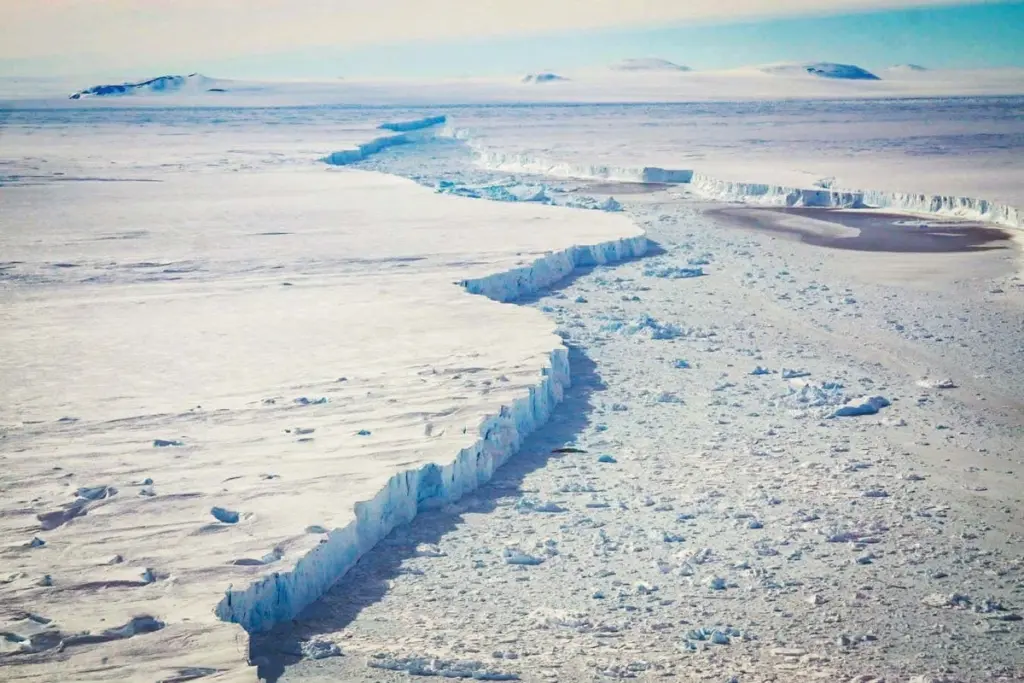
A significant glacier in West Antarctica is experiencing a rapid acceleration in its flow rate, a change observed since 2017. This development may signal that the floating ice shelf at its seaward edge is no longer effectively restraining the glacier’s movement.
The Pine Island Glacier stands as the swiftest-moving glacier in Antarctica and contributes more to global sea-level rise than any other Antarctic glacier. It forms a critical component of the West Antarctic ice sheet, a massive ice body that, if entirely melted, possesses the capacity to elevate global sea levels by an estimated 5.3 meters.
The Role of the Ice Shelf
Positioned in front of the glacier, the Pine Island ice shelf extends out over the ocean. Scientists believe this shelf plays a vital role in buttressing the inland ice, acting as a barrier against the intrusion of warm ocean water. It supports an amount of ice equivalent to 51 centimeters of potential sea-level rise.
The instability associated with both the Pine Island Glacier and its neighbor, the Thwaites Glacier (often referred to as the “Doomsday Glacier”), represents a substantial threat to the long-term stability of the broader West Antarctic ice sheet.
Tracking Glacier Velocity
Researchers, led by Sarah Wells-Moran from the University of Chicago, have been monitoring the movement of the Pine Island Glacier. Their analysis utilized imagery from the Copernicus Sentinel-1 Satellite, supplemented by observational data stretching back to the early 1970s.
The glacier’s velocity exhibited a substantial increase, progressing from 2.2 kilometers per year in 1974 to 4 kilometers per year by 2008. More recently, between 2017 and 2023, its speed surged to nearly 5 kilometers per year. This represents a 20 percent increase over a six-year period and a remarkable 113 percent increase since 1973.
Ice Discharge and Grounding Line Retreat
Between 1973 and 2013, the rate at which Pine Island Glacier discharged ice into the ocean escalated by more than 75 percent. These shifts in glacial activity correlate with a pronounced retreat of the glacier’s grounding line—the point where the ice shelf transitions from resting on the seafloor to floating on the water—by over 30 kilometers.
The Impact of Warmer Waters
Through comparisons with computer models, the research team concluded that the rapid acceleration is a direct consequence of the thinning and fracturing of the ice shelf. This is attributed to warmer ocean water penetrating further beneath the shelf’s surface. The study’s authors note that the sides of the ice shelf have detached from adjacent ice, effectively “unzipping” its margins.
The researchers’ findings suggest that the Pine Island ice shelf now provides minimal buttressing support to the ice upstream, thereby exacerbating ice loss from West Antarctica.
Expert Perspectives
Sue Cook of the University of Tasmania in Australia posits that iceberg calving—the process by which ice breaks off the front of an ice shelf—alone does not fully account for the glacier’s acceleration. She indicated that “most likely the cause is increased damage in the shear margins of the glacier,” adding that “This study helps to confirm that mechanism.”
Ted Scambos at the University of Colorado suggests that warm ocean water might be reaching the ice shelf’s margins where it extends into Pine Island Bay, a fjord carved by glaciers. Scambos stated that “With the loss of the ice shelf, it is likely that ocean circulation in the fjord will speed up, and the intensity of the circulation near the point where the glacier is grounded on the bedrock will increase.”
Nerilie Abram of the Australian Antarctic Division highlighted the study’s contribution in demonstrating the extent and rapidity of the current failure of the Pine Island ice shelf. She commented, “There is no doubt that ice loss from this region will continue to impact the world’s coastlines over the coming decades and centuries.”