
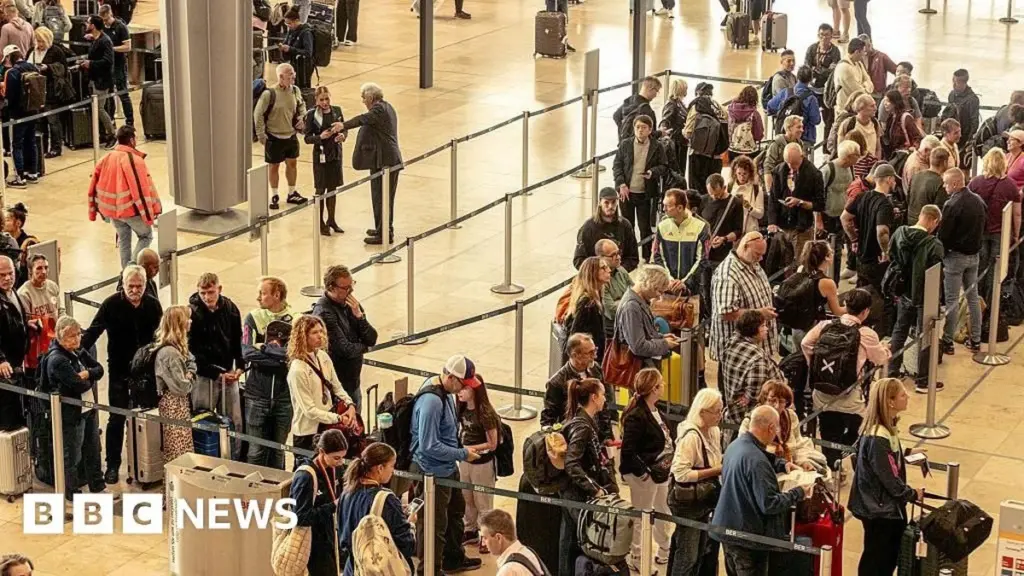
Travellers heading to Europe for upcoming holidays are being warned of significant delays at passport control. The introduction of a new biometric border system, the Entry-Exit System (EES), is continuing its rollout, and passenger experiences so far suggest potential for lengthy waits.
Reports have already surfaced of passengers facing hours-long queues at various European destinations during peak times. These delays are attributed directly to the implementation of the new EES procedures.
An association representing airports has expressed concern, highlighting the possibility of queues extending to five or even six hours throughout the summer period. However, the European Commission has indicated that the new system could be temporarily suspended during peak travel times, up until September, to mitigate these issues.
Early Indicators of Congestion
Social media posts from the past week have detailed instances of travelers encountering three-hour waits at Geneva Airport’s passport control. While Geneva is a popular destination, particularly for British skiers during the winter, the airport authorities are attributing the current congestion, especially on Saturdays, to the new EES at border control.
A spokesperson for Geneva Airport acknowledged that implementing the EES has presented a “major challenge for Swiss customs and Geneva Airport.” Efforts to streamline the process have included increasing staffing levels, according to the spokesperson.
Similar long waits have also been reported at Tenerife Airport in the Canary Islands. Andrew Knight, who manages Salasti car hire at Tenerife Airport, notes that most of his clientele are from the UK. Many arriving for winter sun have found themselves caught in extended queues at border control kiosks.
While some passengers have navigated passport control relatively quickly, particularly during quieter periods, the situation changes dramatically when multiple aircraft land in close succession. This leads to a rapid build-up of queues. Experiences vary widely, with some individuals clearing checks in approximately 20 minutes, while others face delays of an hour and a half to two hours. Occasional system outages have further contributed to the unpredictability of wait times, making the experience “really hit and miss.”
Understanding the Entry-Exit System (EES)
The digital Entry Exit System is designed to eventually supersede the traditional ink stamps in passports. For non-EU citizens, the system requires visitors to register their fingerprints and facial image, in addition to having their passport scanned, upon their first entry into the Schengen area.
This initial registration is valid for three years. Air travelers typically complete this process upon arrival at European airports, often using automated machines or kiosks. Their registered details are then verified during subsequent entries into the Schengen zone.
The EES is currently in a phased introduction, which commenced in October. Presently, the requirement is for half of all border crossing points to be operating under the EES, with at least a third of non-EU passengers expected to utilize the system.
Julia Lo Bue-Said, who leads the travel agent network Advantage Partnership, commented that the new system has “without question, created even more bottlenecks and pinch points in places that were already challenged.”
Increased Border Processing Times
Olivier Jankovec, Director General of Airports Council International Europe, an organization representing over 600 airports, stated in an interview with the BBC that passenger processing times at border control have increased by “four to five times” since the EES was implemented. He indicated that passengers are now typically waiting up to two hours.
Jankovec cited insufficient border staff and issues with some machines not functioning correctly as contributing factors to the delays. He expressed concern that the situation could deteriorate further when large numbers of holidaymakers arrive for registrations during the Easter and summer holidays.
Markus Lammert, a European Commission Spokesperson for Internal Affairs, reported that 23 million entries and exits have already been recorded under the EES, with 12,000 refusals of entry. He maintained that the system has operated “largely without issues” but confirmed that member states would continue to work on system improvements.
From April 10th, the EES is scheduled to be fully operational at every border point for all eligible passengers. However, member countries retain the option to partially suspend EES operations during the summer, up until September, if necessary.
Jankovec suggested that such suspensions would be essential if “the situation becomes unsustainable at border control.” He warned that without these measures, and if problems with equipment and border guard numbers remain unaddressed, waiting times could reach five to six hours.
The Airports Council International Europe emphasized the need for close collaboration with border control authorities to ensure that the system can be suspended promptly when required. Travel association ABTA also noted that border authorities are not fully utilizing their capacity to reduce checks when necessary, contributing to passengers being “caught up in lengthy delays.”
ABTA recommended that, in addition to implementing contingency measures, destinations and border authorities should enhance their planning for peak travel periods. Julia Lo Bue-Said advised travelers to prepare for extended waits, particularly during the February half term and beyond. Her advice is to “plan for the worst,” especially during busy times, and to ensure travelers have refreshments and activities to keep children occupied.