
Life in the United States today presents a series of peculiar contrasts. One must prepare for the possibility of construction workers at one’s home being detained by government agents, while simultaneously contemplating dinner plans. A simple request for a spouse to purchase vegetables from the local grocer can be overshadowed by the worry of them being stopped by U.S. Immigration and Customs Enforcement. Even endeavors like scientific research, writing about the universe’s wonders, are interspersed with reading about children held in detention camps. Despite NASA’s funding surviving a proposed cut, the agency experienced significant workforce reductions in 2025, with little prospect of their return.
The week this commentary is published, NASA is scheduled to launch an astronaut on a mission around the moon, marking humanity’s first such journey in decades. This event is part of the Artemis program, which ultimately aims to land humans on the lunar surface. Beyond that, Artemis is widely seen as a crucial stepping stone toward establishing human presence on Mars. At a SpaceX event, Elon Musk, alongside Pete Hegseth, head of the U.S. Department of Defense (an entity the current administration prefers be called the Department of War), articulated the vision of sending humans to other planets as a vital step toward realizing a “Star Trek universe.” The prevailing narrative encourages excitement, promoting these missions as progress toward a utopian spacefaring future.
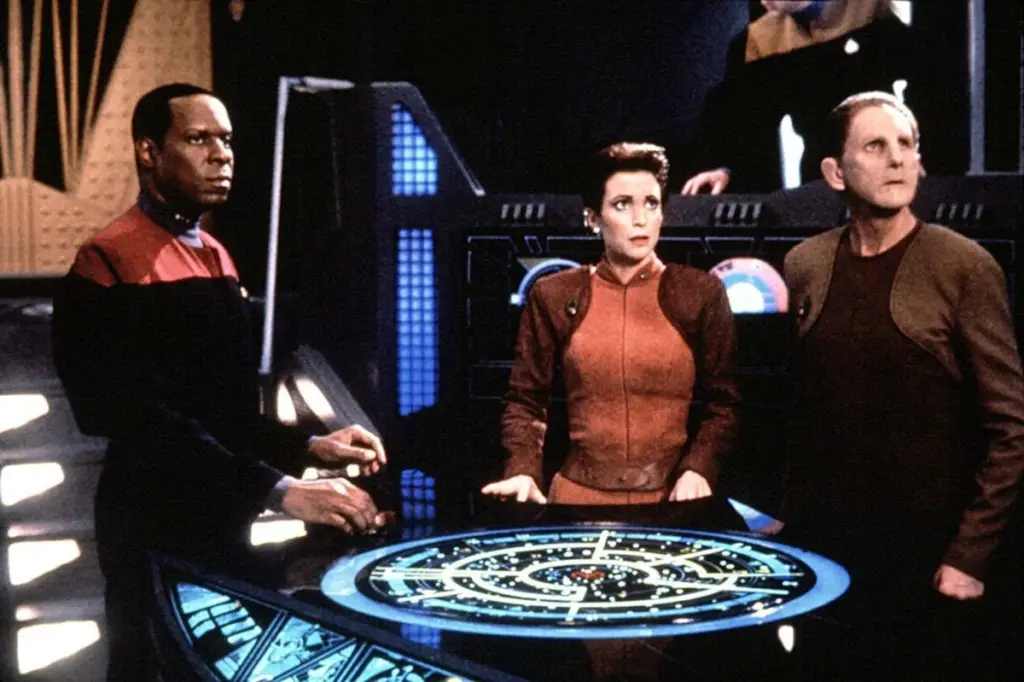
This notion, while appealing, is not entirely accurate. As a devoted fan who attends Star Trek conventions, it’s evident that those advocating for these spacefaring visions often misunderstand the franchise. Were they more familiar with it, they would recognize that the 2020s, as depicted in Star Trek, represent a particularly grim period in human history. The Bell Riots, set in a fictional 2024, depict an uprising of impoverished and marginalized individuals against an authoritarian government presiding over a society with extreme wealth disparities. Within the Star Trek narrative, humanity must also endure a world war where soldiers are medicated to facilitate participation in atrocities.
The parallels between these fictional events and contemporary reality are striking. In the Star Trek narrative, the very individuals promoting their militarized, corporate visions for space exploration are portrayed as antagonists, not as harbingers of a utopian future. Those invoking Star Trek today not only misinterpret their role within its narrative but also fundamentally misunderstand its core message. While space travel serves as the backdrop, the franchise’s true essence lies in humanity’s journey of self-improvement through mutual cooperation, honest engagement with complex philosophical dilemmas, and the imaginative exploration of a socioeconomic system inspired by socialist principles, one that prioritizes the well-being of all.
Could a journey to Mars contribute to such an evolution? There exists a hypothetical scenario where a mission to Mars could indeed advance our appreciation for “infinite diversity in infinite combinations,” the guiding principle of the Vulcan species. Even now, we have successfully dispatched numerous uncrewed missions to Mars, yielding fascinating discoveries. These explorations have revealed that Mars once possessed conditions suitable for life’s emergence, that liquid water may still exist beneath its surface, and that the planet experiences highly unpredictable weather patterns, partly due to its insubstantial atmosphere.
Furthermore, our remote explorations of Mars have underscored its inhospitable nature: it is cold, arid, and by human standards, an extremely difficult place to inhabit. Therefore, even if a crewed mission to Mars were conceived by a unified and peaceful humanity, the fundamental challenge of Mars actively working against human survival would remain. Its atmosphere is unbreathable, and altering its chemical composition would not negate the inherent dangers posed by its soil. For those sensitive to dust, like the author, the experience of a dusty terrestrial room, triggering mild allergic reactions, pales in comparison to the harsh reality of Martian dust. This regolith contains enough silica to cause severe damage to human lungs, leading to a condition akin to the black lung disease prevalent among miners.
One might argue that the intention is not to inhale Martian dirt. However, Mars is prone to colossal dust storms that constantly churn up soil. Any astronaut on the surface would inevitably be coated in this dust. Containing it within habitats would present a significant challenge. The sheer volume of resources required to establish a sustainable settlement on Mars is immense. The logistical feat of launching these materials from Earth’s surface and overcoming its gravitational pull would be a monumental undertaking.
In my view, attempting to colonize Mars appears to be an ill-advised endeavor. However, this sentiment is not a cause for concern, as we are fortunate to already possess a remarkable planet: Earth. While our stewardship of Earth has been inadequate, this situation is not irreversible. For me, this is the essence of Star Trek—not the promise of an advanced future allowing us to abandon our world, but rather a narrative that emphasizes learning to cherish and care for the extraordinary vessel that is our home planet.
What I’m Reading
I thoroughly enjoyed Fara Dabhoiwala’s “What is Free Speech? The history of a dangerous idea.”
What I’m Watching
I am currently captivated by Gina Yashere and Kerrice Brooks in “Star Trek: Starfleet Academy.”
What I’m Working On
My current focus involves navigating the challenges of daily life amidst the U.S. government’s actions against its own population.
Chanda Prescod-Weinstein is an associate professor of physics and astronomy at the University of New Hampshire. She is the author of “The Disordered Cosmos” and the forthcoming book “The Edge of Space-Time: Particles, poetry, and the cosmic dream boogie.”